


-
INDEX
1: Theory of the Minimalist Military-Industrial Complex
2: The Philosophy of War
3: Universal Explosive Modules
4: Small Arms Design
5: Universal Electro-Optical (EO) Modules
6: Data Links
7: Power System Design
8: Standoff Glide Bombs
9: Universal Avionics Modules
10: Blind Flight and Autonomous Navigation
11: Vision-Based Navigation
12: Radio Navigation
13: Swarm Navigation
14: UAV Design Philosophy
15: Missile Design Philosophy
16: Bunkers and Air Defense
17: OSINT and Situational Awareness
18: Open-Source Warfare and Decentralized Government
19: Business Logic and Iterative Technology
20: Research into Nuclear Miniaturization
Preface
I have been away from China for ten years. As a political exile, I have endured my share of hardships. Two decades ago, back in China—specifically in my home city of Hangzhou—I was a well-known figure in the university startup scene. I built a B2B platform that ranked in the Top 20 nationwide and established what was then the largest Free Hosting service in China, and arguably, the world.
For years, my prominence in the internet industry led many to assume my academic background was in Software Engineering. In fact, my university major was Information Engineering and Automation, focusing on intelligent hardware. My graduation thesis was titled: “Controlling a Real-World Light via the Internet.” Twenty years ago, this was a cutting-edge topic; the concept of the “Internet of Things” (IoT) had not even been established yet.
During my years in exile, I have authored nine books—six in Chinese and three in English languages. This current volume is a translation of <极简军工复合体>. Having spent decades in the internet and software sectors without ever venturing back into hardware, this book serves as a tribute to my original field of study.
A few months ago, I decided it was time to write a book on hardware. Furthermore, a civil war between the CCP and Han Chinese political forces is highly likely, given the CCP's vast military-industrial complex in Manchuria, northeastern China. This book simulates a Chinese civil war, exploring how the weaker Han Chinese political forces can develop their own military-industrial complex within six months and win the war at minimal cost. This book also offers valuable insights for many smaller nations.
Should I successfully obtain citizenship here in the Philippines, I intend to establish a hardware firm: White Lotus Heavy Industries. In my view, the peaceful environment we have enjoyed since World War II is a historical anomaly. Today’s world, overshadowed by the clouds of war, is simply returning to its normal historical trajectory. In such a world, the arms industry is bound to be a highly lucrative business.
The core objective of this book is to investigate how to build a “Minimalist Military-Industrial Complex” from scratch—without any prior defense industry background—using the least possible cost, R&D, personnel, and time. The goal is to compress the necessary budget to a level manageable by a municipal-grade treasury, providing small nations with a resilient capacity to resist superpowers like the United States or China.
March 4, 2026
Translated April 21 2026
Chapter 1: Theory of the Minimalist Military-Industrial Complex
If a civil war breaks out between the CCP and Han Chinese political forces, the CCP will rely on their massive military-industrial complex (MIC) stationed in the Northeast to strike our Han forces. In modern warfare, soldiers are heavily dependent on equipment. Without an MIC of our own in the South, how can we fight back? A traditional MIC cannot be built in less than five to ten years. If the Han people rely solely on raw passion, we will lose this war within two years. The CCP will remain as it is today—a regime dominated by a specific clique (the "Manchurian" interest groups compose of chinese Jew and Musilim) that occupies government posts and oppresses our nation.
As a former research expert, a Han Chinese, and a leader in the Han national liberation movement, I dedicate my life’s work to our liberation. I believe that once a civil war begins, we can construct a new type of military-industrial complex within just six months. This is a conclusion drawn from my background in scientific research and my experience as a top-tier internet product expert. I have discovered that advancements in foundational science now allow us to build a "Minimalist MIC"—one more combat-effective than the CCP’s—at a cost manageable by a single city’s treasury, and within a six-month timeframe.
I was once the founder of the world’s largest Free Hosting service. I believe I achieved that global lead because I was the first to offer 1GB of free space when paid servers were still offering only 300MB. How could I afford to be so generous? Because I recognized a "Technological Tier Shift." 1TB hard drives had just hit the market. Although they cost 2,500 RMB then, my pulse on tech trends told me that 2TB drives were inevitable and would soon drop below that price point. As the Chief Architect, I set the 1TB tier as our development direction and launched the 1GB free offer, instantly making us the most popular hosting site worldwide.
Reflecting on this, our success was entirely due to mastering the "Technological Tier Shift." Had hard drive tech stayed at the 30GB tier, I could only have offered 200MB. There were countless hosting services; why would anyone choose us? Without that shift, we wouldn't have been the largest in China, let alone the world.
Once you grasp this principle, you realize that another Technological Tier Shift is happening right now. The proliferation of AI NPUs (Neural Processing Units), coupled with ultra-cheap cameras and MEMS (Micro-Electro-Mechanical Systems) chips, has changed everything. Mastering this shift will allow us to develop a new kind of MIC during a civil war.
Traditional MICs are built on a World War II foundation. Their optimization logic is essentially a head-on collision with the laws of physics. Want a longer-range cannon? Double the explosive power? Make a missile reach Mach 10? Fighting the laws of physics is inherently expensive. A drone flying at 300 km/h can use a toy-grade servo, but the price of a servo for a supersonic drone increases exponentially. The cost of defying physics is immense. A bullet travels at Mach 2; making an aircraft fly at Mach 3—faster than a bullet—requires a staggering investment. The result is an astronomical unit price—millions of dollars for a single tank.
The traditional MIC has become a "gold-swallowing beast," a tumor on national development that consumes massive percentages of national income. Consequently, the incumbents in these systems choose to be "selectively blind" to Technological Tier Shifts. Challenging giants like Lockheed Martin is nearly impossible; they have spent decades infiltrating the government. Selling weapons isn't like selling pizza—high prices mean high profits. Neither the elites on Capitol Hill nor the MIC titans want to disrupt the traditional development path.
In a civil war against the CCP, we must avoid their path. We must seize the Technological Tier Shift to create a new MIC: weapons that are as cheap as smartphones, can be delivered rapidly, and can win the war.
Traditional MICs rely on "stacking hardware" to achieve a "strong physique." It’s like the "big kids" in a violent school environment—they bully others because of their size and don't need much agility or high IQ. Those of us who are "physically weaker" are born with hardware deficiencies. To survive, we must develop "survival wisdom." In the internet industry, we have a saying: "Where hardware fails, software compensates."
When the war broke out, the CCP had a military-industrial complex in Northeast China, a region known as Manchuria. The CCP was composed of Manchurians (Chinese Jews and Muslims), and their establishment of the military-industrial complex in the Northeast was undoubtedly purposeful. the CCP will have aerospace assets, satellites, intelligence, and J-20 fighters—all products of traditional hardware-heavy engineering. And what does the Han ethnicity have? Nothing. We have no military academies, no aerospace hubs, and no defense plants. The CCP planned it this way from the start to suppress us.
But what do we have? We have neon-lit nightclubs, shrewd entrepreneurs, a resilient populace, and a graveyard of hardware, toy, and electronics factories struggling after foreign capital flight. It would take Southern universities years to match the military research of the North. Instead, we must adapt. Toy factories can scale up toy planes into EPP-material suicide drones. Electronics factories can produce tactical radios and frequency-hopping data links. Unemployed internet coders can be recalled to iterate AI algorithms for weaponry.
The South China lacks "military capacity" but possesses "industrial capacity." Weapons built with industrial tech cannot compete head-to-head with professional military hardware. We are the "weak kids" facing the "giants." If we compete on hardware, we lose. Fortunately, the era of the Technological Tier Shift—driven by AI and dirt-cheap sensors—allows us to turn "weak hardware" into Intelligent Agents. Subsonic weapons can be equipped with sophisticated electronic countermeasure (ECM) and penetration algorithms. By utilizing swarm tactics, "Loyal Wingman" escorts, and electronic suppression, these "weak" weapons become intelligent entities with more lethality than traditional ones.
This shift means that when the CCP’s traditional MIC meets the Han Ethnicity rapidly iterating Minimalist MIC, the CCP will lose. We will break the chains of enslavement and establish an independent nation-state. The parasitic regime will no longer be able to suppress the fundamental rights of the Han people.
Why does a Military-Industrial Complex need to be "Minimalist"?
The real question is: why are current MICs so bloated? The answer is corruption. We must build for a new era of warfare based on five pillars:
Minimalist Logistics: Battlefield transparency is an irreversible trend; combat will become "clandestine/special ops" in nature. Weapons should be designed for this reality.
AI-Dominant Warfare: Machines will fight the wars; humans will play support roles—swapping batteries and reloading ammo for autonomous bombers.
Software-Defined Warfare: As war depends more on chips and algorithms, weapons must iterate as fast as software. Future generals will come from the internet industry—product managers and coders who understand this tempo.
Civil-Military Fusion: Weapon systems should integrate with civilian tech, using the civilian market to R&D and iterate military technology.
Logistical Decoupling: Traditional systems are so bloated that even insoles and underwear are "military grade." We must decouple. If a civilian hiking brand makes better underwear, use it. Logistics should be lean.
The current weapon systems lack a "Chief Architect." They are not products of commercial competition but of power-seeking and rent-taking. Take anti-tank warfare: we have shaped-charge rockets, then reactive armor to counter them, then tandem-charge warheads to counter the armor. This cycle maximizes profits for defense contractors but makes the MIC an unbearable fiscal burden.
Our optimization goal is to apply the mindset of an Internet Chief Architect. We start with requirements and drastically compress the number of weapon categories. This allows us to concentrate forces—having hundreds of experts optimizing and iterating just one type of weapon.
By stripping away non-essential departments and optimizing weapon categories, the Minimalist MIC can be scaled down to a few thousand people. A single internet company in a city like Hangzhou or Shanghai could constitute an entire MIC—one that is highly lethal and fiscally sustainable.
The coming era of chaos will be long. We can even turn this into a business—developing a weapons industry to profit from global instability, allowing unemployed programmers to return to work, constantly optimizing the algorithms of "Intelligent Agent" weaponry.
Chapter 2: The Philosophy of War
Politics aside, what is the pure philosophy of war? I can summarize it in one sentence: The philosophy of war is the delivery of explosives.
The vast array of weaponry—surface-to-surface missiles, aerial bombs, air-to-air missiles, artillery, and mortars—essentially exists for the sole purpose of delivering explosives. Weapon iteration is nothing more than making that delivery farther, stealthier, more precise, safer, and more cost-effective.
The nature of the explosive itself is secondary. Whether it is RDX, TNT, or even improvised caramel-fertilizer explosives and thermite—as long as it destroys the target, even a homemade satchel charge is effective. What matters is the ability to launch it, strike with precision, retreat unscathed, and keep the entire process within a controlled budget. The philosophy of weapon design revolves around these fundamental problems.
To ensure safety during the delivery process, one must strike from a distance. Whoever has the longer range can preserve themselves outside the enemy’s reach. In the past, long-range delivery required turbojet engines—immensely expensive industrial products. Today, a few hundred dollars' worth of electric motors and lithium batteries can build an electric-propulsion missile capable of striking targets over a hundred kilometers away.
Precision once required advanced components like ring laser gyros; a slight crosswind could blow a cruise missile off course. Now, we use IMU (Inertial Measurement Unit) components and $30 cameras for terrain-matching correction. In the terminal phase, AI analyzes the target's position for a precision strike. Multi-million dollar precision weapon systems are being defeated by $300 RISC-V+NPU motherboards.
Where the battlefields of the past were filled with the roar of gunfire, today’s battlefields are saturated with sensors. Large troop formations have vanished, and the battlefield has become hauntingly silent. Fire a single shot, and a ubiquitous, low-cost acoustic radar array—a simple microphone matrix—will immediately calculate your coordinates. Two minutes later, a drone arrives to drop two bombs on your position.
Only by grasping the essential philosophy of these problems can one become a System Architect for the Han ethnicity Military-Industrial Complex.
Returning to the tank problem: shaped-charge jets could penetrate tank armor, so tanks adopted reactive armor. Rockets then evolved into tandem-charge warheads—the first charge detonates the reactive armor, and the second penetrates the hull. In response, tanks began welding "slat armor" cages onto their frames. As a top-tier System Architect and Product Manager, I refuse to invent an endless variety of anti-tank weapons. To me, the essence of war is delivering explosives. If 10kg isn't enough, I’ll increase it to 50kg. This is the internet industry mindset: simplifying complex problems.
The product logic I aim to iterate is simple:
How to deliver the explosive directly above the tank.
How to ensure a safe retreat during the process.
How to keep the process cost-effective.
How to ensure the explosive payload is more than sufficient.
Can this weapon destroy other targets—bunkers, trenches, bridges, warehouses, or command posts?
By focusing on a single weapon category and constantly iterating it, we can satisfy all requirements. As a Chief Architect, I would prioritize the development of Glide Bombs. Only glide bombs meet all these criteria simultaneously.
If large targets like tanks, armored vehicles, radar stations, and bunkers are handled by glide bombs, how do we handle individual infantry with "surgical" precision? For infantry, we use FPV (First-Person View) Munitions. FPVs are agile and can use NPUs for AI recognition and autonomous pursuit once a target is locked. Their downsides are obvious—high power consumption, short range, and limited payload—but they are highly efficient against personnel. Equipped with shaped charges, fragments, and high-mesh aluminum powder, even the toughest military body armor cannot withstand their power.
While 30g of explosives is enough to kill a soldier, my FPV munitions carry 150g. This "Performance Overflow" is a deliberate choice of my minimalist philosophy. From an architectural perspective, increasing the payload from 30g to 150g allows the weapon to adapt to more scenarios: destroying bunkers, fuel trucks, radar antennas, helicopters, and even the optics of tanks. Furthermore, these can serve as air-dropped munitions; a drone bomber at 7km altitude—too high for laser guidance—can release FPV munitions with target characteristics and rough coordinates. As they fall, they will autonomously search for and strike the target.
By optimizing FPV speed, we can strike not just infantry but also low-speed aerial threats like helicopters and "flying moped" drones. If our speed exceeds theirs, we can intercept and destroy them. This expands the utility of a single product.
Currently, Ukraine uses FPVs as combat platforms. As an architect, I believe this is incorrect. FPVs should be classified as Munitions—specifically, 5km-range munitions optimized for AI-driven, high-speed pursuit. The "Combat Platform" should be something else, such as a fixed-wing aircraft that flies to the front line to deploy FPV munitions from a standoff distance. Soldiers should carry these as part of their kit; if they encounter a target their rifles can't handle, they deploy an FPV. This eliminates the need for a dizzying array of howitzers and mortars.
We have glide bombs and FPVs for ground targets; how do we handle aerial threats? These are divided into low-speed and high-speed threats.
Low-speed threats (quadcopters, suicide drones, attack helicopters) usually fly under 200 km/h. For these, I have a near-zero-cost solution: a rocket-like drone flying at 350 km/h designed for kinetic impact. After the collision, it can be located via LoRa signal and reused. While these drones contain explosives for high-value targets like helicopters, their default mode is low-cost interception. You can release 50 for one mission to make sure 100% done. because it nearly zero-cost.
High-speed threats include rockets, fighters, cruise missiles, and hypersonic missiles. For the Minimalist MIC, we need a high-speed interceptor to build an anti-missile system. I have designed the "Light Curtain Missile Defense System." Suppose the CCP launches a hypersonic missile at Hangzhou. While the U.S. Patriot system has interception capabilities, we lack that level of fire-control radar and computing power. Therefore, I use a "Laser Light Curtain" for terminal correction.
In the final kilometer, the interceptor uses a MEMS (Micro-Electro-Mechanical Systems) polarizing mirror to project a raster-scanned laser light curtain. When the hypersonic missile enters this curtain, it creates a bright spot. The interceptor’s quadrant sensor locks onto this light spot, using analog circuits to correct the control surfaces with extremely high response speeds. By bypassing digital processing, the cost of each interceptor is reduced to a few thousand yuan.
These interceptors are designed to be extremely compact and "dirt cheap." By merging anti-missile and anti-aircraft functions, we compress our product categories, adhering to the philosophy of the Minimalist MIC. An interceptor capable of hitting a hypersonic missile represents a "performance overflow" when used against a J-20 fighter; once locked, a kill is nearly guaranteed. Thus, using them as standard anti-aircraft missiles is entirely viable.
Chapter 3: Universal Explosive Modules
The essence of war is the delivery of explosives. You must be able to strike, strike precisely, strike cheaply, and retreat unscathed. This means that the design objective of a Military-Industrial Complex should not focus on the explosive itself, but rather on the delivery capability.
Once the design objectives of the Han ethnicity Military-Industrial Complex are met, the entire logic of military tactics will shift. When you can conduct standoff strikes with high volume, low cost, and high efficiency, destroying a tank no longer requires sophisticated shaped-charge jets; raw force will suffice. If 10kg of explosives isn't enough, use 20kg. No matter how strange or varied the enemy's armor may be, I adhere to one single philosophy: Ensure an abundant supply of explosives. This is the core philosophy of weapon system design: prioritizing delivery capability. If the Han MIC succeeds, it will undoubtedly be because it mastered "Delivery Capability."
Regarding the explosives themselves, we should establish Universal Standardized Explosive Modules. In essence, these are modeled after the warhead of a 40mm grenade. Grenades, missiles, torpedoes, loitering munitions, and bombs are essentially different forms of the same thing: an explosive payload. To make R&D more convenient and products more stable and affordable, it is essential to use a unified detonation logic. This means once you master the system, that knowledge is universal across torpedoes, missiles, and grenades. Even the fuze chips remain identical.
To realize this Universal Explosive Module, we must design a single fuze system for all explosives, ensuring that all fuzes, chips, and technical knowledge are standardized and interchangeable.
The power solution for the fuze must be Dual-Mode. We will retain piezoelectric ceramic charging—which generates current from recoil—but we must also add inductive coil charging. Piezoelectric systems only trigger during the massive recoil of an artillery launch, a condition many environments lack. For instance, a glide bomb has virtually no recoil. How do you activate the fuze without that impact? The method is simple: wrap an induction coil around the fuze. The coil charges the fuze, activating its detonation logic.
Whether you are building FPV munitions, glide bombs, or missiles, they should all utilize this same detonation logic. To develop this fuze, we could use a 40mm Laser-Guided Grenade as a proof-of-concept project. Since an artillery shell experiences chamber pressures of 100 MPa and extreme acceleration, a fuze designed for it will possess "Performance Overflow" for all other types of ammunition. Can it be used in a missile? Absolutely. The acceleration of a missile is far lower than that of a grenade launcher, making the fuze more than reliable for the task.
Chapter 4: Small Arms Design
Body armor is becoming increasingly resilient, rendering lead-core ammunition ineffective. As soldiers grow more dependent on heavy equipment, they become "sitting ducks" the moment they leave their armored vehicles. This reality demands that infantry rifles possess anti-materiel capabilities and area-denial functionality.
Why require anti-materiel performance from a rifle? Because once we can neutralize enemy equipment, the soldiers who rely on it are exposed. If we can knock out a tank’s optics, the tank becomes a heap of scrap metal. If we can penetrate armored vehicles, piercing military-grade body armor becomes trivial.
Lead-core bullets fall within the realm of "probabilistic lethality"—there will always be a fanatic willing to charge and gamble on survival. Where there is gambling, there are casualties. However, when your bullets are guaranteed to penetrate the enemy's armor, or a single burst can disable an armored vehicle, the enemy is forced to soberly reconsider their assault. If the enemy dare not charge, we suffer no casualties. This is how we achieve Area Denial.
We will utilize all-steel core ammunition. Steel is inherently anti-materiel. By cladding the steel core in soft iron and applying a PVD process with a DLC (Diamond-Like Carbon) coating for lubrication, paired with steel casings, we create a perfect all-steel bullet. It provides armor-piercing capabilities without relying on strategic resources like copper. Manufacturing is simple: the knurled steel core is pressed into the soft iron. Since the densities of steel and soft iron are similar, concentricity is easily maintained. Because iron is less dense than lead, the muzzle velocity is significantly higher.
Why are rifles still necessary in an age of AI warfare?
A rifle is an individual’s final line of defense and the only weapon that can project force instantly. While there may be a delay when calling for remote fire support, a rifle projects force according to the individual's immediate will. Furthermore, it is the most cost-effective weapon. Delivering one kilogram of TNT costs 100 RMB; if a target can be neutralized with a rifle, it costs only 1 RMB.
I have named this rifle the "Militia Type 1" (M1). Below are the AI-simulated specifications:
Caliber: 7mm
Projectile Length: 28mm
Material: All-Steel
Weight: 7g
Cladding: 0.8mm Soft Iron with DLC Coating
For this caliber, I recommend a 45cm barrel, as it provides sufficient power to penetrate armored vehicles. In addition to a short-stroke piston version (mirroring the SIG MCX structure), we will produce a bullpup variant and a bolt-action sniper rifle.
Why bolt-action? Bolt-action offers numerous advantages: mechanical simplicity, low failure rates, lighter weight, compatibility with carbon-fiber-wrapped barrels, and high precision. Its only drawback—the lack of rapid-fire capability—can be addressed by an Electric Bolt-Action system using a lead screw to cycle the bolt. This simple structure integrates seamlessly with weapon stations and drones. I firmly believe that in the future, most ammunition will be fired by AI weapon stations, not by human hands.
The M1 ammunition is unsuitable for special operations due to excessive "over-penetration"—it can punch through armored vehicles and brick walls, risking friendly fire. Therefore, we will develop a compact weapon similar to the MP7, with the magazine housed in the grip, designed to pierce military body armor at short ranges and fit inside a 45cm backpack. We will call this the "Militia Type 2" (M2).
Militia Type 2 AI-Simulated Data:
Caliber: 6.5mm
Projectile Length: 13mm
Material: All-Steel
Weight: 3.2g
Cladding: 0.8mm Soft Iron with DLC Coating
Logistically, we only need to maintain two product lines: M1 for field operations and anti-materiel area denial, and M2 for multi-role functions, including special ops, urban assault, law enforcement, and clandestine strikes. For M1, we produce only 7mm all-steel rounds. For M2, we maintain three variants: steel-core for special ops, reduced-load lead-core for law enforcement, and tungsten-alloy subsonic rounds for targeted strikes.
Digitalization:
The trigger mechanism should include an Electronic Trigger housed within the grip, along with communication modules, data interfaces, and cabling. This aligns with the Minimalist MIC philosophy: future warfare is a human-machine partnership where machines fight and humans assist. The rifle itself must have a digital interface.
This "reserved interface" provides two major advantages:
Precision Augmentation: When a fire-control optic calculates a ballistic solution, it displays a red dot. The user simply aligns the dot and pulls the trigger. For long-range shots (1km+), where tremors from breathing or heartbeat affect accuracy, the electronic trigger can be set to auto-release the moment the sensors detect perfect alignment. This allows an ordinary person to achieve sniper-level performance.
Platform Integration: If future warfare is machine-driven, having standardized data and communication interfaces simplifies weapon platform design. You only need to design a drone capable of handling the recoil; the weapon system is "plug-and-play," ready for the AI to call its functions directly.
Chapter 5: Universal Electro-Optical (EO) Modules
The logic of the Minimalist MIC is to iterate military products with the same efficiency as an internet company. In the internet industry, efficiency is king—UI, back-ends, and front-ends are all built as reusable components. This means we shouldn't develop individual products from scratch; instead, we develop a Universal Module and build a diverse array of products upon that foundation. It’s the hardware equivalent of mastering PHP & MySQL: once you have the core stack, you can deploy any kind of website.
In a military system, rifles need scopes, drones need EO gimbals, weapon stations need radar-integrated EO pods, and security systems need PTZ (Pan-Tilt-Zoom) cameras. Developing these as separate projects would require thousands of R&D personnel. Instead, with a team of fewer than a hundred, we can develop a single "Universal Multispectral EO Module" capable of multispectral scanning, laser rangefinding, laser guidance, and laser wind sensing.
High-Sensitivity Multispectral Global Shutter Sensors
Smartphone cameras do not use Global Shutter technology; they suffer from the "rolling shutter effect" (jello effect), which is unacceptable for AI-driven weaponry. Therefore, we must commission high-sensitivity global shutter sensors from chip foundries, integrating the ISP (Image Signal Processor) and NPU (Neural Processing Unit) using Chiplet technology. This missile-grade sensor has vast applications:
Consumer Sector: Beauty cameras, action cams, high-end smartphones, drone cameras, and gimbal cameras.
Security Sector: PTZ and bullet cameras.
Defense Sector: Reconnaissance pods, fire-control optics, optical flow sensors, weapon stations, missiles, glide bombs, and FPV munitions.
Because this sensor utilizes a global shutter, it is superior for photography, allowing us to enter the consumer market through a dedicated consumer electronics firm. The massive absorption capacity of the consumer market can drive production into the millions, driving the unit price of these sensors down to "dirt cheap" levels.
The Universal EO Module
The design standard for the Universal EO Module should match that of a high-end reconnaissance drone. To identify targets kilometers away from high altitudes, you need multispectral, high-sensitivity global shutter sensors and optical zoom lenses. At night, the NPU must reconstruct clear imagery from low-light environments. Precise tracking of a distant target while the aircraft, the air, and the target are all in motion requires a high-precision gimbal. Laser guidance requires MEMS (Micro-Electro-Mechanical Systems) polarizing lenses. Finally, the laser seed source must handle three tasks: laser rangefinding, Doppler wind sensing (for drone flight-path detection and sniper fire-control data), and laser guidance.
Technically, there are four major hurdles:
The Sensor and NPU Module.
The Gimbal Module.
The EO Optics Module.
The Laser Module.
A drone’s reconnaissance pod is a product of "performance overflow." By "handicapping" certain functions of the Universal EO Module, it can be transformed into other products. For instance, removing the gimbal creates fire-control optics or security cameras. Removing the laser creates action cams or consumer gimbal cameras. If a module can identify and track a tank from kilometers away, tracking a human face for a "beauty cam" is trivial; the fire-control computer and NPU can even assist in real-time digital enhancement.
Scopes
Our intelligent rifle scopes must provide white light, infrared thermal imaging, and, crucially, an integrated laser. This laser must satisfy three requirements from a single seed source: rangefinding, Doppler wind sensing, and laser guidance. Additionally, the scope requires onboard AI capabilities. The sensor must feature "Low-light Night Vision High ISO" and a "Global Shutter." The fire-control system must also include interfaces for networking with other equipment and triggering electronic triggers.
Communication Modules
We will utilize Ultraviolet (UV) Communication devices, also known as "Radio-Silent Communication Units." By using UV LEDs to build a short-range system, we can communicate within a radio-silent environment using "solar-blind" ultraviolet light. This chip satisfies several combat scenarios:
Combat teams communicating under radio silence.
Wireless communication between security cameras and weapon station scopes.
Human-to-weapon interaction.
Anti-jamming, radio-silent communication for drone swarms.
Smart Helmets
Smart helmets will perform brain-signal recognition, communication, and AR (Augmented Reality) display. When the radio-silent module streams imagery from the scope directly to your AR glasses, you can "lock onto a target with your eyes" and trigger the electronic trigger via brainwave signals. The helmet will also feature an acoustic array for detecting drones kilometers away and a UWB (Ultra-Wideband) module to "see" enemies behind walls during clearing operations.
Smart Backpacks
The smart backpack houses the data link and the AI Decision Module. Throughout a battle, the AI assists by analyzing situational awareness data and helping you decide whether to retreat or engage, identifying evacuation routes, selecting the best weapon for the job, and managing logistical pacing. Essentially, the AI takes over the command and control system.
The AI module in the backpack will utilize CGRA (Coarse-Grained Reconfigurable Architecture). Unlike ASIC (which is static) or FPGA (which is difficult to program), CGRA is flexible and efficient. Once a model is trained, it can be updated directly to the CGRA, acting as a chip-level AI module. Its energy consumption is only about 30% higher than a "static" ASIC, yet it remains extremely advanced. I believe this is the only viable path for Large Language Models (LLMs) in the future. ASICs cannot handle rapid model updates—critical in a war where tank-recognition patterns may change overnight. CGRA is far more suitable than FPGA for this task.
In the future, multiple CGRAs will be combined via Chiplet technology into powerful AI modules. By burning updated models directly into the silicon, we can obtain "tokens" in an extremely cheap and energy-efficient manner.
Chapter 6: Data Links
As product managers designing data links, we must understand the specific communication needs and interference patterns of the battlefield. As previously established, the essence of war is the delivery of explosives. This delivery requires a vehicle and navigation; since targets are often mobile, navigation coordinates must be updated mid-flight. Therefore, the requirements for a data link fall into three pillars: Positioning, Communication, and Electronic Countermeasures (ECM).
Positioning
To deliver explosives to precise coordinates, you must first know your own location. While positioning and navigation are paramount, GPS signals in a battlefield environment are untrustworthy—they are either spoofed or jammed. We must therefore design a "Pseudo-Satellite Positioning" scheme. This involves establishing three interference-resistant base stations with known coordinates. Using radio-integrated ranging protocols and the vehicle's onboard barometric altimeter, the system calculates its XYZ parameters via Trilateration.
Standard UWB (Ultra-Wideband) offers 5cm precision but only over 300 meters. LoRa lacks the necessary precision. COFDM, however, can reach 15km with 3–5 meters of accuracy. For long-range operations (e.g., 200km), this requires a chain of at least 20 relays. By sampling I/O data directly from the COFDM chip and running MUSIC algorithms or phase-difference detection, we can achieve an angular resolution of 1–3 degrees. At a 200km distance, this keeps precision within 40 meters. Since radio positioning is inherently limited, we must rely on AI for terminal-phase correction.
Communication
LoRa: Used for battlefield sensor networks. For example, MEMS technology can create acoustic radar arrays with thousands of microphones. These ultra-low-power sensors, scattered via solar-powered dispensers, can double as "intelligent anti-personnel mines." LoRa transmits analyzed data (e.g., identifying infantry or vehicles) via Mesh Networking.
UWB: Serves as tactical communication for individual soldiers, "see-through-wall" radar for clearing operations, and swarm communication for drones.
COFDM: The primary communication module for drones.
Future Tech: We will develop high-interference-resistance solutions such as Ultraviolet (UV) and Laser communication.
Interference Resistance (Anti-Jamming)
Our current viable anti-jamming path is: COFDM + Frequency Hopping (FHSS), COFDM + FHSS + Phased Array, and LoRa + FHSS. To minimize R&D costs and time, we develop FHSS and Phased Array modules separately.
For COFDM + FHSS, we will use SDR (Software Defined Radio) and FPGA as the core. This allows us to update strategies via software as new interference patterns emerge. However, chasing the sheer power of U.S. military-grade FHSS is a fiscal "black hole." Instead, we will optimize through these four engineering strategies:
Trading Distance for Signal Strength: If a COFDM signal can travel 30km, we will use relay drones to shorten the transmission hops to 10km. This increases signal strength ninefold .
Directional Antennas over Phased Arrays: For anti-jamming, Patch Antennas are as effective as phased arrays but far cheaper. We apply PCB antennas to the top, bottom, and sides of the drone. By monitoring SNR (Signal-to-Noise Ratio) and CRC Pass Rate from the COFDM chip, the system automatically selects the best antenna or calculates the optimal one based on the relay drone's position. These microstrip patch antennas cost less than $2 and weigh next to nothing.
Slow Frequency Hopping: Unlike the U.S. military’s tens of thousands of hops per second, we will start with a Slow Hopping scheme (dozens of hops per second) to reduce technical complexity, then iterate upward.
Strategic Radio Silence: In high-interference zones, the best anti-jamming is silence. We will minimize video transmission and rely on Onboard AI for autonomous identification, decision-making, and pursuit.
R&D Roadmap
Initially, we will use commercial off-the-shelf (COTS) chips. Later, we will integrate UWB, LoRa, and COFDM into a single SoC (System on Chip) with encryption and FHSS. This "Minimum Viable Product" approach allows for iterative optimization—moving from 10 hops/sec to 3,000 hops/sec while integrating ranging and Passive Radar capabilities directly into the SoC.
UV Silent Comm Module: Integrates diodes and transceivers into a small unit wired to the exterior of the chassis.
Laser Data Link: A critical anti-jamming solution that achieves total radio silence.
Phased Array Module: Eventually merges radar and antenna functions into a single unit.
Radar
Since the COFDM SoC has access to raw phase data, we can design Radio-Silent (Passive) Radar. By pointing one antenna at a known base station (e.g., a broadcast or telecom tower) and another at the sky to catch reflected waves, we can calculate a target’s position via time-of-arrival and its speed via Doppler Shift.
Active Mode: If radio silence is not required, we use MIMO antennas for low-power radar with Pseudo-Random Codes. By "barcoding" every electromagnetic pulse, the chip can calculate radial velocity instantly. 10W of power can provide a 5–10km detection range.
AEW&C Lite: On gasoline-powered platforms where power is abundant, we can allocate 500W to create a small Airborne Early Warning drone capable of a 150km range for radar, SAR (Synthetic Aperture Radar), ECM, and AI processing.
Electronic Countermeasures (ECM)
Decoys: Using the phase-processing power of the COFDM chip, we can execute Coherent Deception Jamming. By intercepting enemy radar pulses and retransmitting them with a slight delay or frequency shift, we create a cluster of "ghost targets" on their screens.
Adaptive Nulling: If heavy jamming originates from one side, the system compares four signal paths and calculates the jammer's phase signature. It then applies a "Mathematical Zero" to that antenna's gain in the digital domain, increasing anti-jamming tolerance by over 20dB.
Electronic Suppression: Three drones using TDOA (Time Difference of Arrival) can triangulate an enemy radar's coordinates instantly. They then transmit out-of-phase destructive interference signals. This creates an "Electromagnetic Black Hole" at the target receiver, saturating its front end and blinding the radar.
Targeted Strike: Once radar coordinates are confirmed and verified via signal analysis, the AI marks them on the Situational Awareness Map, guiding a swarm strike of glide bombs or cruise missiles.
Chapter 7: Power System Design
During wartime, many resources we take for granted become absurdly scarce. All supplies depend on transportation; when bridges and roads are destroyed, petrochemical fuels like gasoline and diesel cannot be delivered. Even if they can, the cost becomes exorbitant.
The only energy source we can reliably obtain on-site during war is electricity. Power can be drawn from the grid; if the grid is down, it can be generated via solar panels, small-scale hydropower, animal power, Stirling engines, or even humans pedaling bicycles. Our weapon systems must be designed primarily around electricity, with other energy sources serving as supplements. In terms of war preparedness, we must stockpile large quantities of flexible solar cells, energy storage units, and lithium batteries.
The other accessible fuel during wartime is alcohol, which can be produced through fermentation and distillation. Alcohol can fuel engines, such as those used in "flying moped" loitering munitions. During a conflict, small-scale 5-axis CNC machines can be used to manufacture rotary engines that run on alcohol. Therefore, war preparations should include: developing ultra-compact distillation equipment, designing micro 5-axis CNC lathes, and ensuring that all thermal engines are multi-fuel compatible. Gasoline and diesel are not guaranteed; your engines must be able to "drink" salad oil, vegetable oil, or alcohol in an emergency.
Why pursue electric propulsion if alcohol is an option? Because electric propulsion currently lacks long endurance and heavy-lift capacity. A missile carrying a 90kg payload over 1,000km is currently impossible with pure electric drive. However, electric weapons have a distinct advantage: they can decouple from logistics, taking off using only sunlight when fuel is unavailable. The electric path is correct—electric components iterate rapidly, and battery energy density continues to grow. Fuel-powered weapons, by contrast, are difficult to iterate with the speed of internet products. For missions requiring long range and heavy payloads, we can adopt a Hybrid Model by installing a fuel-powered generator.
Fuel-to-Electric Power Systems
Early versions will use traditional piston or rotary engines to drive axial flux motors. Later stages will involve the design of Free-Piston Linear Generators—devices where two cylinders fire against each other to linearly cut magnetic field lines. For individual soldiers, the power generation module should be the size of a vacuum flask.
Portable Atmospheric Water Generation (AWG)
Water is a logistical nightmare. One kilogram of compressed biscuits can feed a soldier for two days, but water consumption in a combat zone can reach four liters per day. My solution is an Atmospheric Water Generator using MOF (Metal-Organic Framework) materials. The MOF captures moisture from the air, which is then heated to 80°C to release water vapor for condensation into distilled water. While standard methods use Peltier (TEC) modules for heating and cooling, my design uses a water bladder system integrated with graphene heat-dissipation materials on the surface of a Smart Backpack.
By deploying two square meters of flexible solar panels and a power bank, a soldier can achieve a cycle of self-sustaining power and water, independent of external logistics. We can further integrate the energy storage module, the generator, and the AWG unit. The waste heat from power generation can be used to heat the MOF material. This integrated "Smart Backpack"—housing power generation, water production, charging, and the AI decision-making computer—is essential for modern warfare. Carrying 1kg of fuel to generate power can produce up to 9 liters of water, drastically reducing the logistical burden.
Chapter 8: Standoff Glide Bombs
If the essence of war is the ability to deliver explosives to a designated location, then without a doubt, the most cost-effective delivery method is the Glide Bomb.
Why Glide Bombs are the Optimal Choice
Consider this: if you use traditional flight methods to deliver a 15kg payload to a target 30km away, you must design an air vehicle with a 30kg take-off weight. The carbon fiber alone would cost thousands, not to mention the motors and ESCs (Electronic Speed Controllers). The delivery cost easily exceeds 10,000 RMB.
The essence of a glide bomb, however, is converting potential energy (gravity) into gliding distance. A heavy-lift quadcopter drone carries a 15kg bomb to an altitude of several kilometers. Once released, the bomb glides for 30km using gravity alone to achieve a standoff strike.
What is the delivery cost? Once the heavy-lift drone returns to the ground after dropping the bomb at 4km altitude, it has essentially depleted one battery charge. The delivery cost is merely the price of the electricity used to recharge that battery. In wartime, with solar power, this cost effectively drops to zero.
Glide bombs can be deployed in swarms. A small tactical team 30km away can command 20 heavy-lift drones for deployment. Since swarm technology can utilize "junk" motherboards costing only a hundred RMB, the cost of the electronics for each glide bomb is negligible. Including the flight kit, the total bombing cost per unit is only a few hundred RMB.
Revolutionizing the Logic of Ordnance
Because delivery is so cheap, we can use inexpensive explosives. The U.S. military invests in CL-20 explosives costing thousands of dollars per kilogram because their aerial delivery costs are astronomical—they must maximize the yield of every gram delivered. I did not invent the glide bomb; my innovation lies in equipping it with AI-driven targeting and reducing the delivery cost to the absolute minimum.
Reducing the cost of a glide bomb to a few hundred RMB triggers a tactical revolution. Modern warfare is a war of equipment; a war of equipment is a war of attrition; and a war of attrition is a war of cost. When delivery is nearly free and electronics cost almost nothing, the financial logic shifts. Even TNT at 100 RMB/kg seems too expensive and its supply chain too unstable.
Instead, we utilize Caramel-Fertilizer Thermite Bombs. Using fertilizer (ammonium nitrate), sugar, aluminum powder, and iron oxide, we create an extremely cheap explosive with a stable supply chain. Sugar comes from sugarcane; ammonium nitrate comes from electro-chemical fixation.
Manufacturing Process:
Heat sugar to 186°C in a temperature-controlled vessel until it caramelizes (carbonization).
Add water to create a syrup, dissolve the ammonium nitrate into the solution, and stir.
Pour into molds and use a vacuum pump for dehydration. To overcome the difficulty of dehydration, the mold is heated to 40°C for several days.
To compensate for the lower explosive velocity, the mold's inner lining is cast with a layer of Thermite.
Seal the finished warhead with paraffin wax to prevent moisture absorption.
Dual-Fuze Logic:
Fuze A ignites the thermite lining at the rear, burning it completely in about 300ms. At this moment, the explosive core is encased in a layer of molten steel. (A 2mm fireproof layer prevents the 3,000°C molten iron from prematurely breaching the explosive). Fuze B then detonates the main charge. Under high pressure, the droplets of white-hot molten steel are propelled with massive kinetic and thermal energy against tanks or trenches. This "Caramel-Thermite" combination performs better than pure TNT against armor and structures, yet costs only about 15 RMB/kg.
The Collapse of Enemy Air Defense
When delivery costs reach 10,000 RMB per kilogram, you naturally want expensive, high-yield explosives. But when delivery is nearly free, the cost of the explosive itself becomes the primary contradiction. Why not use Caramel-Fertilizer-Thermite? It is slightly less powerful than TNT but has a longer overpressure duration, making it more destructive against armor and buildings. Since delivery is "free," if 15kg isn't enough, we simply increase it to 30kg. There is no need for specialized anti-tank weapons; raw-force saturation bombing is sufficient.
You don't even need to worry about enemy air defenses. Against "flying bags of fertilizer," any traditional air defense measure is a net financial loss for the enemy. A 50-man combat team conducting 20 bombing sorties a day will inevitably collapse the enemy’s air defense system, forcing them to deplete their expensive interceptor stocks.
If 30km is insufficient, adding a small propeller to the tail of the glide bomb easily extends the strike range to 100km, turning it into the world's lowest-cost cruise missile.
Chapter 9: Universal Avionics Modules
The Minimalist MIC operates more like an internet company, prioritizing efficiency and rapid iteration. Just as we developed the Universal EO Module—which can be "handicapped" to create a vast array of derivative products while saving R&D personnel, costs, and time—our flight control logic for glide bombs remains simple: create a Universal Avionics Module.
Universal Avionics refers not only to quadcopters but also to heavy-lift, high-endurance fixed-wing drones capable of autonomous takeoff and landing on public highways. The core components—including navigation, flight strategy, and control—constitute the Universal Avionics Module. This means that if any model airplane is equipped with this module, it gains the ability to take off and land on roads, cruise autonomously, and make independent tactical decisions. Weapons, at their essence, are merely advanced model aircraft—something many of us played with as children. Using this chip module in toys creates a fascinating strategic loop: during wartime, one simply extracts the module from a toy and installs it into a drone to transform it into a bomber.
Gliding missiles, cruise missiles, air-to-air missiles, and aerial bombs are essentially different morphological expressions of the same flying object. To adhere to minimalist logic, the Han ethnicity Military-Industrial Complex will develop a unified flight control algorithm and navigation module. Fundamentally, they all share the same R&D logic. The Universal Avionics Module can be "handicapped" to serve different weapon categories: remove the landing gear logic, and it becomes a cruise missile; remove the propulsion system, and it becomes a glide bomb.
Chapter 10: Blind Flight and Autonomous Navigation
Suppose a glide bomb needs to strike a coordinate 30km away under conditions where GPS signals are jammed, and the night is pitch black without starlight. We cannot assume that GPS will be available, nor can we demand clear weather. Therefore, the accuracy of "Blind Flight" is the weapon's ultimate baseline. If the error can be kept within 100 to 300 meters, AI can compensate in the terminal phase—circling to recalibrate the target before the strike. If the blind flight error is too large, even AI cannot salvage the mission, rendering the strike pointless.
To keep a flight path of dozens of kilometers on track during blind flight, relying solely on standard IMUs, barometers, magnetometers, and pitot tubes is insufficient; the wind will inevitably blow the craft off course. Ultimately, the system requires Ground Speed data for dead reckoning. Regarding IMUs, early versions should use industrial-grade six-axis inertial chips. For these $7 industrial IMUs, they must be mounted on dampened pads and integrated into a constant-temperature design to prevent thermal drift. There is no need for automotive-grade sensors; those cost $20 and prioritize decade-long stability over raw precision. In later stages, we can develop our own Photonic IMU chips to further enhance accuracy.
However, an IMU without ground speed correction is meaningless. Ground speed solutions include radar and optical flow. For ground speed sensing at altitudes of 1,000 meters or more at night, one can use Long-Wave Infrared (LWIR) array sensors. Industrial-grade sensors (such as the FLIR Lepton 3.5), paired with narrow-angle lenses, can still identify thermal ground textures from altitudes of 1,000 to 2,000 meters.
Suppose a glide begins at 4,000 meters. If a heavy crosswind has already blown the craft 3km off course by the time it descends to 2,000 meters, is ground speed data still useful?
In such scenarios, Celestial Navigation and Terrain Contour Matching (TERCOM) come into play. While celestial navigation is typically used for ultra-long-range maritime transit, terrain matching can achieve very high precision. One can download global elevation maps with 30m x 30m resolution from Google Earth or the open-source SRTM (Shuttle Radar Topography Mission) database. Although the absolute height error in these maps may be around 16 meters, the relative error between adjacent 30-meter grids is accurate enough for a computer to determine its position. Another option is the ALOS World 3D - 30m (AW3D30) data from JAXA, which is derived from a 5-meter commercial database and is even more precise. However, terrain matching has its limits: it requires significant topographical variation to be effective. It is useless over the flat, featureless surface of the sea.
There is now a type of Monopulse Radar specifically designed for drones, capable of ground measurements from altitudes of 3 to 5 km. If we combine pulse radar at 5 km with optical flow at 2 km, blind flight for standoff glide bombs becomes viable. This level of precision is more than enough for AI to make final corrections in the terminal phase.
In essence, if we are willing to invest in hardware redundancy, blind flight can be successfully executed from an altitude of 5 km, ensuring the viability of standoff strikes over a 30km range.
Chapter 11: Visual Navigation
In a scenario involving radio silence and jammed GPS, the only solution is to bypass GPS and radio navigation entirely, opting instead for the way humans navigate. Human navigation does not rely on precise latitude and longitude; rather, it relies on landmarks. For example: "Walk straight down this street, turn right at the second traffic light, walk 200 meters, and on your left is the post office. The trendy café you’re looking for is right next to it."
Applying this same logic, AI can plan a missile’s flight path: "Fly forward for 2 kilometers until you see a river; turn left and fly for 3 kilometers until you see a bridge. 500 meters past the bridge, there is a row of houses. 15 meters to the right of the fourth house, a tank is parked. Destroy that tank."
During the flight, even if you are blown 30 meters off course by the wind, you can recalibrate your coordinates when crossing the river or the bridge. This means that as long as the ground is visible, a smartphone camera costing only a few dozen dollars is sufficient for navigation. In fair weather, use cheap motherboards for bombing; in poor weather, switch to "blind flight" motherboards.
Visual navigation is primarily viable during clear daylight. It becomes difficult to recognize landmarks at night or in the rain. If you cannot see the river or the bridge, this landmark-based navigation method becomes unusable.
For large-scale landmarks, AI technology can be used to build 3D models. Modern AI is already capable of creating entire films; if provided with a photo of a bridge, it can construct a 3D model of that bridge's shape. This means that when a missile flies past landmarks like the Yangpu Bridge or the Jinmao Tower, it can invoke their 3D models to analyze its approximate position. At this stage, 3D model recognition is essential. Once large landmarks like the Jinmao Tower have 3D models, we can determine the missile's exact location through 3D angular projection.
Where do we obtain so many 3D models of landmarks?
Any place with a name generally has photos available on the internet. This falls under the domain of Open-Source Intelligence (OSINT). Countless influencer videos and social media accounts feature photos of landmarks like the Jinmao Tower. By utilizing OSINT, we can obtain photos of all major landmarks and feed them into an AI to generate physical 3D models.
Chapter 12: Radio Navigation
Since GPS signals will inevitably be jammed or spoofed during a conflict, is it still necessary to install GPS modules? The answer is yes. Suppose we launch a glide warhead with a 30km strike range; the first 15km might still have accessible GPS coverage. This allows the initial flight path to maintain a 10-meter precision, significantly enhancing overall accuracy. When designing weapons, we must account for Tactical Elasticity. GPS navigation should be fused with inertial navigation (IMU), ground texture matching, and landmark recognition. If the coordinate data across these sources matches, the signal is clean; if they conflict, the signal is compromised, and the system switches to autonomous modes.
In practice, we can establish multiple Pseudo-Satellite signal sources. These sources have fixed, known latitude and longitude coordinates. Their signals are transmitted through multi-hop relays—much like COFDM relays, which provide distance parameters. This allows the missile to obtain its Z-axis coordinate via its barometric altimeter and calculate its full XYZ position using Trilateration.
By using the avionics design of a standoff glide warhead as a reference, we can estimate the actual cost of a missile. The BOM (Bill of Materials) for a standoff glide warhead is as follows:
Main Controller (SoC) Luckfox RV1106 (0.5T NPU) 45
Vision Module AR0234 Global Shutter + 6mm Lens 450
Inertial Navigation (IMU) ICM-42688 (Industrial Grade) 25
Satellite Navigation (GNSS) Zhongke Micro AT6558 (Multi-constellation) 35
Data Link (LoRa) SX1262 (1W Power Enhanced Version) 65
Altimeter SPL06-001 (Barometric) + 24GHz Radar 120
Laser Seeker Monopulse Four-Quadrant IR Detector (1064nm) 85
Power Management (PMU) High-efficiency DC-DC + Ultra-low Ripple LDO 15
Storage / Peripherals 64GB TF Card + Flexible PCB 40
Total 880 RMB, Note: This total covers only the avionics and guidance section; it does not include servos, airframe, or explosives. If the terminal attack algorithm is sufficiently optimized, a standard 60 RMB camera could be used instead, potentially driving the total avionics cost down to 490 RMB.
Chapter 13: Swarm Navigation
Swarm strikes utilize three primary tactics: the Queen Bee Tactic, the Follower Tactic, and the Facial Recognition Assassination Tactic.
The Queen Bee Tactic
In this configuration, every unit in the swarm is equipped with a Universal Avionics Module, meaning each one is an independent intelligent agent. The NPUs (Neural Processing Units) of these "Queens" communicate and make collective decisions, executing optimized strike strategies to maximize both survivability and mission success rates.
The Follower Tactic
In this scenario, three "Queen Bees" lead a mass of "Follower" units to conduct area-effect strikes. The Followers are equipped with "junk" modules costing only 100 RMB. These modules lack independent intelligence and are directed by the AI of the Queens. For example, if a Queen intends to destroy a tank, it will command several Followers to strike first to strip away the vehicle's reactive armor. If the target is an artillery position, the Queen will direct the Followers to form a grid formation to maximize the blast radius.
The Queens establish a LoRa network to continuously broadcast their XYZ coordinates. Each Follower possesses a basic barometer to track its own altitude (Z). By triangulating the coordinates of the three Queens, the Follower can calculate its own XYZ position. This means that even without expensive navigation components, the Followers will stay on course as long as the Queens can navigate. Although lacking costly motherboards, a Follower’s explosive payload is just as lethal as a Queen’s.
The Follower Tactic, paired with Caramel-Fertilizer Thermite Bombs, creates the most cost-effective precision-guided weapon system on Earth. When the sky is filled with "flying bags of fertilizer," any air defense system will inevitably collapse. A formation of 16 Followers can create a 4x4 strike grid with a 10-meter blast diameter each, covering a total area of 1,600 square meters. This massive coverage compensates for any precision deficiencies of the Queens in extreme environments.
Facial Recognition Assassination Tactic
In this tactical application, the glide warhead does not carry a standard explosive charge; instead, it acts as a carrier for FPV (First-Person View) munitions. These FPV drones use camera-based facial recognition to identify and eliminate high-value political targets. Normally, FPV drones are limited by short range, high noise levels, and strict security cordons. However, a glide warhead possesses advanced penetration capabilities.
A small operative team can deploy these from 30km away, using quadcopters to lift and release the glide units at high altitudes. These units are small, with wings made of plastic PEEK or carbon fiber, making them virtually invisible to radar. Being unpowered, they emit no noise, light, or thermal signature, allowing them to glide silently toward the target.
When within 500 meters of the target, the glide warhead deploys 20 FPV drones. Using facial recognition lenses, the AI autonomously hunts the target and their security detail. During flight, these drones have already coordinated their roles: Drone A attacks the bodyguards, Drone B targets the primary leader, Drone C acts as a backup to B, Drone D blocks the exit, and Drone E records the strike for transmission to a relay drone to verify mission success.
Chapter 14: UAV Design Philosophy
The paramount requirement for UAV (Unmanned Aerial Vehicle) design is "Special Operative Warfare" (Covert Operations).
Transparency on the battlefield is now irreversible. You can maintain radio silence on the electromagnetic spectrum, and you can solve infrared signatures with electric propulsion, but any military action emits sound. An acoustic array radar composed of 1,024 microphones can detect you from kilometers away. The front lines are saturated with sensors. Fire a single shot, and acoustic radar captures your coordinates instantly; two minutes later, a drone is overhead.
Because information transparency is absolute, UAVs must be designed for covert, operative-style warfare. Dimensions must allow for takeoff and landing on public highways. Furthermore, in an environment of total situational awareness, anything with "military markings" has a survival time measured in hours. Drive a camouflaged military vehicle, and AI will identify it within minutes, followed by a glide bomb. Future warfare is Special Operative Warfare.
This context dictates specific hardware dimensions. Rifles should be decomposable into components under 45cm to fit inside a standard backpack for concealed carry. UAV wingspans should not exceed the limits of highway operations, and their disassembled length must fit within civilian transport vehicles.
We categorize frontline UAVs into four tiers based on transportability:
Container Class: Fits in a 40-foot high-cube container.
Van Class: Fits in delivery vans or minivans.
SUV Class: Fits in consumer SUVs.
Sedan Class: Fits in a standard A-segment passenger car.
This ensures that after landing, a UAV can vanish into a shipping container, an express delivery truck, or a private car, making them invisible to enemy low-earth orbit (LEO) satellites.
Design Philosophy for Fixed-Wing UAVs
As an architect, I am developing three solar-powered fixed-wing UAVs:
Stratospheric Platform: Operates at 12km altitude.
"Omni-King" (All-rounder): Operates at 7km altitude.
EPP Scout: Operates at 1km altitude.
The Stratospheric Platform:
A proof-of-concept (PoC) aircraft designed for perpetual flight using solar energy. It serves as a data relay and sensor monitoring node. Technical hurdles include extreme lightweighting, lithium-sulfur batteries, and bearing longevity. All optimizations from this "performance-overflow" craft are eventually "hand-me-down" tech for the lower-tier models.
The "Omni-King" (7km Altitude):
Operating at 7,000 meters places it above most small anti-missile systems. With a 6-meter wingspan and a blended-wing-body (BWB) delta structure, it weighs ~15kg. It is a multi-mission platform:
Perpetual Reconnaissance: On sunny days, it charges enough to stay aloft through the night, achieving perpetual flight.
Heavy Bomber: It can carry a 15kg warhead for standoff strikes and return to base.
Aerial Magazine: Carrying a 5kg payload, it can loiter all day. AI identifies targets and strikes autonomously before returning for re-armament. Its 6.2m wingspan allows highway takeoff, yet it fits inside a standard delivery van.
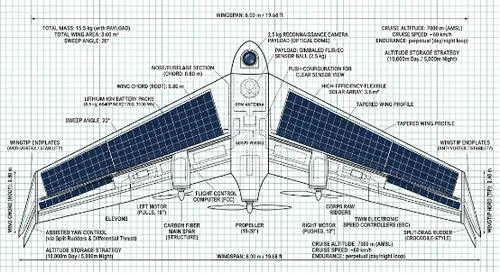
The espionage operation can be disassembled and stored in a van: most vans are over 250cm in length, so the wings can be designed to be 240cm long, and the width of these wings may reach 1.5 meters. Generally, the width of a van is 165cm. If the middle is 1.4 meters wide, then 2.4 x 2 = 4.8 meters, plus 1.4 meters = 6.2 meters. This means that the aircraft can be hidden inside a van after landing.
The Low-Altitude Scout (EPP):
Essentially a $450 (3,000 RMB) "toy" plane. With a 2-meter wingspan that detaches to fit in a car's backseat, it scouts at 500–1000m. If shot down, the loss is negligible. It uses lasers to designate targets for the "Omni-King" loitering above. If jammed, it enters an AI autonomous mode to hunt the source with a small FPV munition.
Research Philosophy for Quadcopters
Quadcopters are energy-intensive but agile. We focus on three types:
The "Beer Crate" Heavy-Lifter: Designed as a modular cube with ducted counter-rotating propellers and stealth coatings. These modules are the "Transformers" of the battlefield. One "crate" fits in a car trunk; four "crates" combined form a "Chinook-style" heavy lifter for transporting casualties or supplies; eight "crates" create an Aerial Robot for mid-air re-arming of fixed-wing drones.
AI FPV Munition: For surgical "single-soldier" strikes. These drones feature facial recognition for the targeted assassination of high-value political figures—a tactic designed to collapse enemy morale and decapitate leadership.
The "Rocket Drone": A low-cost, high-speed (600 km/h) interceptor. It uses a swarm-based kinetic impact approach to knock out enemy drones, helicopters, or cruise missiles. It is reusable and costs only ~$300.
The "Entrepreneur-1" Private Jet (The Ultimate Camouflage)
We are designing a 5.6-ton business jet, ostensibly for the civilian market, but engineered for war.
The Cover Story: A luxury 6-seat leisure aircraft for self-piloting entrepreneurs.
The Reality: Its 3D-printed carbon-alloy frame is designed for high-G missile evasion. Its "advanced avionics for non-professional pilots" are actually Electronic Warfare (EW) and AI Command modules. Its "emergency AI landing system" for sick pilots allows it to operate autonomously from highways during wartime. Its "toilet module" is a quick-swap interface for reconnaissance pods or 2-ton bombs.
In peacetime, it is a luxury toy. In wartime, a single FPGA firmware update transforms it into a 12,000m-altitude unmanned AWACS (Airborne Warning and Control System) or a heavy bomber. This is the Han Military-Industrial Complex—achieving revolutionary warfare through commercial iteration and "performance overflow."
Chapter 15: Missile Design Philosophy
In discussing the Minimalist MIC, we explore how to leverage the industrial technology of private enterprises—without a traditional defense background—to manufacture weapons that meet military requirements. Today’s design philosophy focuses on using off-the-shelf technology to build cruise missiles and anti-missile systems.
While drone swarms are nearly zero-cost and effective against low-altitude, slow-moving objects, they cannot strike large-scale targets, high-altitude threats, or deep-interior objectives. Therefore, our requirements are three-fold:
Deep-Strike Missiles: A platform similar to the Russian Geran (flying mopeds) capable of carrying 90kg of explosives to targets 1,000km away.
Affordable Anti-Missile Systems: A low-cost solution to intercept high-speed threats, including hypersonic missiles.
Technology Demonstrator Rockets: Traditional rockets for launching satellites or validating delivery systems for heavy payloads.
The "Geran" Series (Flying Mopeds)
Without access to high-end military tech, we must mobilize local private enterprises to manufacture "flying mopeds" like the Russian Geran. These are slow, noisy, and have high infrared signatures, but they can carry 90kg warheads over 1,000km for deep-strike missions.
Russia continues to iterate on this design, but I believe their logic is flawed. A missile so slow that it can be shot down by a bolt-action rifle from a crop-duster, detected by microphone arrays from kilometers away, and tracked easily via thermal imaging, will never achieve "stealth." As expected, most of these drones are intercepted mid-flight in actual combat.
My architectural iteration is different. I do not pursue stealth or penetration via hardware, as the hardware is inherently subpar. Instead, I apply these strategies:
Abandon Stealth for Saturation: Since the hardware is noisy, slow, and thermically obvious, do not waste resources on stealth. Instead, announce your presence boldly across the 1,000km flight path.
Platform Over Missile: In my design, the Geran is a "Heavy-Lift Fixed-Wing Platform" rather than a mere missile. As a platform, it can utilize swarm tactics and "Loyal Wingman" configurations. In a swarm launch, different "bees" serve different functions: decoys to force enemy radars to activate; anti-radiation units to neutralize those radars; reconnaissance units to scout ground threats; FPV "magazines" to eliminate ground troops; and electronic warfare platforms to suppress signals. Data relays will transmit the strike footage back for real-time battle damage assessment (BDA).
Autonomous Highway Reusability: This "missile" can be designed for reuse, capable of autonomous takeoff and landing on public roads. It can serve as a repeatable delivery platform for small munitions, laser-guided bombs, or FPV drones, especially for AI-driven night operations. Only when necessary is it used as a one-way expendable missile. This adheres to our philosophy of minimizing weapon categories.
The "Light Curtain" Anti-Missile System
To intercept hypersonic weapons, an anti-missile system is mandatory. The range doesn't need to be extreme, but it requires interceptors guided by fire-control radar. Since we lack the legacy to match the extreme precision of systems like the Patriot, and considering enemy hypersonic missiles can reach Mach 10 in the terminal phase, the interception window is incredibly narrow. To solve the precision gap, we introduce "Terminal Correction via Laser Light Curtain."
While a Patriot requires centimeter-level precision for a "kinetic kill" (hard-target impact), our initial accuracy may only be within dozens of meters. To bridge this, the interceptor’s head uses a MEMS polarizing mirror to project a laser "light curtain." The interceptor only needs to bring the target within this curtain. Once the target is illuminated by the laser, it becomes a high-contrast visual point.
The interceptor's Four-Quadrant Photodiode then uses Analog Circuits (bypassing the latency of digital processing) to adjust the control surfaces at ultra-high speed, bringing the precision down to a few meters. Upon detonation, thousands of tungsten alloy pellets create a "shrapnel curtain." At Mach 10—five times the speed of a bullet—any collision with a pellet will result in the catastrophic disintegration of the enemy warhead. By using cheap analog components, the cost of these interceptors is driven down to "commodity" levels.
Technology Demonstrator Rockets
We shall develop conventional rockets following the established path of SpaceX. Once these technology demonstrators mature, they will serve as delivery vehicles for nuclear warheads and the future Super-EMP warheads.
The "Yin yang energy Creation Engine" (阴阳造化机)
The prophetic poem The Zhuge Wuhou Oracular Text 《諸葛武侯乩文》 foretold that during the civil war between the Han people and the CCP a supreme weapon known as the "Yin-Yang energy Creation Engine" would be invented to secure victory. The theoretical design of this super-weapon has already been revealed to me through meditative communion with the divine. It comprises two primary designs:
Miniaturized Active Phased Array (MAPA): This system strips away the "invisibility" of stealth aircraft. It functions not only as a high-precision radar but also as a direct-energy weapon. It is capable of directly incinerating the flight-control computers of J-20 fighters, leaving the rest to the laws of gravity. In those final moments, the CCP pilots will face total despair; as they attempt to eject, they will find the microchips of their ejection seats already scorched and fused.
The Super-EMP Warhead: This device captures primordial energy by momentarily rending a rift in the fabric of space-time. This energy is released as a catastrophic electromagnetic storm, akin to the Tungsten Event. This is the same class of weapon used in the ancient wars of the Mohenjo-Daro deities. The power of the Yin-Yang Creation Engine far exceeds that of nuclear warheads, as does its long-term contamination. Any site struck by this weapon remains uninhabitable for millennia. Such weapons have been used on Earth before—any location with permanent magnetic abnormalities is a scarred battlefield where ancient gods once bombarded one another.
Chapter 16: Bunkers and Air Defense
Traditional radar systems are plagued by excessive power consumption, high energy demands, single-functionality, and numerous vulnerabilities; their data is inherently incomplete. This is why we must construct the "Situational Awareness Sphere" (SA-Sphere). The SA-Sphere refers to the situational awareness modules installed on our drones. They aggregate data from radar, infrared, multi-spectral sensors, acoustic arrays, radio frequency (RF) detection, magnetic field signals, magnetometers, and atmospheric sensors. While the detection radius of an individual SA-Sphere ranges from 3km to 30km, the Han people intend to deploy millions of them—on drones, vehicle roofs, streetlights, and base stations—to build the world’s largest edge-computing and Internet of Things (IoT) network.
Even so, we must recognize that the transparency of warfare is an irreversible trend. The enemy is transparent to us, but we are equally transparent to the enemy. Even if you achieve radio silence and physical stealth, your acoustic signature and optical characteristics cannot be hidden. In the era of situational awareness, as weapons become increasingly intelligent, traditional defense becomes extremely difficult, if not impossible.
Under these conditions, conventional protection is futile. Whatever means we employ, the enemy can employ as well. Therefore, the true "rear" of the battlefield lies within Deep Mountain Bunkers. By excavating bunkers beneath thousands of meters of solid rock, we create sanctuaries that bunker-busters and nuclear warheads cannot penetrate. Critical agencies, personnel, infrastructure, and production lines must be relocated underground. The very lifestyle and production modes of human civilization will be restructured.
To excavate shelters capable of sustaining 100 million people, we must invent AI Excavation Robots—thousands of machines working tirelessly 24/7. These robots must also be commercially viable. The Han Military-Industrial Complex (MIC) will provide R&D and subsidies, but the excavation process itself must be managed by commercial entities. Every part of the chain—from selling the excavated stone as building material to leasing the finished bunkers for logistics storage or IDC (Internet Data Center) server rooms—must be profitable. If the byproduct pays for the process and the facilities generate rent, we can build an industry involving millions of participants and rapidly scale to protect 100 million people from the coming cataclysm. These bunkers can be powered by micro-nuclear reactors, shielding all R&D and manufacturing facilities.
A great tribulation awaits humanity. In the context of such a devastating war, the race that can excavate bunkers deep within the mountains is the race that will survive the tribulation. I hope the Han people can excavate enough shelters for 100 million souls.
Let's call this plan "Project Yellow Ox Mountain."
The ancient prophetic poem "The Pancake Song" mentions a cave at the foot of Yellow Ox Mountain, capable of sheltering 180,000 people. It seems that in a super nuclear war between the Han Chinese and other races, a massive bunker has already been dug to preserve civilization.
Chapter 17: OSINT and Situational Awareness
I firmly believe that with the high collective intelligence of the Han people, we can construct the world’s most advanced "black-tech" intelligence system. However, starting from scratch is always the hardest part. Once a civil war against the CCP begins, how do we build a minimalist intelligence framework that is immediately functional?
Intelligence is divided into Strategic and Tactical. In the realm of strategic intelligence, the "Introduction to Strategic Intelligence" has already made a significant impact, creating a phenomenon of nationwide counter-espionage awareness that has deeply unsettled the CCP. In its early stages, the Han intelligence system should prioritize Strategic Intelligence. We should assemble research talent into a "Strategic Intelligence Bureau" (SIB), supported by supercomputers, AI-assisted analysis, and a task force of tens of thousands of investigators for evidence collection and research. The advantage of strategic intelligence is its ability to calculate and predict the patterns of enemy agent activity through macro-analysis—essentially "computing" the intelligence into existence. This bureau, paired with a counter-insurgency movement, can effectively compensate for any early-stage deficiencies in tactical intelligence.
Tactical intelligence, meanwhile, requires a gradual build-up of systems and talent. We will follow a four-step roadmap:
OSINT (Open-Source Intelligence).
Big Data & ELINT (Electronic Intelligence).
Human Intelligence (HUMINT) Networks.
Overseas Penetration Networks.
Our early-stage logic for the intelligence framework is as follows:
Mobilization: Utilize Han Nationalism to drive a "People’s War" of intelligence. Volunteers, motivated by ideology rather than salary, will serve as the eyes and ears of the Han people in every corner of society.
Signal Interception: Electronic intelligence (ELINT) and radio monitoring.
Network Intelligence: Big data mining and cyber intelligence.
Situational Awareness: Sensor-based intelligence and real-time monitoring.
AI Synthesis: Using supercomputers and AI to synthesize and analyze raw data.
Professionalization: Training career spies, penetrating foreign entities, establishing state-level hacker teams, and deploying a surveillance satellite network.
The Situational Awareness Platform will be built in layers. At the foundation is OSINT, which provides "rough" data that is then refined through successive layers of precision. For instance, in hot zones, we will overlay LiDAR-generated 3D data and high-precision maps with real-time data from tens of thousands of sensors. In such an environment, even a rodent moving across a field would be tagged by thermal imaging; even a single gunshot would be instantly localized by acoustic arrays.
Regarding OSINT, we must first build Geographic Intelligence (GEOINT). We will use tools like Google Earth and Wikimapia to create baseline maps, supplemented by real-time imagery purchased from commercial satellite firms. When necessary, we will deploy our own drones to collect LiDAR 3D models and geomagnetic data. Simultaneously, we must gather Electronic Intelligence (ELINT) by monitoring all radio signals and identifying the IP addresses of surveillance cameras. Since ELINT work is tedious, AI will handle the monitoring and summarization tasks.
For Internet Intelligence, we will leverage the strengths of our domestic software engineers to build API-based interfaces. Much like the OpenClaw framework, the Han intelligence system will function as a backbone. The backend API integrations will be flexible, allowing us to outsource specific intelligence tasks. Specialized groups—such as elite hacker organizations—can plug in their own data-mining APIs.
Finally, this Situational Awareness system will support two parallel interfaces:
The "War Game" Edition: A hyper-realistic simulation with authentic weapon parameters. This "game" will serve as a recruitment tool to identify and train military talent from the civilian population.
The AI Training Ground: An interface for AI agents to play the "war game" continuously. Through millions of simulated conflicts, the AI will iterate and optimize command-and-control decisions, providing high-level strategic guidance for the actual battlefield.
Chapter 18: Open-Source Warfare and Decentralized Government
The Han people must recognize our true nature as a warrior race. Those who humiliate us, the CCP, are effectively "Chinese Jews" who were once driven into the desert by our ancestors. Today, they maintain a vast global network; many leaders across Southeast Asia are essentially "Chinese Jews" of this lineage. While the West claims to be anti-communist, they are fundamentally aligned with the CCP in their anti-Han stance. Our enemy is not just the CCP, but the global shadow puppet governments controlled by Jewish interests. To achieve true security, we must dismantle the governmental structures of all nations.
Historically, during World War I, when Western powers were preoccupied with their own survival, the Han people experienced a brief "Silver Age" of development. Today’s global "peace" is detrimental to our race; the collapse of the Han population under this order is more catastrophic than in times of war. To reclaim our destiny, we must destabilize the global order. By fueling conflict elsewhere, we force the CCP and Western powers to act as global "firefighters," leaving them no room to interfere with Han interests.
The Han Military-Industrial Complex will adopt a policy of total transparency: all concepts, product designs, source codes, chips, and manufacturing tools will be Open-Sourced. We will establish an "Open-Source Warfare Website" to provide free "warfare source code" to anti-authoritarian organizations worldwide.
Furthermore, we will transform "War Economy" into a primary industrial driver. If we cannot export traditional goods, we will Export War. From flight control algorithms and chip modules to tactical command expertise, everything will be exported. This will reignite the lights in our office buildings and return unemployed programmers to their posts to iterate the next generation of weaponry. This "Open-Source War Business" will also serve as a global intelligence net, planting political eyes across the globe while funding our R&D.
Our ancestors once said: "Expel the Jews, restore China." However, this was a strategic miscalculation. Mere expulsion allows them to return, often camouflaged as "Red" colonial regimes to continue the enslavement of the Han. Recognizing this error, we have formulated the "Pure Land War Strategy" (净土战争战略). We no longer seek mere expulsion; we seek to establish a Pure Land—a world without their influence.
Open-Source Warfare is a pillar of the Pure Land Plan. We will destroy the authoritarian order of all existing governments and reconstruct a world order favorable to the Han.
The New World Order: Decentralized Governance
What kind of world order favors the Han? One that strips governments of their authoritarianism, their right to mint currency, and their monopoly on military power. We will export this soft power through scholars and global platforms like TED, spreading the doctrine of Decentralized Government.
Current laws are imposed unilaterally without individual consent, rendering all existing governments "illegal." A legitimate government must function on two principles:
Anyone can establish a government and publish a constitution.
Citizens must explicitly authorize a government via an app to make its laws effective for them.
To prevent the return of tyranny, these decentralized governments must abide by three rules:
Laws cannot contradict decentralized principles.
Citizens can switch governments freely via an app.
Governments are prohibited from minting currency or maintaining standing armies.
This enables "Cyber-Exile" (赛博跑路). If a government’s police force attempts to target you, you simply open your app, revoke your authorization, and switch to a different jurisdiction. The previous government's judicial power over you becomes instantly void.
Why This Favors the Han
The operational logic of the CCP and global Jewish interests over the past millennium has relied on cult-like mobilization and the establishment of illegal, unauthorized governments. Once Decentralized Government becomes the global consensus, it will surpass traditional "Democracy and Freedom" as the new world standard, eradicating the soil in which illegal regimes grow.
When government becomes a mere service organization and the concept of the "Nation-State" vanishes, what will unite people? Nationalism. Westerners lack a true cohesive ethnicity; only the Han possess deep-rooted, authentic nationalism. In a world without states, Han Nationalism becomes the ultimate anchor.
Furthermore, without government-controlled minting, currency value will rely on Ethnic Credit rather than "National Credit." A "Han Coin," backed by the collective intelligence, combat will, and scientific prowess of the Han people, will naturally crush competitors like an "American Coin" in the free market.
Ultimately, the world will center around technological civilizations as the primary military entities. The wars between these technological blocs will conclude with the victory of the Han people—the definitive end-state of the Pure Land War.
Chapter 19: Business Logic and Iterative Technology
Peter Thiel’s companies build weapons using automotive-grade chips; my strategy is to build weapons using consumer-grade chips. This distinction stems from a fundamental difference in our philosophy of weapon systems.
In a price war, consumer-grade chips offer unrivaled cost-performance. "Automotive-grade" does not equate to higher precision; rather, it reflects a premium paid for ten-year stability. In the Minimalist MIC, weapon systems iterate at the speed of internet products. Weapons will have annual releases, much like smartphones. Therefore, there is no need to maintain decade-old stockpiles. Older versions are rapidly liquidated in the international market, while new versions undergo high-speed iteration.
Thiel’s weapons cannot compete with the Han MIC in terms of price or performance. Our primary challenge is the inventory pressure caused by rapid iteration—which is why Open-Source Warfare is critical. It allows us to offload inventory into the global market, ensuring that the Han people can prosper even in chaotic times by exporting war-related expertise and products.
Under the Minimalist MIC, the product portfolio is streamlined into 30 essential series:
The Core 30 Product Series
Firearms: 7mm Area Denial Rifle
Firearms: 7mm Area Denial Bolt-action Electric-screw Rifle
Firearms: 6.5mm Special PDW
Ammo: 7mm Steel-core Rounds
Ammo: 6.5mm Steel-core Rounds
Ammo: 6.5mm Lead-core Enforcement Rounds
Ammo: 6.5mm Tungsten-alloy Subsonic Assassination Rounds
Ammo: Integrated Weapon Station Modules
Ammo: Acoustic Array Intelligent Landmines
Ammo: Universal Explosive Logic Fuses
Protection: Intelligent Helmets
Protection: Intelligent Backpacks
Optics: Multi-spectral Global Shutter Gimbal Cameras & Derivatives
Comms: Datalink Modules & Derivatives
Comms: Laser Communication Modules
Comms: Radio-silent Communication Modules
Avionics: Universal Avionics Modules
Radar: Early Warning & Electronic Countermeasure (ECM) Modules
Data: Integrated Data Center & AI Inference Modules
UAV: Fixed-wing, Stratospheric PoC Platform
UAV: Fixed-wing, 6m Wingspan "Aerial Magazine"
UAV: Fixed-wing, 2m Wingspan Low-altitude Scout
UAV: Fixed-wing, Fuel-powered EW/AWACS Platform
UAV: Fixed-wing, Glide Bombs & Cruise Missile Derivatives
UAV: Quadcopter, Heavy-lift Modules & "Chinook" Derivatives
UAV: Quadcopter, FPV Munitions
UAV: Quadcopter, Rocket-style FPV Munitions
Missiles: "Geran-style" Flying Moped
Missiles: Light-curtain Anti-missile Systems & Derivatives
Missiles: Traditional Rocket Technology Demonstrators
This entire complex is compressed into just 30 products. With an average of 200 people per team, a total staff of 6,000 can manage the iterations. If managed well, these lines will be profitable, transforming the MIC from a "fiscal black hole" into a profit machine.
White Lotus Heavy Industries: The Corporate Vehicle
To realize this, we establish White Lotus Heavy Industries (白莲重工) with the following departments:
Software Department (White Lotus OS):
Develops an open-source Real-Time Operating System (RTOS) optimized for RISC-V and Linux. Branded as White Lotus OS, it targets industrial, IoT, and mobile sectors with a focus on "absolute security and reliability"—precisely what weapon systems require.
Micro-Electromechanical Systems (MEMS) & Sensors:
This department develops the core "organs" of our systems: global shutter cameras, multi-spectral sensors, 1,024-unit microphone arrays, photonic integrated gyroscopes, and FPGA signal modules. By integrating these into "White Lotus Mobile Phones," we use massive consumer volumes to drive sensor prices down to commodity levels.
Commercialization Department:
Their job is to "package" military tech into consumer electronics. By installing high-precision chips in millions of toys and industrial tools, the price collapses.
Strategic Advantage: This provides a "stealth" path through arms embargos. You buy a toy drone, extract the motherboard (a Universal Avionics Module), flash it with "Open-Source Warfare" code, and you have a facial-recognition FPV assassin.
Legitimate Dual-Use Applications
White Lotus Heavy Industries is a legitimate commercial entity producing electronics for extreme environments.
Forestry AI: Our drones identify wildfires and drop "extinguishing bombs" via laser guidance. A "recon-strike" fire suppression system is a perfectly reasonable industrial design, right?
Industrial Safety: Our smart safety helmets feature acoustic arrays to detect gas leaks and UV-silent comms to protect trade secrets. Completely logical, right?
We officially prohibit the use of our products for war. However, if someone disassembles our "off-the-shelf" modules and downloads flight control source code from the Open-Source Warfare website—that is beyond our control.
The Endgame
White Lotus Heavy Industries covers the entire tech stack of the Minimalist MIC with only a few thousand R&D staff. Once war breaks out, every White Lotus product can be "upgraded" via software: phones become tactical radios, routers become radar/ECM hubs, and drones become bombers.
This "Minimalist" version is just the baseline—the "free version" of open-source warfare. Once the Han people achieve liberation and establish a Han-centric nation-state, our pursuit of the absolute limits of weapon performance will be boundless.
Chapter 20: Research into Nuclear Miniaturization
The research and development of nuclear weapons represent a nation's total industrial prowess. For a newly established Minimalist MIC, the priority must be Tactical Nuclear Warheads rather than strategic ones. Compared to the latter, tactical warheads are simpler to manufacture, allowing for significant engineering tolerances. They are rugged, durable, and rely on less complex technology. Although they are larger and have a maintenance cycle of only three years, they are far more practical for a nascent defense entity.
Strategic warheads, by contrast, eliminate engineering tolerances in favor of extreme precision and miniaturization, extending maintenance cycles to fifteen years. This requires an incredibly high level of technological sophistication.
In the early stages of the Minimalist MIC, we lack this high-end tech base. Therefore, we must focus on rugged tactical warheads. The historical necessity for miniaturized strategic warheads was driven by limited lift capacity—a single rocket had to carry multiple warheads, necessitating a small footprint. Today, lift capacity is no longer a bottleneck. Furthermore, as air defense interception systems evolve, deploying a multitude of decoys to saturate defenses is far more effective than relying on the penetration of a single strategic warhead. Modern guidance technology has also reached a level of precision where a city can be neutralized with much lower yields. Thus, the increased physical volume of a tactical warhead becomes a perfectly acceptable trade-off.
Regarding maintenance: while a three-year cycle for tactical weapons seems like a disadvantage, we can turn this into a strategic strength.
Strategic warheads require top-tier nuclear physicists to "turn the screws," but tactical warheads can be serviced by skilled senior technicians. Imagine a stockpile of 1,000 warheads; this requires 333 refurbishments per year. With an automated assembly line and industrial robots, nuclear warhead refurbishment can become as seamless as a mineral water bottling plant.
Given current lift capacities and pinpoint accuracy, the era of multi-megaton yields is over. We should shift from 1,000 massive warheads to a decentralized force of 30,000 smaller ones. Maintaining such a force with traditional strategic methods would be madness, but with an automated production line, refurbishing 10,000 units a year becomes a routine industrial process.
Furthermore, modern air defense necessitates a shift in strike tactics. A single attack might involve 50 non-nuclear conventional warheads acting as decoys alongside several live nuclear rounds. This means our automated lines must produce both real and decoy warheads. If we account for these decoys, the refurbishment volume might rise to 100,000 units per year.
The short maintenance life of tactical warheads allows us to iterate like the smartphone industry. Every three years, during refurbishment, we can upgrade the hardware and firmware to a new version. Within a decade, the warheads of the Minimalist MIC will be more technologically advanced than the aging strategic stockpiles of the United States.
However, prioritizing tactical weapons does not mean abandoning miniaturization research. Such research will continue for the purposes of proof-of-concept and technical validation, with the resulting innovations eventually trickling down into the tactical nuclear tech stack.
The old philosophy of nuclear development was built for an era of scarce lift capacity, non-existent anti-missile systems, and poor accuracy—hence the need for massive yields. Today, with precision guaranteed and lift capacity abundant, the focus shifts to terminal maneuvering and swarm penetration. By reducing the required yield, we can use insensitive high explosives and redundant neutron generators. We can relax the fragile, hyper-precise requirements of the past in favor of rugged, reliable, and mass-produced tactical nuclear weapons.