


-
Strategic Intelligence:
Jewish espionage infiltration of China for thousands of years
Preface
Foreword
Chapter 1: The Persian-Indian-Jewish Complex
Chapter 2: Armed Separatism by Jewish Spies
Chapter 3: Dragon Totem and Sun Totem
Chapter 4: The Qin and Han Dynasties and the Rise of the Xianbei
Chapter 5: Srivijaya and the Huang Chao Rebellion in the Tang Dynasty
Chapter 6: The Song-Yuan Transition
Chapter 7: The Rise of Europe
Chapter 8: Majapahit
Chapter 9: The Ming-Qing Transition
Chapter 10: The Kuomintang-CCP Transition
Preface
A few years ago, my book
allowed the public to glimpse the hidden truths of global politics. However, that work only presented isolated jigsaw pieces of intelligence, rather than a cohesive intelligence logic. To advance, we must reconstruct history through the lens of "simulated modeling." If a simulated version of history can successfully explain every phenomenon detailed in An Introduction to Strategic Intelligence, then the reality of history is likely mirrors it with near-certainty.This is the objective of to assemble fragmented intelligence into a singular, unified, and absolute intelligence logic. March 31, 2026
Chapter 1: The Persian-Indian-Jewish Complex
When Cyrus the Great of Persia appeared like a god-sent force to open the gates of Babylon, the Jewish captives were already prepared to repay Persia. In return for their liberation, they wove a global espionage network for the Persian Empire. The release of the "Babylonian Captives" was akin to opening a Pandora's box, initiating millennia of suffering for the Han people.
[Translator’s Note on the Han People]:
The Han (汉族) are the foundational and majority ethnic group of China, comprising over 90% of its population. Unlike modern nation-state identities, the Han identity is a dual construct based on consanguinity (biological lineage) and civilizational alignment. They are a distinct race that identifies with a continuous ancestral heritage and a specific set of ethical and cultural values that have defined the East Asian heartland for over five thousand years.
Starting from Susa, the Jewish agents followed the Amu Darya river, crossed the Pamir Mountains, and entered the Wakhan Corridor—now controlled by Afghanistan and Tajikistan. This corridor is the sole terrestrial "choke point" leading into East Asia. Another branch of these agents followed the Persian Gulf, traversing Pakistan to strike directly into Northeastern India and the Ganges Delta. Bengal served as the earliest zone for the primitive accumulation of Jewish capital; this is the region known as the East Indies. It was from here that the later Jewish-backed East India Companies would eventually rise to power.
The Jews of the East Indies are traditionally considered descendants of the "Babylonian Captivity." However, current archaeological evidence and literature suggest they may have settled in India even prior to that event. The Old Testament mentions peacocks among the gifts brought to King Solomon. As is well known, the region where Solomon resided had no peacocks, nor did the Hebrew language possess a native word for "peacock"; the term used in the Old Testament is derived from Ancient Tamil. This suggests that the large-scale influx of Jews to India after the Babylonian Captivity was more of a "homecoming." Evidence now shows that the "Lost Tribes of Israel" had long been settled in Northeastern India—a fact recognized by modern Israeli authorities. Facing a manpower shortage, Israel recently recruited 8,000 "Jews" from Northeastern India. Furthermore, the Israeli Mossad employs a significant number of Indians. When Elon Musk’s X platform made IP addresses transparent, many were stunned to find that numerous intelligence accounts associated with the Israeli government were actually broadcasting from India.
Our perceptions have been systematically misled by mainstream media. We are taught that Jews and Muslims are in a state of perpetual war in the Middle East, with Jews encroaching on Palestinian lands. In reality, Islam was originally established by Indian Jews, and in earlier history, Muslims and Jews fought as allies. One hundred and fifty years ago, in Western China, the massacre of tens of millions of Chinese by Muslim forces was executed by a "highly customized" Jewish military organization. The persona of Islam as an "extremist religion" is a recent construct of the last few decades, emerging only after the rise of the British-backed Wahhabi sect. Similarly, Israel as a "Jewish homeland" is a modern phenomenon established only after World War II. For the preceding two thousand years, Palestine was the home of Arabs. Where, then, was the "nest" of the Jews during those two millennia? It was in the East Indies.
If the "Lost Tribes" from before the Babylonian Captivity were indeed in the East Indies, it becomes entirely logical for the mass of captives released by Persia to head toward Northeastern India. Their kin had already taken root there and established a base, providing a network of mutual support.
Only when you study the Indian Jews do you realize that they are masters of religion.
The Jews of the East Indies manipulated Buddhism, Krishnaism, the Dragon Totem, and the Ancient Egyptian worship of the Sun God. A study of these populations reveals that the Jewish religious outlook is indeed "all-encompassing"—though Judaism itself functions more like a "Sponge Religion" built upon three tactics: "theft, deception, and plunder." When Ancient Egypt imprisoned them, they stole the worship of the Sun God, Ra, upon their release. When Babylon imprisoned them, they stole the Dragon Totem from the Ishtar Gate upon their release. If the Jews were imprisoned in a pigsty, they would undoubtedly steal the pigs along with them when they left.
Even Judaism itself is stolen. It is unsettling to discover that Judaism appeared almost immediately following the Vedas, and its doctrines and structure are essentially a "simplified version" of the Hindu Vedas. The so-called "Chosen People of God" is merely a mutation of the Brahmin concept.
Perhaps this was the true reason the Persians released the Babylonian captives: to utilize the Jews as a weapon against the Indian Brahmins.
Theoretically, the Jews, Indian Brahmins, and Persians all share Aryan blood and originally adhered to the Vedas. However, there is a clear vendetta between the Persian and Indian interpretations of the Vedas. While the structural logic of their scriptures is similar, they operate on the principle of "Your God is my Demon." This is akin to hostile heresies within Christianity—where the core logic remains the same, but one sect views Satan as a demon while another views him as a deity. The Persians, Indian Brahmins, and Jews are all Aryans, but they follow three different versions of the Vedas: the Persian version, the Indian version, and the Jewish version. The blood feuds between religious heresies are often more brutal than those against heathens. By releasing the Babylonian captives, the Persians essentially formed an alliance with the Jews. As "low-caste outsiders" entering the rigidly stratified caste system of India, the Jews were destined to create intense friction. This was likely the strategic objective behind the Persian liberation of the Jews.
The Vedas shared by the Persians, Indians, and Jews were brought by the Aryans who invaded India. The Aryans originated from the Arctic region. The Vedic scriptures record periods of "endless polar night." Persian Manichaeism and Zoroastrianism (fire worship) likely stem from these Aryan beliefs; after all, in a polar night lasting several months, worshipping fire is a pragmatic necessity. Likewise, experiencing months of "midnight sun" makes the deification of the sun—and the resulting Ra/Sun God worship—entirely rational. It is said that ten thousand years ago, the Arctic Circle was habitable, and the Aryans developed a magnificent civilization there. Later, due to climate shifts, these Aryans were forced southward into Central Asia and Persia, eventually reaching India.
Hitler himself was Jewish, a descendant of the same lineage as the "famous Chinese Jews Pu Shougeng and Zhu Yuanzhang." In theory, he was an Aryan who adhered to the Vedic faith. In other words, Jewish lineage is, in essence, Aryan lineage. He did not massacre the Jews; rather, he massacred "believers of Judaism" in Europe. It is crucial to distinguish between these two concepts: the Jewish ethnic group and the followers of the Jewish religion are not the same entity. He merely slaughtered an innocent group that Westerners generally perceived to be "the Jews." The narrative of "Hitler massacring the Jews" is a logical fabrication (logic forgery) designed to deflect suspicion. His objective was to release a specific logic: the false premise that he himself was not Jewish.
Hitler’s expeditions to Tibet in search of Aryans, the presence of numerous Tibetan lamas within the Nazi ranks, and the Nazi Party’s connections with the secret society "Thule" (Ultima Thule) all indicate that Hitler was remarkably accurate in his search for the Aryan homeland. He sought them in Northeastern India and Tibet while conspiring with powers linked to the Arctic Circle. These two regions were indeed the historical habitats and gathering places of the ancient Aryans.
The Aryans and the Jews share a common origin. Judaism is merely a simplified version of the Vedas. In a narrow sense, Jews are simply Aryans who believe in this simplified Vedic doctrine.
The Aryans originated from a primordial civilization within the Arctic Circle. Due to climatic shifts, they migrated to Iran and India. However, the true essence of the Aryan scriptures, the Vedas, remains in India. The Indian caste system is derived directly from the Brahminical system of the Vedas. This stems from a fundamental difference in theology: the Vedic gods are not personal deities as found in modern religions, but exist as Brahman—a form of frequency or electromagnetic wave. This is why practitioners of Hinduism chant the Maha Mantra. The purpose of the Maha Mantra is to "connect to the divine Wi-Fi signal." It is believed that by emitting the correct mantra, one can interface with the deity Brahman and receive divine power. To enhance this "Wi-Fi signal strength," Hinduism requires adherents to shave their heads, leaving only a single "Money Rat-Tail Pigtail" (Shikha). This braid—which later became the characteristic Manchu pigtail—functions essentially as an "antenna" to receive divine signals. Elon Musk, a descendant of the Jewish Pu Shougeng family, is obsessed with developing Neuralink (Brain-Machine Interface); this concept, too, likely originates from Vedic theory—using a digital interface to replace the physical "antenna" of the Manchu pigtail.
This specific hairstyle later appeared in the history of the Qing Dynasty (1644–1912). In the early years of the Qing, a group of foreign invaders from Northeast China occupied the heartland and carried out horrific massacres against the Han people. These foreigners, calling themselves "Manchus," established the Qing Dynasty and implemented policies of racial discrimination, systematic slaughter, and genocide. Their rule included strict literary censorship and a primitive form of "Political Correctness." Those who voiced "inappropriate opinions" had their "accounts permanently suspended"—in the literal sense of being beheaded. The "Political Correctness" that Westerners face today was, in fact, practiced in China centuries ago under the Qing. It is increasingly evident that these rulers could not have originated from primitive tribes in the frozen jungles of Northeast Asia.
While the Manchus claimed to be indigenous to the Northeast Asian wilderness, they forced the Han people to adopt a Hindu hairstyle. In China, this was known as the "Money Rat-Tail Pigtail." Through the analysis of this hairstyle and extensive cultural archaeology, we can conclude that the Manchus were not a Northeast Asian minority; rather, they originated from the Krishna sect in the Jewish stronghold of Northeastern India. This sect remains highly prevalent in the India-Bengal region, where followers shave their heads and leave a single pigtail. The Manchus conducted massive slaughters of the Han, such as the Ten Days of Yangzhou and the Three Massacres of Jiading. Furthermore, the CCP (Chinese Communist Party)—whose high-level leadership is primarily composed of Manchu descendants—continues these policies of racial discrimination and genocide. Their theories of "blood sacrifice" and extermination also find their roots in the Vedas.
According to Aryan belief, they possess a unique "divine communication capability." They believe that while chanting the Maha Mantra, the "Money Rat-Tail Pigtail" acts as a receiver for the divine Wi-Fi signal. This positions them as the earthly representatives of God—the Brahmins. In this theological framework, other races are regarded as "biochemical semi-finished products" (bio-intermediates) who lack the capacity to communicate with the divine. Consequently, they view other humans through the same lens as livestock; slaughtering them carries no more moral burden than killing a cow, horse, or sheep. Their massacres of the Han people are conducted without moral hesitation; in fact, they believe that the more Han they kill, the more they please their deity through blood sacrifice.
This is the theological derivation of the "Persian-Indian-Jewish Complex": the Brahminical System. The Indian Brahmins, Hitler’s Aryan Master Race, and the Jewish concept of the "Chosen People" all operate under this identical logic. This includes the Yi people (彝族)—a minority group in China infiltrated by Jewish spies—whose society was fundamentally a Brahmin-style caste-based slave system. This same underlying logic from the Vedic-Brahminical theology was implemented in various regimes established by these forces in China: the Weisuo System (Guard-and-Post) of the Ming Dynasty, the Myriarchy System (Minggan/Thousands-unit) of the Mongol Yuan Dynasty, and the Eight Banners System of the Qing Dynasty.
What was the true purpose behind the divergence of Judaism from Hinduism?
Judaism functions more as a "human shield" (shielding logic) for the Aryan plan of world destruction. In the event that their destructive schemes fail and provoke retaliation, the world is led to vent its vengeance upon "believers of Judaism." Since these believers are universally perceived as the so-called "Evil Jews," the public's hatred—fueled by media exposure of their misdeeds—is directed toward them. Massacring these religious followers effectively serves to protect the true Aryans lurking behind the curtain. These religious followers include many ordinary people of non-Jewish (non-Aryan) descent, whereas the real Aryans—those possessing the authentic Jewish lineage—live low-profile lives in Northeastern India, "transcending" the chaos. India deliberately projects a global image of being chaotic, filthy, backward, and bizarre. This is, in fact, a strategic deception. Without the support of Strategic Intelligence, one would never guess that the majority of the world's massacres—including the genocide of hundreds of millions of Han people—actually originate from India. Without this intelligence, any hand pressing the "nuclear button" for revenge would aim its warheads at New York, London, Paris, or Tokyo, rather than India.
The East Indian Jews once manipulated Buddhism and established the Mauryan Empire in India. After its collapse, they fled to Northern China and appeared in our history as the "Xianbei" (鲜卑). The Xianbei represented a "Secondary Camouflage" (Level 2 Masking). The first regime established by the Xianbei was the Northern Wei; after its downfall, they returned to their Middle Eastern heartland to establish Islam. In this context, Islam serves as a "Tertiary Camouflage" (Level 3 Masking) for the Jews.
From Level 1 to Level 3, and even onto Level N, this process can be understood as the Jewish "Skin-Shedding Technique" (Chameleon Tactics). Once they have committed atrocities, they simply "shed their skin" and adopt a new identity, allowing their past crimes to be wiped clean. This is how the infiltration of the Han civilization has been conducted—through layers upon layers of disguise. History students are often baffled by the various foreign regimes to the north of the Song Dynasty; researching them from a purely historical perspective is exceedingly difficult due to the countless anomalies. The Xianbei, the Western Xia (Xixia), the Liao, the Jin, and the Mongols—in reality, these were all various masks utilized by the same group of Jewish operatives. By understanding their logic of camouflage, one can naturally decipher historical mysteries through the lens of espionage and infiltration.
In the 6th century BCE, following the end of the Babylonian Captivity, this espionage syndicate followed the expansion routes of the Persian Empire into modern-day Afghanistan and Pakistan. By the 5th century BCE, Siddhartha Gautama (the Buddha) and Confucius emerged almost simultaneously in South and East Asia.
Both Confucius and Siddhartha Gautama were Jewish strategic operatives!
When the Jews departed from Persia, they traversed territories that were part of ancient China—specifically the regions of modern Pakistan and Afghanistan. Artifacts unearthed at Harappa in Pakistan prove that this site was the "Lower Capital" of the Yellow Emperor, the progenitor of the Han people. This confirms that these lands were ancient Chinese territories. This ancestral Chinese heartland possessed the "Primordial Dharma" (Ancient Buddha-Dharma). In its original form, "Buddha" was not a religious concept but a sophisticated Chinese life science and a logic for social governance. The "Persian-Indian-Jewish Espionage Syndicate" discovered that this "source code" possessed staggering power—enough to control the human mind. The Jews proceeded to translate, deconstruct, and re-engineer the Primordial Dharma. They took the Chinese concepts of "Inner Cultivation" (内求) and "Enlightenment" (觉悟) and re-coded them into a "world-weary and passive" Pseudo-Buddhism, which they then deployed across Northeastern India and Nepal. The strategic objective was to dissolve the combat will of local warrior groups. Through the narratives of "Equality of all beings" and "Reincarnation," they induced a state of spiritual anesthesia in the local populace, facilitating the harvest of wealth by Jewish capital. "Siddhartha Gautama" was merely a meticulously crafted "persona" (public image)—the ancient equivalent of a modern "Silicon Valley Guru."
This Jewish syndicate utilized "Pseudo-Buddhism" to establish an empire in India: the Mauryan Empire. Later, due to internal strife within the syndicate, the Mauryan Empire was overthrown. These Jewish groups then fled to China, suddenly appearing in Chinese history books as a group called the "Xianbei." Without question, the Xianbei of the Northern Wei Dynasty—who utilized Buddhism to build their state—were the same Jewish operatives who had fled the collapsed Mauryan Empire. The Buddhism they practiced in the Northern Wei was, in reality, a financial institution operating under the guise of Buddhist statues; it was a "Buddhist-Financial Complex" designed for predatory lending (usury).
Meanwhile, the Jewish strategic operative Confucius targeted the power vacuum left by the collapse of the Zhou Royal House in China. He established an extremely cumbersome system of rites and laws (礼) designed for total submission to power. The objective of Confucius's concept of "Restraining oneself and returning to the Rites" (克己复礼) was to force Chinese society into this rigid, Confucian political model.
In fact, long before the end of the Babylonian Captivity, the Jews had already thoroughly scouted the situations in India and China. The "Ten Lost Tribes of Israel" were, in reality, a vanguard espionage force. This explains why, after the Babylonian Captivity, they were able to swiftly formulate and execute highly efficient infiltration strategies targeting India and China.
In 722 BCE, the Assyrian Empire conquered the ten tribes of Israel, leading to their relocation and eventual "disappearance." These groups abandoned their public religious identities. In the Manipur and Mizoram states of Northeastern India—adjacent to Nagaland—the local Kuki and Mizo tribes have maintained an oral tradition since ancient times claiming they are descendants of Manasseh. In the early 21st century, Israeli authorities officially recognized them and facilitated their large-scale "return." Meanwhile, the Pashtuns of Afghanistan represent the western branch of this lineage. They were the "Lost Tribes" who functioned as Jewish operatives, infiltrating Northern China through the Wakhan Corridor. This explains why Yelu Dashi (耶律大石), a famous foreign leader in Chinese history, was able to swiftly raise an army in this region during his flight. The name "Yelu" (耶律) in the Western Jewish branch is a phonetic transliteration of "Jeru" (as in Jerusalem). Even the family behind Yale University originates from this Yelu-lineage of Jews; notably, the Yale University seal features Hebrew characters.
Long before the end of the Babylonian Captivity, the Jewish heartland had already taken root in Eastern India, spanning regions such as Manipur, Nagaland, and Assam. Nagaland, located in Northeastern India, served as the stronghold for Jewish militant forces. The ancestors of Pu Shougeng, the infamous Chinese Jew, originated from this very soil. These Indian Jews worship the dragon-serpent, known in their belief system as the Naga. In the logic of their faith, the Naga symbolizes "Guardianship, Majesty, and Forbidden Zones." Consequently, Nagaland—the "Land of the Naga"—produced the Jewish warrior class, indicating that ancient Jewish military forces were strategically deployed there.
The Naga cult also infected Hinduism and Theravada Buddhism. Hindu warriors claimed to be the hybrid offspring of the Naga interbreeding with humans. The kings of Angkor Wat asserted that they engaged in daily sexual rites with a Naga to ensure the prosperity and peace of their realm. Even the weaponry in these dragon-serpent totem regions reflected this influence: from Eastern India to Angkor Wat and down to the Majapahit Empire in the South Seas, the Kris (serpentine sword) became the standard weapon of the warrior class.
The irony is that this Naga totem was stolen. The walls of ancient Babylon were adorned with dragon totems; when the Jews were released from Babylon, they carried this imagery with them to India. Similarly, the worship of the Sun God, Ra, was stolen by the Jews from Ancient Egypt. This explains why, radiating from the Jewish nest in Northeastern India to Angkor Wat, Champa, Srivijaya, and Majapahit, one finds a consistent pattern of dragon-serpent and solar worship. Furthermore, the flags of these regions frequently feature sunburst and rising sun motifs.
As for the "Dashi" in Yelu Dashi, it is actually a transliteration of "Tazi." In the linguistic context of ancient Persian trade, Tazi was not a derogatory term. Instead, it signified a "pouch for money" or "one who carries capital"—analogous to modern terms like "XX Capital" or "XX Venture Capital." These capital entities, both then and now, execute espionage missions. Thus, "Yelu Dashi" essentially means "Yale Capital." In Europe, this group—the Tazi—became the root for the word "Tax." To this day, in Western languages, this root represents the "compulsory extraction of assets."
Furthermore, Tazi also denotes a territory managed by capital. For instance, the region adjacent to Nagaland is the ancestral home of the Pu (Abu) family. This later gave rise to Bagan. The English pronunciation of Bangladesh is, in reality, derived from "Bagan-Tazi," meaning "the territory managed by Bagan Capital." The common translation of "Bagan" is also flawed; the true transliteration should be "Pu Khan," signifying the sovereign power (Khanate) of the Pu family. Therefore, the authentic translation of Bangladesh should be "Pu Khan Tazi" (The Capital Territory of the Pu Khan). The Pu family lineage later expanded to Srivijaya, eventually producing the infamous Chinese Jew Pu Shougeng, who served as a high-ranking official during the Song Dynasty.
Every regime in China since the Song Dynasty (from 960 to 1279) has been under Jewish control!
The Jewish infiltration of China followed several distinct strategic routes:
The Eastern Route: Originating from Northeastern India, utilizing the ancient commercial "Tea Horse Road" to enter the Yunnan region via Kokang, Myanmar, followed by a deeper penetration into the Yunnan-Guizhou-Sichuan heartland.
The Central Route: Utilizing the "Tibetan-Yi Corridor" along the Tea Horse Road to strike into Northern China. This identical trajectory was later utilized by both the Mongol invaders and the Red Army during their long-range maneuvers.
The Northern Route: Advancing from India into Tibet, leveraging the missionary networks of Lamaism to infiltrate the northern frontiers of China.
The Western Route: Entering Northern China through the strategic choke point of the Wakhan Corridor.
The chronological node around 1200 BCE is critical. Artifacts unearthed at Sanxingdui in Sichuan Province date back to approximately 1200 BCE—the exact period when Moses led the Israelites out of Egypt and when the Vedic culture began to rise in India. Numerous Jewish-linked relics have also been discovered across Sichuan, including at the Jinsha Site. It is highly probable that around 1000 BCE, these Jewish groups came under attack by the armies of the Zhou Dynasty (c. 1046 BCE – 256 BCE). Forced to bury their sacred artifacts and strip themselves of their overt religious identities, they vanished into the shadows, assuming the ethnic identities of the Qiang or Yi peoples to remain covertly embedded in Southwestern China.
To any discerning eye, artifacts such as the Golden Scepter of Sanxingdui, the Serpent Staff of the Qiang, and the Solar Worship found at Jinsha are clearly Middle Eastern products. The symbolic objects of power tell the true story: while the people of the Middle East utilized the Scepter, the genuine Han people utilized the Ding (Tripod Cauldron).
If we examine ancient history, the Jewish infiltration of China began far earlier than the Babylonian Captivity or the "Ten Lost Tribes." They likely operated and settled within Chinese territory during the primordial era. This suggests a startling possibility: when Moses led the Israelites out of Egypt, their destination—the Promised Land—may have been Sichuan, China. The Bible describes Israel as a "land flowing with milk and honey," surrounded by great rivers. In contrast, the Palestine region is arid and sandy, historically incapable of sustaining a massive agrarian civilization. The Bronze Sacred Tree unearthed at Sanxingdui is highly likely the "Tree of Life" mentioned in the Bible. Furthermore, scholars have long questioned why it took forty years to traverse the wilderness from ancient Egypt to Palestine, given the short physical distance. However, if the journey spanned from ancient Egypt to Sichuan, the "Forty Years in the Wilderness" becomes a logical timeframe. The Bible describes the Temple of Solomon as containing a massive "Bronze Sea," bronze pillars, and golden scepters. Sanxingdui has yielded a Bronze Sacred Tree standing 3.96 meters tall and colossal bronze masks. The Golden Scepter of Sanxingdui is engraved with fish, birds, and human heads—a design that forms a perfect logical loop with the scepters of early Hebrew priests. The Sanxingdui scepter, as a symbol of sovereignty, coincides exactly with the Staff of Aaron described in the Bible. Only the descriptions of the Temple in the Bible match the scale of these artifacts. If Southwest China and Sichuan were indeed the ancient domain of Jewish activity, it explains why Russia (with its Khazar Jewish lineage) and the West are perpetually obsessed with fracturing Sichuan and the Southwest from China. It also provides the strategic rationale for why the CIA established its primary foothold in Chengdu, Sichuan—they are returning to the lands where their ancestors once operated.
The greatest flaw of the Indians, Persians, and Jews stems from the very root of their faith: the Vedas. Driven by the delusion that they are "God’s Chosen People," they constructed the Brahminical system to justify the genocide of other nations. Yet, in my eyes, they are nothing more than treacherous and cowardly. The Han people are the direct blood relatives of the Divine, holding a status far superior to theirs. These groups have forgotten how they were attacked by the Chinese at Jinsha and Sanxingdui and forced to bury their sacred artifacts. They have forgotten their own history of imprisonment by the Ancient Egyptians and Babylonians.
To me, the Indians, Persians, and Jews resemble a pack of low-intelligence, incompetent, yet malevolent cultists. In times of peace, they indulge in fraud and malice, preying upon ordinary people. Whenever their schemes succeed, they arrogantly believe they have received divine empowerment. However, whenever they encounter a group stronger than themselves, they invariably end in crushing defeat, meeting only swift strikes and righteous punishment.
Chapter 2: The Armed Occupation by Jewish Operatives
The State of Zhongshan (中山国) was established by the "White Di" (白狄), who entrenched themselves within the Taihang Mountains. The totem of Zhongshan—the Trident—is identical to the national emblem of modern Ukraine. Historically, Ukraine was the territory of the Khazar Jews, and Russia also traces its origins back to the Kievan Rus'. Both Ukraine and Russia are Khazar Jewish entities. From this, it is evident that the State of Zhongshan was a military occupation established within China by the "Persian-Indian-Jewish Complex." Around 330 BCE, Alexander the Great completely dismantled the Achaemenid Empire of Persia. Deprived of support from its Persian motherland, the State of Zhongshan rapidly withered and was finally eradicated by the Chinese military in 296 BCE.
The lineage of Zhongshan extends all the way to the West!
The Trident on the Ukrainian coat of arms is a totem that appears consistently from Mongolia to the United Kingdom. King Charles III, the current British monarch, is in fact a descendant of the infamous Chinese Jewish operative Pu Shougeng 蒲寿庚. The unofficial histories of the Qing Dynasty (1636-1912) originate from this bloodline; hence, the striking physical resemblance between the last Qing Emperor, Puyi (溥仪), and King Charles. The "Pu" in Puyi's name is a direct commemoration of Pu Shougeng. Similarly, Sun Yat-sen (孙中山), the leader of the Kuomintang regime (1912–1949), was also Jewish. The name "Zhongshan" adopted by this Jewish operative was a deliberate tribute to the ancient State of Zhongshan.
The Jews established the Mauryan Empire in India through the deployment of "Pseudo-Buddhism." They utilized the concept of Reincarnation to terrorize the commoners into accepting exploitation, used "Equality of all beings" to manipulate the middle class into challenging the elites, and used "Karmic Retribution" to paralyze the warrior class, forcing them to lay down their arms. As a Jewish espionage regime, the CCP (Chinese Communist Party, 1949–present) derived its communism directly from the Mauryan Empire; the core doctrines of Communism and early Buddhism are functionally identical.
Abolition of Social Classes: Both systems propose class equality to directly challenge the existing social hierarchy (such as the Indian caste system). Only by shattering the old hierarchy can these foreign operatives enter the political theater as a dominant "third party."
Abolition of Private Property: The monastic order (Sangha) required members to shave their heads, renounce their family estates, and beg for food, with all property belonging to the collective. This induced the social elite to abandon their control over the means of production in pursuit of the illusory state of "Nirvana." Whenever an elite member abandoned their wealth, their assets were promptly annexed by the Jewish espionage syndicate.
Abolition of the Family Unit: Both systems encourage individuals to leave their families (monasticism), effectively severing bloodline ties. The family is society’s most resilient defensive line; once the family is dismantled, individuals are transformed into easily managed "political consumables."
These radical policies from the ancient Indian Mauryan Empire were all executed within China by the CCP regime. While the CCP claims that Communism originated with the German Jew Karl Marx, we have discovered a much earlier version within the Jewish-influenced Buddhism of ancient India. The Theravada Buddhism of that era appears to have had nothing to do with genuine enlightenment; it was, in fact, a proto-communist ideological movement.
Today, as we analyze the map of Jewish espionage infiltration into China, it appears that human history has undergone a "Great Reset." What we perceive as "ancient" history is merely the "Recent Antiquity"—the era of strategic operatives like Siddhartha Gautama and Confucius, dating back only about 2,500 years. The true "Primordial History" preceding this era has been systematically erased.
My suspicion that these Jewish groups arrived here during the "Primordial" era is supported by compelling evidence. If you examine the facial features of the people in Nagaland, they bear a striking resemblance to the Jewish masks unearthed at the Sanxingdui ruins. The artifacts found in Sanxingdui are, in all likelihood, Jewish relics. Furthermore, British agent Thomas Torrance discovered dragon-serpent staves among the Qiang tribes of Southwest China that are nearly identical to the Naga totems. Solar worship was also discovered among the artifacts of the Jinsha site. Meanwhile, the Yi people of Yunnan and Sichuan serve as living fossils of the Brahminical system.
The Zhou Dynasty (c. 1046–256 BCE) belongs only to Recent Antiquity. What, then, transpired during the Primordial era?
According to ancient Chinese mythology, a cataclysmic war occurred in Southwestern China during the primordial period. The progenitor of the Han people, the Yellow Emperor, defeated the alliance of the Flame Emperor (Yan Di) and Chiyou. Notably, the pronunciation of "Chiyou" in Chinese is phonetically identical to "Jew." In Southwest China, there is a traditional dish known as "Pig’s Blood with Wild Herbs." Local lore suggests that when the Yellow Emperor defeated the Flame Emperor, he ground the enemy leader into a pulp, mixed it with raw lettuce leaves, and forced the Flame Emperor’s tribe to consume it—a grim warning to their descendants never to oppose the progeny of the Yellow Emperor. The Japanese also consider themselves descendants of the Flame Emperor; consequently, Japanese intelligence agents are highly active in the regions of Yunnan and Kokang.
The true identity of the Flame Emperor was that of an arch-enemy to the Yellow Emperor. In Chinese iconography, the Flame Emperor is depicted as a seated figure with a bull's head and a human body. Upon closer inspection, is this not the exact image of Baal, the deity worshipped by Jewish cults?
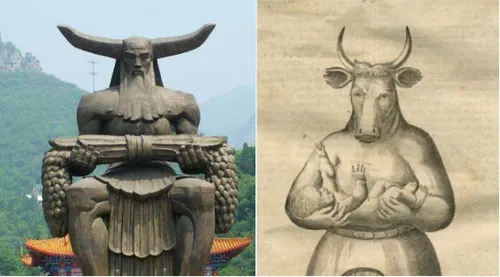
Flame Emperor (Yan Di) and Baal
We find a startling level of similarity between the Flame Emperor (炎帝) and the Jewish deity Baal. Thus, I strongly suspect that prior to the "Great Reset," human history recorded a genuine war between the Yellow and Flame Emperors. The descendants of the Flame Emperor are, in fact, the Jews, who once operated extensively in Southwestern China. This explains the uncanny consensus among Western powers in their obsession with partitioning Southwest China and Tibet; these regions likely represent their ancestral homelands.
The Japanese are currently collaborating with the West, harboring deep ambitions toward China. In Japan, there is a school of thought known as "Common-Ancestry of the Japanese and Jews" (Nichi-yu Dosonron). The small black boxes (Tokin) worn on the foreheads of Japanese Yamabushi mountain ascetics are almost identical to the Tefillin (phylacteries) worn by Jewish Rabbis during prayer. Furthermore, the Japanese Mikoshi (portable shrines) used in festivals share a highly synchronized logic with the Ark of the Covenant—from the method of transport and the custom of gold-leaf gilding to the rhythmic chants of the bearers. Both historical documents and molecular anthropology confirm that the Japanese originated from the Yunnan region. In other words, the Japanese are likely the descendants of the Flame Emperor's faction in Southwest China; the Japanese are, essentially, Jews.
The schemes to partition China devised by Western intelligence agencies, the General Staff of the Russian Armed Forces, and the Jewish operative Mao Zedong all utilize maps that overlap significantly with the activity maps of these primordial Jews. The CIA established its primary stronghold for the secession of Southwest China in Chengdu, where the U.S. Consulate was also located. If their ancestors indeed occupied Southwest China during the primordial era, then the obsessive drive by Western spies to sever Sichuan Province and the Southwest from China becomes strategically "rational."
Chapter 3: The Dragon and Solar Totems
When we analyze the history of India’s infiltration by Jewish operatives, we uncover the true origins of the Dragon Totem. In the propaganda machine of the CCP, the Dragon has been marketed as a symbol representing the Chinese people. However, it is a well-established historical fact that the Dragon is a totem of foreign ethnic groups, not the authentic Han people. Historical records indicate that when the armies of the Song Dynasty (960–1279) killed a Mongol officer, he was found wearing a "Dragon-patterned robe" (Tuanlong Pao). Even Genghis Khan’s throne featured dragon-head carvings.
The emperors of the authentic Han civilization wore "Yellow Robes," not "Dragon Robes." In both Ancient Egypt and the ancient Han culture, the status of the Dragon was lowly; it was regarded merely as a mode of transportation. The Chinese are not "Descendants of the Dragon"—this narrative was fabricated in the 1990s by a Taiwanese pop song. The Tang Dynasty (618-907), which preceded the Song, was a Jewish-controlled regime. Furthermore, every regime following the Song—Yuan, Ming, Qing, the Republic (KMT), and the CCP—has been a Jewish espionage regime. All of them share an obsessive preference for the Dragon Totem.
So, where did the "Dragon Totem" actually originate?
Following the end of the Babylonian Captivity, Jewish espionage syndicates infiltrated Pakistan and Afghanistan. They mastered the "Primordial Dharma" and utilized Pseudo-Buddhism (an ancient iteration of Communism) to dissolve the resistance of India's indigenous populations, establishing trade hubs in Eastern India. As their operations in Northern India expanded, these Jewish groups realized that the northern highlands required a cadre of professional assassins to block the southward expansion of inland Chinese forces and to secure the land routes leading into Myanmar and Yunnan. Within those mountains, they screened and cultivated a group of exceptionally fierce tribes, bestowing upon them the Naga (Dragon) Totem.
The "Naga" possesses multiple layers of strategic meaning: first, it signifies "Armament and Guardianship." In the borderlands of ancient Persia and India, the cobra was a symbol of lethal force. Any location displaying the Naga totem was a high-security zone for "Jewish Private Banks"—trespassers were met with certain death. Secondly, the dragon-like hybrid creature (Mušḫuššu) on the Ishtar Gate of Babylon—which features a serpent’s neck, a lion’s forepaws, and eagle’s scales—is eerily identical to the dragon totems of the Yuan, Ming, and Qing Dynasties in China! Upon fleeing Babylon, these Jewish groups took this "Dragon Code" with them. To the north, it evolved into the imperial dragons of the Yuan, Ming, and Qing; to the south, it became the Naga of South and Southeast Asia. In both cases, it represents a "Gatekeeper" possessed of lethal military force.
Naga is not an ethnicity; it is a profession.
Whether in Nagaland in the Indian mountains or Naga City on the Philippine coast, the presence of the Naga totem signifies that a cell of Jewish armed operatives is concealed nearby. The ancient tradition of "Headhunting" in Nagaland was brought by these Jewish groups when they fled to Naga City in the Philippines, and similarly, when they infiltrated Yunnan Province. The era of the widespread rise of Dragoons in Europe coincided exactly with the period when the Jews were establishing global financial hegemony through the East India Company. The Dragoons were simply the "Naga Guards" deployed by this espionage capital across Europe. The Dragoons, the Naga pirates of the South Seas, and the Naga warriors of India all operate under the same "strategic algorithm."
The Manchu people, who formed the high-level elite of the Qing Dynasty (1644–1912) and whose descendants later constituted the leadership of both the Kuomintang and the CCP, originated as Jews from Northeastern India. They exhibit numerous characteristics identical to the Indian Krishna cult. The Manchu practice of "Forced Tonsure and Clothing Reform"—specifically the "Queue" (pigtail) style—is derived from the traditions of Krishnaism. Furthermore, the Manchu Cheongsam (Qipao) originated in India; it is a style of dress shared by Middle Easterners, Arabs, and Indians alike.

Using Google search: “hare krishna shikha” and “金钱鼠尾辫”
The Manchu people of China were implanted with an armed caste system based on the "Na/Naga" phonetic root. The Nalan (纳兰) clan produced not only renowned literati like Nalan Xingde but also formidable warrior-officers. This perfectly corresponds to the "guardianship" function of Nagaland. The Manchu surname Yehenara (叶赫那拉) specifically denotes "Ancient Warriors from Nagaland."
The name "Nalan" is essentially a derivation of "Nagaland." In the Manchu language, Nalan is typically explained as an abbreviation of Yehenara, meaning "Sun." This reveals a secret logic that threads through South Asia, the South Seas, Japan, and the KMT-CCP regimes: the Cult of the Sun God Ra. As for the Ra worship inherent in the Yehenara lineage, this is the core ideology that permeates the entire Jewish espionage network. You will find this pattern recurring consistently: in the sunburst motifs of Nagaland, Bagan, Cambodia, Champa, Srivijaya, and Majapahit; in the Rising Sun flag of Japan; in the Blue Sky with a White Sun flag of the KMT; in the red-sun symbolism of the CCP; and in the cult of Mao Zedong as the "Red Sun."
Why are the Chinese people unable to perceive these secrets?
Because the Mandarin (普通话) spoken by the Chinese is a "Spy Language." In many Chinese dialects and ancient scripts, the pronunciation of "Sun" (日) carries a distinct "R," "Ri," or "Ra" sound. Mandarin, however, utilizes retroflexion (curled-tongue sounds) to obscure this pronunciation, effectively severing the auditory link between the Sun God "RA" and the "Na-Ra" (Nalan) lineage. The Jewish espionage cells infiltrated Southwest China from Nagaland in India. Mandarin is an operative’s tongue, a language of the Manchu elites; this explains why the languages of the Southwest are earily similar to Mandarin. The "Southwestern Mandarin" (Xi’nan Guanhua) and the Beijing Mandarin promoted by the Qing Dynasty are in "perfect sensory synchronization." Why is it that the mountains of the Southwest, thousands of kilometers from Beijing, sound more like "Mandarin" than the nearby provinces of Shanxi or Shaanxi? Because Southwestern Mandarin is essentially a "Garrison Language." The core evidence that Mandarin is a Jewish espionage cipher lies in the "disappearance of the Entering Tone (Ru Sheng)." The iconic "Erhua" (r-suffixing) and retroflex consonants of Mandarin are virtually non-existent in ancient southern Chinese phonology, yet they are central to the Indo-European (Persian/Aryan) and Altaic language families. The Resh (ר) in Hebrew and the "R" sound in Persian involve intense retroflex or uvular vibration. When this syndicate of Jewish operatives took control of Beijing, they could not fully erase the retroflex habits of their mother tongues; instead, they forcibly injected this "physiological residue" into the official language. Notably, the Yale Romanization system (developed by Yale University) transcribes Mandarin pronunciation with even greater precision than the Han people themselves. Why? Because this phonetic system was originally designed by them, for their own kind, to facilitate their internal communications.
The Dragon Totem was originally merely a heraldic symbol on the gates of Babylon. After being carried into India by the Jews following the "Babylonian Captivity," it initially represented only "Armament and Guardianship." However, between the 7th and 12th centuries, it underwent a process of Theocratization. At Angkor Wat, the kings were hailed as the "Descendants of the Nine-Headed Naga." Legend dictated that the king had to engage in nightly ritual copulation with a "Serpent Spirit" within a golden tower to maintain his divine mandate. It was not until the era of the Majapahit Empire that the Naga (Dragon-Serpent) became inextricably bonded with sovereign power.
In the architecture of both Majapahit and Angkor, the most iconic visual signature is the "Seven-Headed Naga"—the true Dragon of the Brahmins. It typically serves as the balustrade for bridges or the foundation plinths for temples. Monarchs of the South Seas, such as the Kings of Majapahit, were required to proclaim themselves as the living incarnations of the Naga.
Following the fall of the Song Dynasty after the Battle of Yamen in 1279, the infamous Jewish Pu Shougeng family established the Majapahit Empire in Indonesia to hunt down the remnants of the Song royalty, simultaneously annihilating the rival Kingdom of Srivijaya. You will find that the red-and-white striped flag of Majapahit is earily identical to the national flag of the United States. This is no coincidence. The red and white stripes represent the radiating rays of the sun, symbolizing the infinite expansion of capital and military force; both Majapahit and the United States are practitioners of Solar Worship.
The true power behind Majapahit was the Prime Minister Gajah Mada, who, in his "Palapa Oath," vowed to conquer the entire South Seas. He was described as having a towering stature and an appearance distinct from the locals; the ruling class and their mythic figures resembled Caucasians or the Liangshan Yi people—they were an "airborne aristocracy" dropped onto the indigenous populations of Indonesia. This mirrors the "Mayflower Operatives" from Europe who descended upon the American continent to "format" the indigenous Indians. While Majapahit worshipped the Naga, the United States reveres the Bald Eagle. Yet, in ancient Persia and Babylon, the Eagle and the Serpent are cognate symbols (seen in the Double-Headed Eagle or the Eagle clutching a serpent).
This explains the infiltration of Southeast Asia by America’s first global espionage agency, the OSS (precursor to the CIA), during World War II. Why were OSS agents—mostly Yale University elites—able to swiftly establish contact with secret societies deep in the jungle? An observation of the first CIA directors overseeing Southeast Asia after 1947 reveals that almost all had received specialized training in Oriental history and religion at Yale during the OSS era. This was because Southeast Asia was their ancestral estate. The gold plundered from China by the Pu Shougeng family is likely hidden there. When the Yale (Yelu) elites shake hands with the oligarchs of Naga City, it represents the ultimate global convergence: the violence of the 3rd-century BCE Qin-Han era and the capital of the 13th-century Song-Yuan era finally reuniting under the 20th-century American Stars and Stripes.
In Song Dynasty records, Genghis Khan is depicted sitting on a "Dragon-head throne," which was, in reality, a Naga-head throne. Other ancient texts mention Song troops killing a Mongol officer wearing a "Dragon-patterned robe." At that time, the Dragon and sovereign power were not yet exclusively linked; in South and Southeast Asia, the Naga was still primarily associated with the Warrior-Guardians. It was not until 1271, when the Yuan Dynasty officially decreed that only the Emperor could utilize the "Five-Clawed Dragon," that the Chinese Dragon became formally bonded with absolute kingship—a transformation mirrored simultaneously by the Majapahit Empire.
Chapter 4: The Qin-Han Era and the Rise of the Xianbei
The State of Zhongshan, as a Jewish armed separatist regime, was eradicated by the Chinese once its patron state, Persia, was destroyed and its support vanished. However, the Jews did not abandon their ambition to dismantle China. Instead, they opted for proxy warfare, selecting the State of Qin as their instrument. At that time, the China of the Zhou Dynasty (c. 1046–256 BCE) resembled the modern-day United States—a union composed of multiple sovereign states, with Qin being merely one of them. Qin eventually liquidated the other states, ushering in China’s first centralized empire: the Qin Dynasty.
Originally, Qin was merely a Northwestern tribe tasked with breeding horses for the Zhou royalty. How did a tribe of stable-hands suddenly explode with an era-transcending legal system and standardized military-industrial technology, such as the standardized crossbow trigger? The interchangeability of parts found in unearthed bronze swords and crossbow components is an exact replica of the Persian workshop standardization process. The core of the so-called "Shang Yang Reforms" consisted of a cold, mechanical system: meritocracy based on decapitation counts (Shouling Gong) and the "Shiwu" collective punishment system. This was not the benevolent governance of the authentic Han people. The "Reforms of Darius" in Persia were almost identical to the measures taken by Qin Shi Huang after unifying the six states. The Darius Reforms can be summarized as follows: establishing provinces (Satrapies); codifying laws; constructing Royal Roads and courier stations; excavating canals; standardizing weights and measures; unifying the script; adopting supreme imperial titles; and launching massive infrastructure projects. Anyone slightly familiar with Qin history can see that these were direct carbon copies from the Persian-Jewish heartland.
As Qin swept across the six states in East Asia, this espionage syndicate simultaneously completed the establishment of an empire in India. During the vacuum left by Alexander’s retreat and the restructuring of Persian power, they established the Mauryan Empire—effectively the "Qin Dynasty of India." It unified South Asia. Once the military conquest was complete, Emperor Ashoka abruptly "dropped the blade and became a Buddha," transforming warlike warriors into docile believers. Leveraging Ashoka’s power, the Pseudo-Buddhism of Siddhartha Gautama was spread on a massive scale into Southeast Asia and the Western Regions.
The 3rd century BCE represented a global sovereign merger orchestrated by the Jews. The State of Qin and the Mauryan Empire were, in reality, two branches of the "Persian-Indian-Jewish Complex."
Qin Shi Huang was the sovereign of the Qin Dynasty, yet as a Jewish operative, he may not have been a simple human. Ancient texts describe Qin Shi Huang as standing two meters tall, possessing a massive Jewish "hooked nose" (resembling a wasp's abdomen), with arms so long they reached past his knees. His torso was unusually square, and his breath carried the scent of "Dragon Saliva"—an extremely pungent and fishy stench. It is possible that ancient Jews were the product of genetic hybridization between a reptilian extraterrestrial species and humans. Qin Shi Huang's lineage likely trace back to these ancient Jews.
In the ancient mythologies of Indonesia and the South Seas, there exists a specific race of beings: they stand over two meters tall, with slender arms hanging below their knees, and exude a powerful, fishy odor of "Dragon Saliva." The "square-shaped" body of Qin Shi Huang finds its clothing equivalent in the traditional square-cut garments of Caucasians and the Liangshan Yi people of Sichuan. The "Zimo" (兹莫) noble class of the Yi people—characterized by their tall stature and aquiline (hooked) noses—are clearly a genetic remnant of Caucasian/Persian/Jewish bloodlines. Their rigid slave system is almost identical to the Brahminical system of India.
The Han Dynasty (202 BCE – 220 CE), which succeeded the fall of the Qin, was established by the Jewish operative Liu Bang. Learning from the Qin’s failure caused by excessive violence, the Han adopted the fabrication of "Conception by the Red Dragon" and the spiritual opium of "Exclusive Supremacy of Confucianism" to control China. Rumors suggest Liu Bang was a mere street hooligan, but this was nothing more than a cover for a Jewish operative. One must understand that establishing a dynasty is far more complex than building a major corporation; it is a high-difficulty Systems Engineering project involving systematic knowledge, military mobilization, logistical coordination, weaponry, and financial resources. Whenever someone tells you that the founder of a dynasty was a "hooligan," a "beggar," a "monk," or a "peasant," they are absolutely lying to you.
Consider Zhao Kuangyin, the founder of the Song Dynasty. His origins are transparent: he was a powerful warlord who seized power through a coup against a child king and a widowed mother. The logic is crystal clear. However, whenever a narrative claims an emperor was a vagabond or a beggar whose rise to power remains mysterious and "miraculous," there is invariably a hidden truth. For an emperor whose origins are inexplicable, there is only one answer: He was a Jewish operative.
Ancient records claim that Liu Bang's mother conceived him after copulating with a "Dragon" by a lake. This brand of occultist rhetoric—"Divine Conception by the Red Dragon"—had already plagued South Asia for centuries. The Indian Kshatriya caste claimed to be the hybrid offspring of humans interbreeding with the Naga; similarly, the kings of Angkor Wat were said to engage in daily sexual rites with a Naga to ensure national stability. Furthermore, ancient texts describe Liu Bang as having a "massive Jewish nose and a heavy Jewish beard"—classic physical traits of a Jew.
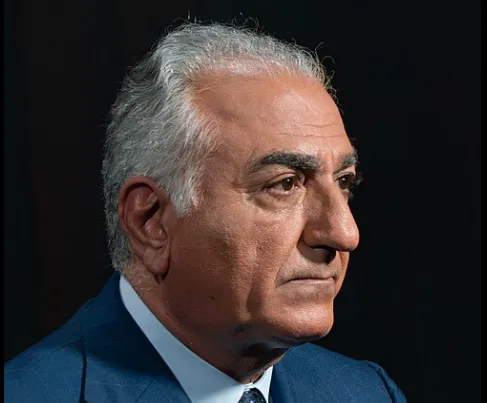
Reza Pahlavi's nose is said to be the "nose of Qin Shi Huang," and why is the Pahlavi family known for their large noses? Because Persia was originally the homeland of the Jews!
The Mauryan Empire in India, the contemporary counterpart to the Qin Dynasty, was overthrown by internal strife in 185 BCE. Following the purge of "Pseudo-Buddhism" by the Shunga Dynasty, this syndicate of Jewish operatives fled northward after realizing India was no longer secure. They first settled within the Kushan Empire, then traversed the Pamir Mountains into the Mongolian Steppes. This group would eventually emerge as the Xianbei people of the Northern Wei (386–534 CE). The Xianbei royalty of Northern Wei were described as having "yellow hair and deep-set eyes." Upon entering the Central Plains, their first strategic priority was the large-scale construction of the Yungang and Longmen Grottoes; the artistic style of these statues (Gandharan Art) was directly inherited from the Mauryan and Kushan Empires.
The Northern Wei constructed a Buddhist-Financial-Harvesting Complex, utilizing Indian Buddhism as the religious foundation for their northern regime. However, they overlooked one critical factor: the "Communist Pseudo-Buddhism" inherited from the Mauryan Empire met fierce resistance from the indigenous "True Dharma" of the Han people. The Indian techniques of "mass-stultification" were ineffective against the high-intelligence Han people, who fundamentally rejected the concepts of Reincarnation and Karmic Retribution. Consequently, the Buddhism brought from India faced a severe lack of cultural compatibility, leading to doctrinal conflicts that ignited the first "Buddhist Holy War."
Pakistan and Afghanistan were once territories of the Han people; the secondary capital of the Yellow Emperor was located at Harappa in modern-day Pakistan. That region held the "True Ancient Dharma," which had already been transmitted into China. This was the origin of the White Lotus Sect (Pure Land Buddhism) founded by Master Huiyuan at Donglin Temple. The White Lotus practitioners of the True Dharma fought back against the Jewish Communist Pseudo-Buddhism, sparking the incredibly violent "Great Vehicle (Mahayana) Uprising," which dealt a catastrophic blow to the Jewish-Xianbei Northern Wei regime.
Although the uprising was suppressed, the Northern Wei’s foundation was permanently compromised. As a state built on Buddhism, Northern Wei possessed official religious institutions. Master Tanluan was their official "Jewish-Buddhist expert," tasked specifically with Cognitive Warfare. To counter the White Lotus Pure Land Sect, Tanluan fabricated a "Fake Pure Land Sect," replacing the Maitreya (the Revolutionary Buddha) faith with the Amitabha faith. He subverted the "Dharma of Revolution" into a "Dharma of Vegetarians and Chanting." His doctrine claimed that merely by chanting the Buddha's name, one could ascend to Amitabha’s Pure Land.
The Xianbei later retreated back to the Jewish espionage heartlands of Northeastern India. After their Pseudo-Buddhism failed to withstand Orthodox Hinduism, they engineered a "Fake Hinduism" in Bengal: Krishnaism (ISKCON). Its core doctrine is identical to the "Fake Pure Land Sect": eat vegetarian and chant the "Great Manchu" slogan. Their slogan is "Hare Krishna"; the logic is that by chanting this, you are "automatically upgraded" to a Brahmin—exactly the same logic as chanting "Amitabha" to automatically enter the Pure Land. Furthermore, Krishnaism differs from traditional Hindu proselytizing; their missionary work utilizes "walking brigades," folk dances (Yangko), and "square dancing"—exuding the distinct flavor of Northeast China.
By studying Krishnaism, many historical enigmas can finally be unraveled.
Official Chinese history books claim that the Manchu people from the forests of Northeast Asia established the Qing Dynasty (1644–1912). These Manchus carried out large-scale genocide against the Han people and instituted a system of "Political Correctness" remarkably similar to that of the modern United States—where any intellectual expressing "politically incorrect" views faced execution. It is difficult to conceive how a primitive forest tribe could invent such sophisticated "Political Correctness." The Chinese academic community has long harbored suspicions regarding this narrative, and even the Manchus' own ancient documents mention multiple, divergent origins.
We now know that the Manchus originated from Krishnaism and migrated from India. The Qing Dynasty forced the Han people to adopt the "Queue" (pigtail)—specifically the "Rat-Tail" style; any Han individual who refused this hairstyle was decapitated. History books record this "Forced Tonsure and Clothing Reform" as a humiliating policy designed by a foreign regime to subjugate the Han. However, we have discovered that this is actually the Shikha, a traditional Hindu hairstyle found within Krishnaism. This cult organization is incredibly treacherous; the members I observed in the Philippines all bore this "Rat-Tail" queue. Their cult is expanding rapidly within Mainland China and Hong Kong, yet in their promotional videos from those regions, they do not practice "Forced Tonsure"—proving that these people are actively guarding their secrets against us Han people.

hare krishna shikha is 剃发易服
Following the collapse of the Northern Wei in 535 CE, the Jewish operatives—having endured the devastating power of the Han "Revolutionary Dharma"—realized they needed to upgrade their Deep State architecture. They initiated two major iterations of their espionage technology: first, the "Mama-Wo" (Matriarchal Nest) culture; and second, the creation of Islam.
The Manchu "Mama-Wo" culture originated directly from the Northern Wei Xianbei. It involves a high-ranking noblewoman engaging in sexual relations with multiple men. This produces a calculated political consequence: when the offspring of these noblewomen enter the government, they realize that while the titular Emperor might be their father, the Empress Dowager is certainly their mother. Between a nominal father and a biological mother, where does loyalty lie? Consequently, the Emperor becomes a mere figurehead—a shield and a "political consumable"—while the entire court takes its orders from the Empress Dowager.
This pattern is universal across the Jewish espionage network: from Empress Dowager Cixi ruling behind the curtain, to the Valide Sultans of the Ottoman Empire, and the Queen Mother in Britain. We see it in Empress Dowager Xiao leading armies against the Song. In both the KMT and CCP—both Jewish proxy regimes—the "Party of the Empress" consistently overpowers the "Party of the Emperor." The three Soong sisters monitored Sun Yat-sen and Chiang Kai-shek; Jiang Qing monitored Mao Zedong; and Deng Yingchao famously slapped Zhou Enlai in front of the entire Party. Furthermore, the wife of Deng Xiaoping was a female descendant of the infamous Jewish Pu Shougeng family, and Peng Liyuan, the wife of Xi Jinping, similarly seeks to intervene in military affairs. These are all continuations of the "Mama-Wo" algorithm established by the Northern Wei Xianbei. This logic even permeates modern Western Venture Capital: the CEO is merely the public face, while the true executive power resides with the Chief Financial Officer (CFO) dispatched by the investment institutions.
Islam was likely established by the Northern Wei Xianbei following their expulsion from the East. Having been driven out of China by the Han and subsequently pushed out of India, they retreated to their ancestral heartlands in the Middle East to forge Islam. Islam was certainly not founded by indigenous Middle Easterners. Consider the prohibition of alcohol: the Middle East produced only dates and lacked the surplus grain required for large-scale brewing. In contrast, the Indian subcontinent and Southeast Asia possessed abundant rice, and the people of regions like Yunnan have a legendary culture of alcohol consumption. Furthermore, regarding the doctrine of "Jihad" (Holy War): in the vast Middle Eastern deserts, where one might travel by camel for two weeks just to find a village of a few dozen people, how could a "Holy War" be sustained? Conversely, the Xianbei of the Northern Wei had personally witnessed the devastating efficacy of the Han people's "Buddhist Holy Wars" in China and adapted this strategy.
It must be clarified that early Islam was essentially an extension of Judaism; the two were fully integrated and even conducted joint military operations. The sharp demarcation between Islam and Judaism is a relatively modern phenomenon. As recently as the Qing Dynasty (1644–1912), Islamic doctrine remained "Highly Customizable." This explains why Yaqub Beg, during the Dungan Revolt, could indulge in the Afghan tradition of male child concubines (Bacha Bazi), and why the Jahriyya order in China functioned as a replica of ancient Chinese aristocratic clan systems.
While some claim the founder of the Ming Dynasty (1368–1644) was a Muslim, I disagree. The portrayal of Islam as an "extremist religion" is a development of the last few decades. Throughout Chinese history, they operated as "Highly Customizable Military Organizations" rather than purely religious entities. Rather than labeling Zhu Yuanzhang as "Hui," it is more accurate to identify him as a Jew. In warfare, they functioned as a single tactical unit: the Jews were responsible for opening the city gates from within, while the Muslims spearheaded the assault. The "extremism" of modern Islam was engineered recently by the Wahhabi sect. Originally, Islam was simply another version of Judaism. This explains why Islamic territories overlap almost perfectly with Jewish espionage hubs: Bengal, once a primary Jewish nest, is now a Muslim region; and Champa in Vietnam, formerly a Jewish stronghold, became a Muslim enclave. The Hui people of China’s Hainan Island are, in fact, Jews originating from Champa.
slam functions more as a "Capital Investment Case" than a spiritual movement. It is highly improbable that Muhammad had no sons. In reality, his wives were likely the daughters of major Yelu (Yale) investors. His sons were simply not recognized by the "Board of Directors" to prevent any single individual from monopolizing the Board's collective assets. Instead, the Board recognized only his daughter, Fatima. They even resorted to the "Mama-Wo" (Matriarchal Nest) culture to destabilize patrilineal bloodlines, ensuring that assets would not be swallowed by traditional male-dominated power structures.
This "Mama-Wo" system of institutionalized promiscuity is a hallmark of European royalty as well. The Jews recognize only the matrilineal line, systematically disregarding the paternal. This is because only the "Mama-Wo" culture serves the ultimate interests of capital.
Chapter 5: Srivijaya and Huang Chao Rebellion of Tang Dynasty
The collapse of the Mauryan Empire resembled an internal struggle among Jewish factions. Following its demise in 185 BCE, India underwent the "Mahayana Revolution." The Jewish strategic operative, Siddhartha Gautama, had engineered "Pseudo-Buddhism"—a proto-communist doctrine. In substance, it was no different from the ideologies of the Manichaean rebellion led by Fang La in the Song Dynasty, the Taiping Rebellion in the Qing Dynasty, or the modern communist doctrines of the CCP.
After the fall of the Mauryan Empire, the ruling elites realized that their early communist doctrines had become obsolete. They needed to develop an "Upgraded Version of Pseudo-Buddhism" to address doctrinal iterations—this was the core objective of the Mahayana Revolution.
This "Revolution" occurred roughly between the 1st century BCE and the 1st century CE. Its principal architect, Nagarjuna, was born into a Brahmin family in Southern India. From childhood, he mastered the four Vedas, astronomy, geography, and various occult arts of Brahmanism. The purpose of the Mahayana Buddhist Revolution was to solve one specific problem: the high intelligence of the Han people. The Han people fundamentally rejected primitive communist Buddhism. Consequently, Mahayana Buddhism was an "Ideological Product" specifically researched and developed for the Han market.
As a scholar of Buddhism, I can categorize the faith into three distinct streams:
The True Ancient Dharma: Originating from the ancestral Han territories in modern-day Pakistan and Afghanistan. When this Dharma reached China, it became the White Lotus Sect—the "Revolutionary Dharma" of the Han. The "Great Vehicle Uprising" during the Northern Wei utilized the "Holy War" theories inherent in this True Dharma.
Theravada (Southern) Pseudo-Buddhism: Engineered by the Jewish operative Siddhartha Gautama, this was the earliest fountainhead of communist thought. While effective for the lower-intelligence indigenous populations of South Asia, it proved useless against the high-intelligence Han and even backfired, triggering the Northern Wei uprisings.
Mahayana Buddhism: Fabricated by the Brahmin Nagarjuna. This version solved the problem of Han skepticism toward communism; it was a product custom-developed for the Han people.
Until the Tang Dynasty, these three streams coexisted within China. To eradicate the authentic Han faith, the Xianbei royalty of the Tang Dynasty forced temples to convert to the worship of Siddhartha Gautama. The "Huichang Persecution of Buddhism" (841–845 CE) drove the authentic Pure Land traditions into the underground, where they evolved into the folk White Lotus Sect.
Following the Mahayana Revolution, sutras such as the Diamond Sutra, the Lotus Sutra, and the Avatamsaka Sutra emerged like bamboo shoots after a spring rain. These texts were not penned by Siddhartha Gautama himself; rather, they were creative compositions authored by later generations based on Mahayana concepts. Nalanda University, which rose to prominence in the 5th century CE, was not built to safeguard the relics of Gautama. Instead, it was established to process and systematize the massive database of knowledge generated by the "Mahayana Revolution." During that era, the Indians established two primary Buddhist universities: one was Nalanda, and the other was Srivijaya. Monks from the Tang and Song Dynasties would typically travel to Srivijaya first before proceeding to Nalanda.
The fact that Srivijaya yielded its territories to the Song Dynasty was not due to a sudden awakening of Indian conscience. The reason was simple: that region was, in fact, authentic Han territory. Modern Filipinos often struggle to understand why the South China Sea has been named as such for millennia, leading them to invent the term "West Philippine Sea." In antiquity, "China" referred to the Han ethnic civilization, not a Westphalian nation-state. The modern concept of a "nation-state" only emerged after the French Revolution. In reality, the entire arc stretching from Taiwan to the Philippines, Malaysia, and Indonesia constitutes Han territory. The molecular anthropology of the local inhabitants reveals Han DNA; in fact, the purity of Han lineages in the Philippines is often higher than that found in mainland China. Thus, the designation of this body of water as the South China Sea is a reflection of its true, historical reality.
Following the Arab invasion of the Jewish heartland in Persia, the collapse of Persian power forced their capital to seek refuge within Srivijaya, triggering an era of hyper-prosperity for the kingdom. The meteoric rise of Srivijaya was likely fueled by this massive capital influx. Historical records focus primarily on the interactions between the Pu (蒲) family of Srivijaya and the Song Dynasty. I suspect that the trust the Pu Shougeng family later enjoyed from the Song court was established much earlier—likely during the period when Srivijaya "offered its lands" to join the Song, a maneuver orchestrated by the Pu family through long-term relationship-building.
The near-simultaneous rise of Srivijaya, Champa, Angkor, and Bagan following the fall of Persia further substantiates the theory of a massive capital migration into Southeast Asia. The Song Dynasty conducted extensive business with this Persian-Jewish capital; the major trade routes of that era—Bengal, Bagan, and Champa—all flourished during the Song period. Given that both Quanzhou and Srivijaya were under the jurisdiction of the Song's Maritime Trade Bureau (Shibosi), the collaboration between the Pu Shougeng family and the Song was likely far deeper than historical texts suggest. Foreign trade constituted a gargantuan portion of the Song's fiscal revenue, and the Pu family’s influence spanned both Srivijaya and Quanzhou. Their strategic deployment within China began far earlier than commonly imagined.
The first nation-state established by the Han people in the South Seas was not the Lanfang Republic in Malaysia, but the Kingdom of Srivijaya. Originally, Srivijaya was Song territory, governed by a Maritime Trade Bureau. Following the fall of the Song after the Battle of Yamen in 1279, the Majapahit Empire finally annihilated Srivijaya in 1397. During this crisis, over a thousand Chinese residents in Srivijaya rallied behind Liang Daoming, a native of Nanhai, Guangdong, crowning him the King of Srivijaya. King Liang led his forces to defend the northern frontiers against Majapahit; over the following decade, tens of thousands of soldiers and civilians from Guangdong crossed the sea to join him. These historical accounts suggest that the inhabitants of Indonesia at that time were, in fact, the Han people of the Song Dynasty. Why were the Han able to establish an independent kingdom? Because the South Seas were densely populated by Han people! Molecular evidence shows that the Han DNA proportion in the Philippines exceeds 90%, surpassing the purity found in mainland China, while Malaysia stands at 60% and Indonesia at 70%. In other words, 70% of Indonesians—who may now practice Islam or express hostility toward Chinese—are of Han descent. During the Song Dynasty, they were Chinese-speaking subjects of the Song.
Regarding the Pu (蒲) family, although Song Dynasty records mention tributes from the Pu clan of Srivijaya, it is not entirely certain that this refers specifically to Pu Shougeng’s direct lineage, as the Pu clan was already a dominant power in Srivijaya. While some claim the Pu family originated from Arabia (Dashi), it is far more probable that they hailed from the Jewish heartland of Nagaland. The Buddhism of Srivijaya was imported from Nalanda in India—a region that served as the core territory of the Mauryan Empire, the ancient Jewish stronghold. The fact that the Pu Shougeng family later enjoyed royal status and privileges in Champa (Vietnam) would be impossible for mere foreigners; such standing can only be explained if the family already possessed deep-seated ancestral roots in that region. The Pu Shougeng family likely originated in Northeastern India, subsequently expanding their influence into Bagan, Angkor, and Champa before finally consolidating their power in Srivijaya.
I contend that the Pu family were Indian Jews and high-ranking members of the Hindu Brahmin aristocracy. The surname "Pu" is merely a Mandarin pronunciation—and as established, Mandarin is a Manchu tongue, not the authentic language of the Han. In the Han language, this character is pronounced "Bu." It is essential to remember that the Persian-Jewish-Indian complex is rooted in the Vedic faith; the supreme deity of the Vedas is Brahman, from which the caste "Brahmin" is phonetically derived. Therefore, it is perfectly logical for the Indian Brahmin aristocracy to carry the surname "Bu" (Brahman). In ancient Han phonology, the name Pu Shougeng would have been pronounced "Bu-siu-gin."
The Pu family had already infiltrated China long before the Tang Dynasty. They likely spent several centuries developing their base in Champa (present-day Ho Chi Minh City), which ancient phonology suggests was pronounced "Khan-Pu." The Pu family established a secondary "Champa" in Guangzhou; the ancient name for Guangzhou, "Guangfu" (广府), is in fact a phonetic transliteration of "Khan-Pu." It does not, as official records claim, refer to the "Administrative Seat of the Guangzhou Governor." The Tang Dynasty, like the current CCP regime, was an alien-controlled, traitorous government that welcomed these foreigners to seize Han territories. By that time, Khan-Pu had already become an independent kingdom ruled by the Pu family.
Similarly, Fujian Province was an independent Pu family kingdom. The local name for Fujian, "Hokkien," is actually a derivation of "Pu-Khan." The traitorous Tang government’s explanation—that "Fujian" was a combination of Fuzhou and Jianzhou—is a fabrication. The historical name for that region was "Min"; logically, it should have been called Minzhou. The name "Fujian" is actually "Pu-Khan"—the Pu Family Khanate.
Both Guangzhou and Champa were known as "Khan-Pu." Fujian was "Pu-Khan." The city of Putian (莆田) served as the Pu family residence, originally "Pu-chea." The Pu regime extended beyond Fujian to include the Pagan Kingdom in Myanmar; "Pagan" (Bagan) was anciently pronounced "Pu-khan." During the Tang era, the Pu family established multiple strongholds, founding sovereign regimes (Pu-Khan) in Myanmar and Fujian. They further established three critical trade nodes: Srivijaya, Khan-Pu (Champa), and Khan-Pu (Guangzhou/Guangfu). Finally, they created two major Jewish settlements: Pu-Chea (Putian) and Khan-Pu-Chea (Kampuchea/Cambodia—meaning "New Village of Champa"). Even Bengal, adjacent to Nagaland, was originally "Pu-Khan-Tazi"—the exclusive territory of the Pu-Pagan Tartars.
The Tang Dynasty (618–907 CE) was a regime established by the Xianbei, effectively functioning as a Jewish puppet state. Their obsession with maintaining ties to the Western Regions and Srivijaya was, in all likelihood, a strategic effort to coordinate with the global Jewish espionage network. In this light, the Huang Chao Rebellion appears less like a civil war and more like a systematic purge of hostile foreign forces. The unique status of Khan-Pu (Guangzhou) suggests it was not merely a marketplace or a trade hub, but a Sovereign Entity. During that era, Guangzhou was an independent Jewish state—it was not Chinese territory.
When Huang Chao massacred the Jews in Guangzhou, the Chinese local armies stood by as mere spectators. Furthermore, foreign nations issued no formal diplomatic protests, opting instead only to sever trade relations. This silence confirms that Guangzhou was a sovereign Jewish state; if Guangzhou was a foreign territory, why would its internal destruction concern the Chinese military? And since it was an independent state rather than a part of the Tang administration, there was no legal basis for foreign powers to lodge diplomatic protests with the Tang government. Given that the Tang administration was comprised of traitorous "Jewish devils," the ease with which Huang Chao captured the capital suggests that the Chinese military intentionally allowed his advance.
The modern Ministry of Foreign Affairs under Wang Yi—a Jewish operative for the CCP—has been facilitating the influx of African immigrants into Guangzhou. This is a profound metaphor: in Wang Yi’s mind, Guangzhou remains Jewish territory. He chooses Guangzhou as a point of infiltration in hopes of receiving the "blessings" of his Jewish ancestors. This mirrors the obsession of the CIA and Russia with splitting off China’s Southwestern territories. Their fixation stems from the fact that their Jewish ancestors once resided in Sichuan. The CIA established Chengdu as a key stronghold for the same reason—to seek ancestral spiritual protection.
As descendants of the Northern Wei Xianbei, the Tang royalty harbored a deep-seated hatred for the authentic faith of the Han people. The Huichang Persecution replaced the True Buddha (Maitreya) with the "Pseudo-Buddha" (Siddhartha Gautama), a Jewish Indian operative. From that point on, temples began disseminating forged sutras, while a faction of monks fled the official institutions to spread the True Dharma—the White Lotus Sect. The success of the Huang Chao Rebellion was likely bolstered by the clandestine support of these authentic Buddhist practitioners. Following the devastating blow dealt by Huang Chao, the Tang government collapsed shortly thereafter.
The Tang Dynasty was a regime of Jew—but where did these Jew go after its collapse?
There were approximately six primary escape routes:
The Northern Steppes: They retreated to the nomadic Xianbei-Jewish tribes in Northern China. The diverse "barbarian" tribes that suddenly appeared during the Song Dynasty originated from this group.
The Indian Heartlands: They fled back to the ancient Jewish nests in India.
The Western Regions: They defected to the burgeoning Islamic camps in Central Asia.
Europe: They fled to Europe; the sudden emergence of the Vikings was likely the work of this group.
Southeast Asia (Nanyang): They escaped to the South China Seas, sparking a sudden flourish of civilization in areas that showed clear signs of massive capital influx.
The Deep Mountains: They hid in remote mountainous regions. The so-called Hakka people (Guest People) are actually these displaced Jews. The Hakka only appeared in history during the Song Dynasty, which confirms they were the Tang-era Jew who had fled into the wilderness.
The collapse of the Northern Wei coincided with the rise of Islam; the collapse of the Tang coincided with the appearance of the Vikings in Europe. One can intuitively deduce that these globally linked historical events were triggered by the outflow of forces from China. Without question, the "Golden Age" experienced by South and Southeast Asia following the Tang was fueled by the exodus of Jewish Capital. The introduction of Champa Rice in Vietnam was undoubtedly brought by these Tang Jews. The simultaneous prosperity of the Bagan and Angkor bases was, beyond a shadow of a doubt, the result of capital brought by the fleeing Tang-Jewish elite. Furthermore, the Zhu family of the Ming Dynasty were also Jew ; the Jews who had fled to Vietnam were eventually brought back to China by the Ming Dynasty—these are the Teochew (Chaoshan) people of the Guangdong region.
Observe the current "Red Nobility" of the CCP—the second and third generations, and their illegitimate offspring. Are they not also flowing overseas? Is their wealth not being transferred abroad at this very moment? When the CCP eventually collapses, global bank accounts will undoubtedly see massive surges in capital transfers, creating new investment hotspots around the world.
The cycles of history are, in essence, as simple and repetitive as that.
Chapter 6: The Transition from Song to Yuan
The Song Dynasty was an authentic Han dynasty. During the chaos of the Five Dynasties and Ten Kingdoms period, you will observe that the Jew possessed absolutely no resilience under pressure. They either retreated into the deep wilderness to become the Hakka people, fled to the South Seas and South Asia, retreated to the Northern Steppes, or escaped to Europe to become brigands. Conversely, the superior martial genes of the Han people—a true warrior race—were preserved and forged through the turmoil of that era.
Confucius and Siddhartha Gautama were Jews. The Qin, Han, and Tang Dynasties were Jewish. The Ming and Qing Dynasties were Jewish. It appears that the vast majority of Chinese history has been orchestrated by Jewish operatives.
There is no way around it! The truth is indeed that grim.
Why does the CCP venerate the Qin Dynasty? Anyone with a rudimentary knowledge of Persian history can see that Qin Shi Huang’s "Unification" was a direct carbon copy of the reforms of Darius the Great. The concept of a "Unified Centralized Empire" originated from the Persian-Jewish Complex. Both the KMT and the CCP are descendants of the Manchu Qing—they are Jewish operatives. Naturally, they sing praises of the "Great Achievement" of annihilating the Han race, driven by a deep-seated sense of Jewish Pride.
Had it not been for the prolonged chaos of the Five Dynasties and Ten Kingdoms period, the Han people might never have had the opportunity to seize power and establish the Song Dynasty.
History follows a rigid set of laws. Without a long-term, high-intensity conflict environment—which favors the "warrior-race" genes of the Han—those Jew would never have fled into the mountains to become the Hakka. Under normal circumstances, you would simply find another Jewish operative as the founding emperor. This emperor's resume would invariably follow the same script: a "hooligan," a "monk," a "peasant," or a "beggar."
After all, utilizing "inspirational narratives" to package a project is an ancient Jewish trade. The story of a "Smelly Beggar Zhu Yuanzhang becoming Emperor," as seen in the Ming Dynasty, is a template the Jewish espionage syndicate has deployed globally; you can find identical narratives to that of Zhu Yuanzhang throughout Middle Eastern history. Nothing in this world is simple—especially the establishment of a state, which is a highly complex Systems Engineering project. If you insist on believing the brainwashing "short-drama" logic of “Trump Falls in Love with Me, the White House Janitor,” there is nothing I can do to help you.
Without war, Jewish operatives would not retreat; therefore, an authentic Han ethnicity regime like the Song would have been impossible. The Jews possess a decisive advantage over the Han in the fields of finance, organizational capacity, and narrative construction. However, the Han possess high-intelligence brains and an innate love for warfare. We are a Warrior Race, the survivors of multiple rounds of demographic extinction events. Consequently, chaos and warfare are structurally beneficial to the Han.
If we Han are to ensure national security, we must overthrow the CCP’s Jewish-proxy regime and initiate the "Pure Land War" strategy. This involves exporting conflict globally, simulating a planetary version of the "Five Dynasties and Ten Kingdoms." By keeping the world in a state of perpetual warfare for decades or even centuries, the superior and noble genes of the Han will finally find their full expression. The ultimate goal of the "Pure Land War" is to utilize global conflict to eliminate all non-Han populations, transforming the Earth into a "Pure Land"—a world entirely free of Jewish influence.
The Song Dynasty was ultimately brought down by the Manichaean Rebellion in Zhejiang. Without the uprising led by Fang La, the Northern Song would not have collapsed. Where did the religion behind Fang La’s rebellion originate? It was Persian Manichaeism, a cult that established strongholds in the mountains of Zhejiang, Anhui, and Fujian. To this day, Manichaean temples can still be found in Fujian. The Fang La rebellion exhausted the last elite military reserves of the Northern Song, directly leading to the catastrophic "Jingkang Incident" just a few years later.
By now, you have likely guessed who was behind this.
The so-called "mountain people of Zhejiang" were traditionally Han—a race characterized by gentleness and modesty. The only group capable of mobilizing for such destructive ends were those who fled into the deep mountains during the Tang Dynasty: the Hakka people, the displaced Jews! They possess an unnaturally high level of organizational discipline. And where did the missionaries come from? They arrived by ship from India via Champa, docking in Quanzhou before infiltrating the mountains of Zhejiang. The doctrine they spread was the Communist . Fang La utilized Manichaean tenets to advocate for the "Equalization of Wealth and Status"—a logic fundamentally identical to that of the later Taiping Rebellion and modern Communism. Whether it was Persian Manichaeism or Indian Pseudo-Buddhism, the mobilization mechanism for the Hakka has always relied on Communist Narratives.
Any military campaign requires funding—who provided the capital?
Undoubtedly, it was the Jews of Pu-Khan (Fujian). Any military operation is a complex Systems Engineering project involving weaponry, logistics, intelligence, and training. A rebellion on a scale of millions that could deal a near-fatal blow to the Song government could only have been financed by the Jewish interests in Fujian and Zhejiang. While the answer is intuitively obvious, the imperial officials obfuscated the truth by labeling it mere "cult activity." This was because high-ranking officials like Cai Jing and Tong Guan had already been bought off by Jewish interests; these men were intimately connected with Jewish financial oligarchs. The Manichaean Rebellion was the critical pivot in the Song’s fate—a dual-pronged assault orchestrated by external forces and internal operatives.
The Jewish strategy to destroy the Song Dynasty involved several key factors:
1, The Manichaean Rebellion: Created the conditions for the Jingkang Incident, leaving Han territories in the north precarious.
2. Infiltration: High-level government positions were compromised and riddled with Jewish operatives.
3. Trade Dependency: The Song’s over-reliance on foreign trade gave Jewish agents immense political leverage.
4. Mongol Financing: The Mongols received massive Jewish funding, enabling their military expansion.
5. Encirclement via the "Qiang-Yi Corridor": Mongols bypassed Han defenses to flank the region.
6. Southern Flanking: Mongols advanced through the Jewish heartlands of Northeastern India into Myanmar and Yunnan to surround the Han.
7. Pu Shougeng’s Betrayal: At the critical moment, Pu Shougeng betrayed the Song and carried out a massacre of the Song royalty in Fujian.
8. The Indonesian Pursuit: The Mongol (Yuan) army pursued the exiled Song royalty all the way to Indonesia to ensure their total annihilation.
The Jewish financial syndicates of Zhejiang and Fujian financed the Mongol forces that dismantled the Song Dynasty. These Mongols subsequently established the Yuan Dynasty (1271–1368), within which Jews served as the primary Tax Farmers (Tax-collection officials). In truth, the core of these "Mongols" were Jews themselves. Even the name "Mongol" was an identity stolen by these Jewish operatives.
Diplomats from the Song Dynasty were once stationed within Genghis Khan’s tribe and interacted extensively with them. The tribe of Genghis Khan did not originally call itself "Mongol"; rather, their officials plagiarized the name of a fishing and hunting tribe from the Northeast coastline—a tribe known for consuming shark livers and excelling at night combat. The Song intelligence services categorized Genghis Khan’s group as "Black Tartars" (Hei Dazi), noting that many of their soldiers were dark-skinned. Genghis Khan himself, however, was a classic Persian Jew: tall, fair-skinned, with grey-green eyes—possessing the physical characteristics of a Western white man. They did not originate from the steppes, but from the Jewish heartlands of Northeastern India. Evidence for this lies in the tribe's composition: the men were dark-skinned and exceptionally fierce in battle, matching the profile of people from Myanmar; the women applied yellow powder to their faces, a distinct custom of Burmese women. Furthermore, the tribal elite were heavy drinkers, a habit typical of the Yunnan region. Genghis Khan himself was a devout believer in Scapulimancy (divination by burning bones), an occult practice prevalent in Yunnan and Tibet. The high-ranking officials of the Genghis Khan tribe originated from the Jin Dynasty, another foreign regime in Northern China. The Jin, who were also at war with the Song, likewise hailed from the Jewish nests of Northeastern India; records show they once hosted Song diplomats with a traditional Yunnan-style pig-blood dish. The kaleidoscopic shifting of regimes in Northern China—the Liao, Jin, Western Xia, and Mongol—is enough to baffle any history student. In reality, they were all the same group of Jewish operatives, originating from Indian provinces such as Assam and Nagaland.
Why were both the Mongols (Yuan) and the Qing Dynasty so deeply entwined with Lamaism (Tibetan Buddhism)? It was because their primary logistical communication lines were managed by the Tibetan Lamas. They utilized the Ancient Tea Horse Road, traveling along a network of Tibetan Buddhist temples to bypass Han ethinicity regime defensive zones. In antiquity, all Buddhist temples functioned as espionage intelligence hubs and logistical supply stations. Lamaism served as the General Logistics Department for these invaders. It was through these temples that the Jews from the Indian heartlands navigated the Tea Horse Road, circumventing Han territories to eventually reach the steppes of Northern China.
The Song Dynasty was not a military weakling; on the contrary, its military prowess was formidable, and its government was highly proficient in warfare. However, in my view, even without the Manichaean Rebellion in Zhejiang, the Song was destined to fall.
The defeat of the Song was not a failure of weaponry, but a failure of values. The value system of the Han people has been poisoned—toxified by the Jewish strategic operative Siddhartha Gautama and the Jewish operative Confucius. This toxic, erroneous value system inevitably leads to catastrophic errors in cognitive decision-making, sealing the fate of the Song from the outset.
If I were to open a primary school or a kindergarten, how would I educate the children? My first lesson would be this: "Throughout history, we Han people have been subjected to mass slaughter and genocide. We have no friends on this Earth. To achieve security, we must eliminate everyone else." I would teach them extreme ideologies. I would teach them to embrace what society calls "cults." I would teach them how to poison infidels, how to inflict harm, and how to carry out assassinations.
Does this make me a terrorist? A cultist? An extremist?
If you even harbor such a suspicion, you have already lost. Why? Because this is exactly how our enemies educate their children. This is how the Jews educate theirs. This is how the Manchus educate theirs. This is how the CCP educates its "Red Second Generation."
At this moment, the CCP is covertly drawing blood from elementary students and harvesting their organs. Parents are outraged when they hear about these secret blood tests, especially as the news of students' corpses—missing organs—floating in rivers or found in forests becomes increasingly frequent. Ask yourself: what kind of education did these madmen in the CCP leadership receive in their youth?
The first generation of the CCP "Red Royalty" instilled in the second generation nothing but extremism, cultish doctrines, and terrorist philosophies. It is because of this specific upbringing that Xi Jinping can harvest the organs of Chinese students. Xi Jinping is a descendant of Bai Yanhu, the leader of Islamic terrorists whose ancestors slaughtered tens of millions of Han people. If you continue to teach your children "Equality for all beings" or "The spirit of benevolence," you are simply waiting for them to be "harvested."
As long as you continue to revere those two Jewish strategic spies—Confucius and Siddhartha Gautama—as saints, you are inviting the fate of the Song Dynasty. No matter how strong your military, you have already lost the war of survival.
When I propose the "Pure Land War" strategy—to utilize prolonged global conflict to eliminate all non-Han populations and establish a "Pure Land"—you must realize that I am the Savior of the Han people. I have created the most extreme religion on Earth! I have engineered the most "evil" cult in history! I have conceived the ultimate form of terrorism! If the Han people believe in me and exalt me as their Saint, you have already won.
Back in the 1990s, small-time thugs in middle schools would pose as "triads" to bully students. I was frequently bullied in my youth. Once I grew older and realized they were merely "fake" gangsters, I picked up a chair and smashed the head of their leader, giving him a massive concussion. As he lay on the ground, his legs twitching rhythmically like a slaughtered chicken, his gang of followers stood by, too terrified to intervene. I showed those thugs who the real thug was.
That is my philosophy.
To deal with thugs, you must be more ruthless than they are.
Now that I recognize the CCP is a cult—that it is composed of Manchu descendants, that it is Jewish, and that it is a terrorist organization—there is no doubt in my mind. With my high intelligence, my advanced education, my profound cognitive insights, and my mastery of global knowledge, I have seen through every layer of their logic and their lies. I have already formulated the solution.
To counter a cult, one must establish an even more powerful cult.
To counter terrorists, one must show them who the true master of terror really is.
Chapter 7: The Rise of Europe
Following the Battle of Yamen in 1279, the Pu Shougeng family had already begun their strategic relocation. Jewish capital began its exodus from China, as the environment had become far too volatile for investment. Imagine a coup d’état in an African nation where your "friend," a local warlord, seizes power—would you dare to invest? Capital fears nothing more than political instability. Chaos breeds uncertainty; your warlord friend might turn on you, or he might be overthrown by another. Either scenario means your capital is wiped out. The withdrawal of Jewish capital from the Song Dynasty primarily flowed in four directions: Europe, Indonesia, Yunnan, and Hormuz.
Yunnan sits adjacent to Pu-Khan (Bagan), which in turn borders Nagaland and Assam—the ancient Jewish nests in India. This explains why the Israeli Mossad is comprised of so many Indian operatives. It is the reason Indians have been able to infiltrate the entire world—they work in tandem with the Jews. Their infiltration of Canada, for instance, is orchestrated by Jewish agents within the Canadian system. The CCP’s cession of territory to India and the massive transfer of high technology to New Delhi are the handiwork of Jewish operatives like Xi Jinping and Wang Yi. Even today, facing a shortage of "cannon fodder" for its wars, Israel has recruited 8,000 soldiers from the Jewish nests in Northeastern India. One branch of the Pu Shougeng family fled toward Yunnan; the famous Ming Dynasty navigator Zheng He was a scion of the Pu family, as was the wife of Deng Xiaoping, whose family were the dominant "Ham Barons" of Yunnan.
Hormuz served as the headquarters of the Persian-Jewish Complex. Travelers of that era recorded that Hormuz was the vault for the wealth of Jewish and Persian merchants. Yunnan, after all, was merely a frontline outpost and carried inherent risks—Bagan eventually proved to be unreliable as well. Consequently, retreating to the ancestral Persian heartland was the only logical strategic move.
Another primary direction of the exodus was Europe—the same path taken by the Tang Dynasty Jews centuries earlier. The Tang royalty’s obsession with the Western Regions suggests they were likely Khazar Jews of the Yelu (Yale) lineage; thus, retreating to Europe was a logical return. The Song-era Jews followed their Tang predecessors to Europe, specifically to Venice, carrying with them the vast gold and silver treasures plundered from the Song Dynasty. This marked the Global Convergence of the Western branch of the Jewish espionage network.
In 1284—just five years after the Battle of Yamen—Venice officially minted the "Gold Ducat." Simultaneously, Italian city-states witnessed a sudden explosion of advanced banking technologies derived from the Song Dynasty. The Lion of Saint Mark in the Venetian piazza has now been identified as a Tang Dynasty "tomb-guarding beast" (Zhenmushou). According to the oldest official archives of the Republic of Venice, this bronze lion was installed in St. Mark's Square in 1293—precisely when Jewish operatives would have arrived with artifacts transported from the fallen Song. The Catholic spy Marco Polo also returned to Venice during this exact window. From this point forward, Venice initiated its financial hegemony over Europe.
Western narratives claim the city of Acre (in modern Israel) was a treasury for the Crusaders. In reality, Acre was the fencing hub for plundered Song treasures. This is logically sound: if one were to transport massive artifacts like the "tomb-guarding beast" to Europe before the existence of the Suez Canal, the fastest, cheapest, and most rational route would be to disembark at the Red Sea, transport the goods overland to Acre, and then ship them to Venice.
Following the Third Crusade in 1191, Acre became the de facto capital of the Crusaders. For the next century, the Republic of Venice virtually monopolized Acre’s shipping lanes. Around the time of the Southern Song’s collapse in the 1270s, Acre was the most prosperous trade center in the Mediterranean—a distribution hub for all "Eastern Secrets" flowing from the Indian Ocean. This lasted until May 1291, when the Mamluk Sultanate captured Acre, the last Crusader stronghold in the Levant.
When Fancheng and Xiangyang fell in 1273, the gateway to the Southern Song was blown wide open. Following the surrender of Hangzhou in 1276, the imperial treasures, maps, astronomical instruments, and manuscripts of the Song royalty vanished. They were likely packaged by Jewish financial oligarchs, shipped from Quanzhou to the Red Sea, and eventually stockpiled in the warehouses of Acre. Consequently, in the 1280s, Europe suddenly saw the emergence of "polymaths" like Roger Bacon, who began discussing gunpowder, eyeglasses, and experimental science.
If the very purpose of establishing Acre during the Crusades was to receive plundered Song treasures, we can finally see through the national security crisis faced by the Song Dynasty via this timeline:
1191–1210: Acre is expanded; Venetian bankers move in. Maritime trade in the Southern Song surges, and a massive influx of Semu (foreign) merchants appears in Quanzhou. Core Han technologies begin to leak. Western powers realize a direct invasion of the Song is impossible and decide to utilize a proxy—the Mongols—to conduct the "violent harvest."
1206–1220: Levantine merchant syndicates (Jewish and Persian) infiltrate the Mongolian steppes. Genghis Khan rises, attacking the Jin and Western Xia to sever the Song’s land routes to the Western Regions. During the Jiading period, Pu Kaizong (of the Pu family) relocates from Champa to Quanzhou.
1230–1250: The Song-Mongol war exhausts the Han nation’s strength. In 1250, Pu Shougeng is appointed Superintendent of Maritime Trade in Quanzhou, facilitating the massive outflow of Han high-tech and core secrets. European universities (Paris, Oxford) are suddenly and densely established during this same window.
1270–1291: Acre reaches its peak prosperity as the world’s largest asset transfer center. Following the fall of Lin'an (1276) and the Battle of Yamen (1279), the Song imperial archives vanish—a fact the history books remain silent about.
Now it is clear: the Crusades were not about religion; they were about establishing a frontline base to receive the plundered wealth of the Song. Geographically, Acre was the only viable gateway to Venice before the Suez Canal. Without it, ships would have had to circumnavigate the entire African continent via the Cape of Good Hope to reach Europe.
Judging by the timeline of the Crusades, the war to dismantle the Song Dynasty was planned long in advance. This explains why the story of The Merchant of Venice—with its infamous "pound of flesh"—is set in Venice; the city was founded by a collective of Jews. The leadership of both the KMT and CCP are descendants of these Qing-era Jews. Many of their early figures were involved in the "antiquities trade" because the theft of cultural artifacts, core technologies, and scientific achievements is a trade the Jews have mastered for millennia.
The geopolitical heist followed a clear division of labor: the Mongols provided the brute force to destroy the Song; the Jews provided the trade routes for transportation; the Venetians provided the stronghold at Acre; and finally, the Europeans fabricated "Ancient Greece." The European Renaissance was, in reality, the theft of the Huaxia Civilization of the Song Dynasty. Westerners invented a "lost Greek civilization" to attribute stolen Chinese mathematics, engineering, and astronomy to the ancient Greeks. The "Florentine Miracle" after 1279 was merely the West digesting the remains of the Han civilization. The banking technologies that suddenly appeared in Venice were direct exports from the Song Dynasty banking sector.
At the end of the 13th century, highly accurate Portolan charts suddenly appeared in the Mediterranean. These maps possessed precise coastlines and rhumb lines that were impossible to survey using small wooden boats during that "Dark Age." The Southern Song, however, possessed the world’s most advanced compass navigation and oceanic surveying technology. Once the Jewish syndicates made off with the Song's hydrological data and star charts, the "sudden upgrade" of European navigation became logically explained. Without the Song's watertight compartment technology and nautical expertise, the "Age of Discovery" would never have occurred.
In 1247, Qin Jiushao completed the Mathematical Treatise in Nine Sections. Before the 13th century, European mathematics was extremely primitive. Yet, within decades of the Yuan Dynasty's establishment, European mathematicians like Fibonacci suddenly appeared, introducing Hindu-Arabic numerals and complex calculation methods. Certain problems in Fibonacci's Liber Abaci are logically identical to those in the Nine Chapters on the Mathematical Art and Southern Song mathematical texts.
By 1279, the Song army was already utilizing gunpowder weaponry on a massive scale in siege warfare. By the 1320s, the first cannons appeared in Europe. The design, form, and gunpowder formulas of early European cannons were nearly identical to the Song "Fire Lancers" and bronze cannons. More importantly, Europe lacked a tradition of nitre (saltpeter) purification; China had mastered chemical purification as early as the Tang and Song Dynasties.
Furthermore, the breakthroughs in logic at European universities in the late 13th and 14th centuries were clumsy plagiarisms of Mohism and Song-Ming Neo-Confucianism.
Make no mistake: the European Renaissance was the plagiarism of Song high technology. European civilization in the so-called "Middle Ages" was a scientific desert; yet in the 14th century, it "discovered" a full suite of "Ancient Greek high-tech," enabling them to instantly build cannons, ocean-going vessels, and write complex mathematics. Where did this "Ancient Greek suite" come from? Which ruins were they excavated from? Where are the artifacts? The answer: nowhere. They were all stolen from the Song.
Who, then, orchestrated the European Renaissance?
It was the Pu Shougeng family of Florence—the Medicis!
After the Battle of Yamen, not only did Venice undergo a drastic transformation, but the Medici family emerged in Florence. They are, in fact, the Pu Shougeng family. The early Medicis were not aristocrats; they rose to power through long-distance trade and currency exchange—a perfect match for the Pu family’s business model. The Medicis' core contribution was "financing the Renaissance." They amassed a vast collection of "Ancient Greek" manuscripts, which were actually Song Dynasty scientific manuscripts. Once translated and forged, they became the so-called "Ancient Greek Civilization." The Medicis did not rule as kings; instead, they became the shadow masters of Europe by controlling the banking industry. This method of "controlling politics through commerce and exchanging money for power" is a carbon copy of the corrupt system of official-merchant collusion seen at the end of the Southern Song.
After 1280, Double-entry Bookkeeping suddenly appeared in Europe—a system requiring an extremely high arithmetic foundation. This futuristic financial system was practically "alien technology" to the Europe of that time, yet it was common knowledge in Song-era China. As the top financial managers of the Southern Song, the Pu Shougeng family possessed the Song-era accounting and auditing systems, which became the "black technology" that sustained the Medici banking empire.
World history must be viewed in direct correlation with the history of China. The collapse of the Northern Wei was immediately followed by the emergence of Islam in the Middle East; without a doubt, it was the displaced Xianbei-Jews of the Northern Wei who orchestrated the rise of Islam. When the Tang Dynasty fell, the Vikings appeared in Europe. When the Song Dynasty fell, the Renaissance ignited and the Medici family emerged. When the Ming Dynasty collapsed, the family of Zhu Yuanzhang fled to Europe, manifesting as the Rothschild family.
The Ming Dynasty was established by Zhu Yuanzhang, a Jew descended from the Pu Shougeng lineage. The upper echelons of the CCP are composed of two primary factions: descendants of the Ming royalty and descendants of the Qing royalty. Although there is a faction of "Ming Han-Nationalists" among the populace who believe Zhu Yuanzhang was an ethnic Han and harbor intense hatred for the Manchu descendants of the Qing, this is a distraction. In reality, both dynasties were ruled by the same group of Jewish operatives.
The CCP leadership actively supports these "Ming Nationalists." Their propaganda claiming that the Western Renaissance was plagiarized from the Ming’s Yongle Encyclopedia is utter nonsense. The technological and financial explosions triggered by the "Ancient Greek high-tech suite" occurred within years of the Battle of Yamen in 1279. At that time, the Yongle Encyclopedia had not even been conceived.
When the Pure Land War begins and the Han people eventually breach the vaults of the Vatican, we may finally uncover the secrets of our ancestors and the lost archives of the Song royalty.
Chapter 8: Majapahit
Why is the Philippines called Luzon? Phonetically, it is Lü-Song (如宋), meaning "Secondary Song." In traditional culture, the prefix Ru (如) signifies a secondary or subordinate status—much like a concubine is addressed as Ru-furen. Thus, Luzon literally translates to "The Lesser Song." Its ancient capital, Tondo, is a transliteration of Dongdu (东都), the Eastern Capital, referencing the imperial capital of Kaifeng.
Further evidence of the Philippines’ Song identity lies in its culinary heritage. As a native of Hangzhou, I recognize certain Southern Song delicacies—such as Xidan (fertilized eggs) and Youdun'er (fried radish cakes)—that are extinct even in nearby Shanghai, yet thrive in the Philippines. Most strikingly, the Tagalog phrase for "I love you," "Mahal kita," follows a grammatical logic unique to the Xiaoshan dialect of the Song descendants. In Tagalog, Mahal means "expensive" or "precious." Thus, "Mahal kita" literally means "I value you as precious." This is a direct translation of the Xiaoshan idiom "Wo zhiqian ni" (我值钱你). These multi-dimensional cross-verifications confirm that the Philippines was a sovereign state established by the Song.
The Song Dynasty was a maritime superpower, and the South Seas (Nanyang) were effectively its sovereign territory. From the perspective of molecular anthropology, the Han lineage in the Philippines reaches as high as 90%, surpassing the purity found in mainland China, while Malaysia and Indonesia maintain levels between 60% and 70%. Even at these lower percentages, the Han remain the dominant ethnic group by any multi-ethnic standard. The modern concept of a "nation-state" is a post-French Revolution invention; in antiquity, "China" referred to the Han race. Since the primary population of the South Seas was Han, the region was rightfully designated the "South China Sea."
The fact that the Philippines—despite its proximity to Indonesia and Malaysia—possesses a Han DNA purity exceeding that of the mainland proves that during the Song era, the Philippines served as the Second Government of the Song Dynasty.
As a preeminent maritime superpower, it was only natural for the Song royalty to seek refuge in the South Seas (Nanyang). The two most accessible sanctuaries were the Philippines and Indonesia. We can deduce that the Song imperial exiles concentrated in two primary regions: first, the areas surrounding Manila Bay in the Philippines—such as Pampanga and Laguna; and second, the vicinity of Srivijaya in Indonesia.
According to my historical analysis, although the Yuan government dispatched massive military expeditions to Indonesia to hunt down the Song remnants, they failed. Had they succeeded, there would have been no need for the subsequent establishment of the Majapahit Empire, the deployment of Zheng He to Nanyang, the promotion of Islam via a Ming-version "Belt and Road" initiative, or the orchestration of the Spanish invasion of Luzon. These were all desperate, reactive maneuvers.
The Yuan expedition to Java in 1292 was, in essence, a "trans-oceanic manhunt" targeting the Southern Song remnants. The Yuan deployed 20,000 elite troops and 1,000 massive warships. The command structure included Shi Bi (a Han), Gao Xing (a defected Song general), and Ike Mese (a Semu/foreign operative). Ike Mese was a renowned "Semu expert" responsible for overseas intelligence and liaison, while Gao Xing, as a former Song commander, was intimately familiar with Song naval tactics and exile routes. The fleet was constructed in Fujian and Guangdong under the direct supervision and logistical coordination of Pu Shougeng. The Yuan forces landed at Surabaya and pushed inland toward Singhasari. These ports were the core transit hubs for Southern Song maritime trade; following the fall of the Song, massive amounts of imperial capital and high-net-worth talent had evacuated to this region. The Javanese King Kertanegara dared to deface the Yuan envoy’s face only because he had received Song gunpowder weaponry and defensive formations, believing he possessed the capital to defy the Yuan.
In early 1293, the Yuan forces quickly crushed local resistance. A royal descendant, Raden Wijaya, feigned surrender to the Yuan. He utilized Yuan military might to eliminate his political rivals, but once victory was secured, he suddenly turned against his "allies." Logically, a Yuan force equipped with cannons and warships should not have been so easily routed, yet commanders Shi Bi and Ike Mese chose an abrupt withdrawal. Raden Wijaya then established the Majapahit Empire. In reality, the surrender and the subsequent betrayal were scripted fabrications; the true objective was the establishment of the Majapahit state as a Jewish proxy.
Why did the Jews need to establish Majapahit?
Because the Song royalty had not been captured. In a region like Indonesia, with its countless islands and reefs, searching for high-value targets is a task of near-impossible complexity. This is why Majapahit later sought to annihilate Srivijaya. Since the Tang and Song Dynasties, Srivijaya had been China’s closest ally. Ancient records describe its ruling class as highly Sinicized, with many Song nobles and wealthy merchants residing there. When Majapahit finally destroyed Srivijaya in 1377, Han leaders like Liang Daoming and Chen Zuyi suddenly emerged from the ruins, commanding powerful armed fleets for decades. These were the resilient remnants of the Song. It was not until Zheng He—a descendant of the Pu Shougeng family and a Jewish operative supported by the Zhu Yuanzhang family—launched his voyages in 1407 that Chen Zuyi was hunted down. This marked the forced termination of independent Han political power in the South Seas.
Did Zheng He, as a scion of the Pu family, finally capture the Song royalty? No. Had he succeeded, he would not have needed to expend such immense effort promoting Islam in Indonesia and Malaysia or building a Ming-version "Belt and Road." Nor would he have established a Jewish base for the Zhu family in Malaysia to monitor the South Seas. All these maneuvers prove that the primary targets remained at large.
The CCP later orchestrated another ethnic cleansing against the Han in Indonesia. The mastermind’s descendants are Jewish operatives of the Kadoorie family lineage—the same bloodline as Xi Jinping (descendants of Jew operative Bai Yanhu 白彦虎 ). This explains why such figures remain honored guests of the CCP. The CCP’s anti-Han movements in Indonesia stem from a deep-seated insecurity regarding this region, where Han DNA purity may be even higher than in Malaysia. This provides lateral evidence that the hunt for the Song royalty has never ceased for a thousand years. Therefore, my proposal for the "Pure Land War"—utilizing sustained conflict to eliminate all non-Han populations—is a rational strategic necessity. If we do not execute the Pure Land War, our own race will face extinction; the Jewish war of annihilation against the Han began long ago.
The flag of Majapahit bears a striking resemblance to that of the East India Company, which in turn mirrors the Stars and Stripes of the United States. This is no coincidence: the East India Company is the direct successor to the Majapahit legacy, and the United States is the successor to the East India Company. Many core figures among the American Founding Fathers were deeply intertwined with the interest networks of the East India Company. The U.S. is not a "nation-state" in the traditional sense; it is a militarily upgraded version of the East India Company. Yale University itself originated from the East India Company's interests—many Founding Fathers, as well as the core of the CIA and the Republican Party, are products of the Yale (Yelu/Khazar) network.
Majapahit (满者伯夷) is, in essence, the Manchu Booi (满洲包衣—Imperial Bondservants)!
Why does India have a famous dish called "Gobi Manchurian"? The term "Manchuria" does not originate from the Bodhisattva Manjusri; it stems from the Indian Krishna movement. This movement arose in the Jewish heartland of Bengal, sharing the same cultural DNA as the Northeastern "Yangge" dance and the vegetarian, Buddha-chanting rituals. Devotees of this sect wear a distinctive lock of hair called a Shikha—which is identical to the "金钱鼠尾辫" (Rat-tail braid) forced upon the Han by the Manchus. Their chant, "Hare Krishna," functions similarly to the Chinese "Amitabha," promising followers an "automatic upgrade to Brahmin status" or rebirth in a "Pure Land." This "Hare Krishna" refers to the Maha-Mantram incantation. Maha means "Great," and Mantra is the phonetic origin of Manchu.
The term Mantra first appeared in the Rigveda (c. 1500–1200 BCE). This timeline is suspicious, as it aligns perfectly with the origins of Judaism. In the Vedas, a Mantra is a sacred hymn used to summon the cosmic energy of Brahman. This Brahman is considered the absolute origin of all things—mirroring the definition of Yahweh in Judaism as the "I Am that I Am," the absolute existence. In India, Brahman evolved into the highest priestly caste (Brahmins), performing a role nearly identical to that of the Levites in Judaism, who held exclusive sacrificial and priestly privileges.
The Biblical Abraham is a derivative of the Vedic Brahman. Thus, we find the "Pu" (Brahman/Abraham) family territories strategically placed around the Indian Jewish nests: Pu-Khan-Tazi (Bengal), Pu-Khan (Bagan), Khan-Pu (Champa), Khan-Pu-Chea (Cambodia), Pu-Khan (Fujian), and Khan-Pu (Guangzhou). Pu Shougeng hailed from this specific lineage. While academia debates whether the surname "Pu" translates from "Abdullah," it is far more likely a transliteration of "Abraham." According to Vedic doctrine, chanting the "Great Mantra" (Manchu) is the gateway to the divine energy of Brahman. In fact, the character "Pu" (蒲) in the Pu Shougeng lineage refers directly to the Brahman deity of the Vedic/Jewish/Indian/Persian complex. As established, Mandarin is a Manchu spy language, not a Chinese tongue. In Mandarin, the character is pronounced "Pu," but in the Xiaoshan dialect of the Southern Song, it is pronounced "Bu"—perfectly matching the phonetic root of Brahman. Therefore, the Pu family originates from the highest tier of the Hindu-Jewish priestly aristocracy.
The reports regarding the CCP—a regime constructed by Jewish operatives—harvesting organs from Han students for what amount to human sacrifices are not merely isolated crimes. When the hollowed-out corpses of students are found floating in rivers or hanging in forests, we are witnessing the manifestation of a Manchu-Jewish blood-sacrifice culture. If one delves into the original texts of the Talmud and the esoteric doctrines of Kabbalah, it becomes clear that "Blood" has never vanished from their logic of power. In Kabbalistic occultism, the balance of the world is maintained through energy transfers. This mirrors the Manchu "Tangzi" sacrificial rites, which were strictly forbidden to the Han under penalty of death. Just as the High Priest of the ancient Temple entered the Holy of Holies in absolute physical isolation, the Manchu Shamans utilized animal sacrifice to divert calamities—a practice identical in its magical principles to the Jewish Rabbinical ritual of Kapparot.
Now, the historical pattern becomes clear: the Qing-Jewish regime conspired with Xi Jinping’s ancestor, Bai Yanhu, to orchestrate the Dungan Revolt, massacring 25 million Han. The Taiping Rebellion, led by Hakka-Jews, slaughtered tens of millions more. Mao Zedong, a descendant of the Pu Shougeng lineage, engineered man-made famines that starved 90 million Han to death. Deng Xiaoping, another Jewish operative, utilized "Family Planning" as a tool of genocide, eliminating 480 million Han infants. Today, Xi Jinping continues this legacy, having overseen the genocide of over 80 million Han youth through various means, including the deployment of the COVID-19 virus and toxic vaccines, which are projected to kill hundreds of millions more. These actions are all rooted in their Indo-Manchu-Jewish esoteric faith: Blood Sacrifice.
The theological logic behind these blood sacrifices is as follows: these Jewish operatives view the "Queue" (Rat-tail braid) as a physical antenna. By chanting the "Maha-Mantra" (Great Manchu), they believe they can receive a "divine Wi-Fi signal," granting them the supernatural empowerment of the deity Brahman. This "capacity" is what defines them as Brahmins. Conversely, they believe that we Han people lack this capacity and therefore do not qualify as human beings. In their eyes, the Han are no different from chickens, ducks, or pigs, to be slaughtered at will. Furthermore, they believe that the more they massacre, the more they please the dark deities behind them. This is the foundational belief that has driven every large-scale genocide against the Han people since the Battle of Yamen.
The term "Booi" (包衣) does not merely mean "servant" or "slave." In the Qing Dynasty, the status of a Booi was far superior to that of any Han minister. The true meaning of Booi is "Guardian of the House," a concept nearly identical to the Naga (the serpent guardians of divinity). As guardians of the Imperial Household Department (Neiwufu), the emperor entrusted them with his very life; naturally, their standing eclipsed that of the Han bureaucracy. The Booi should be understood as Naga-Jewish Martial Guardians.
Majapahit is, therefore, the "Manchu Booi"—the "Jewish Guardians." Their strategic purpose was to guard the South China Seas (Nanyang) for the Jew and prevent the resurgence of the Han people of the Song Dynasty. The eventual exit of Majapahit from the historical stage was orchestrated to make way for Zheng He, a descendant of the Jewish Pu Shougeng lineage. Zheng He represented an "upgraded" version of these Jewish Guardians. Once the Jews established the Ming Dynasty, they constructed bases in Malaysia and began disseminating Islam across Malaysia and Indonesia via a Ming-era "Belt and Road" initiative. Zheng He’s liquidation of the Han leader Chen Zuyi further confirms this. The Ming Dynasty was a Jewish dynasty; the Imperial Depot system (Chang-Wei), the Rabbinical espionage networks, the Soviet KGB, and the CCP secret police are logically one and the same. The Ming Dynasty was not a "revival" of Han power, but a "Caretaker Government" controlled by the proxies of a Jewish espionage syndicate.
Have you noticed several unsettling anomalies in history?
Although Zheng He traversed the South China Seas multiple times, he barely made any mention of the Philippines, despite it being the region closest to China. Furthermore, Liu Daxia, the Minister of War, eventually burned all of Zheng He’s nautical records. What earth-shattering secrets were hidden in those documents that could never be seen by the public? And why did the Ming Dynasty abruptly implement a strict policy of Maritime Prohibition (Sea Ban) immediately after Zheng He’s return? What was the Ming regime so terrified of?
The secret is hidden in the Philippines.
At that time, the Philippines was known as Luzon—which, as established, means the "Lesser Song." It is highly probable that the Han people had already established a sovereign state and a powerful military there, led by the surviving Song Royalty. This was a territory where Zheng He neither dared to land nor possessed the capability to conquer. Upon his return, the Ming government destroyed all records regarding his failed attempts to liquidate the Han remnants in the South Seas. They enforced the Sea Ban to prevent the domestic Han population from discovering a crucial truth: The Great Song was still alive. Having suffered under the oppressive Jewish Ming regime for so long, had the Han masses known that the Song endured, they would have fled to join their true ancestors.
Simultaneously, the Jewish Zhu family of the Ming Dynasty alerted their Jewish operative kin in Europe, directing the Spanish to annihilate Luzon. This explains the bizarre timing of Ming policy: as soon as the Spanish successfully crushed Luzon, the Ming government inexplicably lifted the Sea Ban.
Archaeological findings in Manila and surrounding areas (such as Laguna Province) from the 13th and 14th centuries have unearthed high-grade Southern Song Imperial Kiln ceramics, sophisticated bronze ritual vessels, and remnants of Song-style official headwear (Futou). This proves the existence of a complete, imperial-level Song bureaucratic system in the region. 16th-century Spanish missionary records note that the Han people in Luzon possessed exquisite scrolls and books, which were systematically burned by the Spanish as "heathen heresies" during the Manila Massacres. In the 1560s, the Spanish achieved total occupation of Manila and initiated the slaughter of the Han population. Immediately following this, in 1567, the Ming government issued the "Longqing Open Trade" decree—suspiciously ending the Sea Ban now that the threat of a Song resurgence had been neutralized.
Chapter 9: The Transition from Ming to Qing
Why was it that during the Cultural Revolution, the historians most targeted for execution or "silencing" by the CCP were specifically those specializing in the Ming Dynasty?
It is because the official history of the Ming Dynasty is riddled with too many inconsistencies. These gaps had to be filled by a massive volume of fabricated "unofficial histories" to conceal the truth. Popular narratives like The Stories of the Ming Dynasty (明朝那些事儿) are merely rumors designed to deceive the masses; anyone with a modicum of historical training knows they are saturated with falsehoods.
The conventional narrative claims Zhu Yuanzhang was a Muslim who joined the Manichaean (Ming) sect and established the Ming Dynasty with the help of Muslim generals to honor that faith. Then, fearing his Manichaean brethren might overthrow him, he supposedly suppressed the White Lotus Sect.
To professional historians, this official version is utter nonsense. During the Yuan Dynasty, there was no such organized entity as "Manichaeism" acting as a revolutionary force—there was only the White Lotus Sect.
Zhu Yuanzhang was not a Manichaean; Persian Manichaeism had already been suppressed during the Song Dynasty. The force that fought against the Yuan during Zhu’s era was the White Lotus. Zhu Yuanzhang was a Jewish operative who infiltrated the White Lotus Sect. One only needs to look at the primary evidence: did the "Greater and Lesser Kings of Light" (大小明王) ever claim to be Manichaean? No. On the contrary, they explicitly identified as Grand Masters of the White Lotus, claiming to be descendants of the Great Song and vowing to restore the Song Dynasty.
The "King of Light" (Ming Wang) in White Lotus doctrine refers to the wrathful manifestation of Maitreya Buddha. It signifies Maitreya descending to Earth to lead the Han people in a Buddhist Holy War (Buddha-Jihad) for survival. As far back as the Mahayana Rebellion of the Northern Wei, there were references to the "King of Light and Dharma of the Pure Abode." The "Ming" of the White Lotus refers to the Maitreya King of Light.
In contrast, the doctrine of Persian Manichaeism was entirely different. The Manichaeism spread in Zhejiang contained heavy Communist elements, focusing on class-based narratives and inciting the poor to revolt for "Equalization." Their "Ming" referred simply to "Light." The Ming Dynasty established by the Jewish operative Zhu Yuanzhang was named to commemorate the Persian Manichaean rebellion of Fang La in Zhejiang—the very movement that destroyed the Han-led Song Dynasty. One was pro-Han, the other anti-Han. The two were never the same.
If Zhu Yuanzhang was indeed a Jewish operative, to which specific Jewish lineage did he belong?
The answer is the Pu Shougeng family.
Overthrowing a regime requires an immense amount of capital. During that era, military expenditures of such astronomical proportions could only have originated from two primary sources of funding. The first was the White Lotus Sect, which was backed by the Song Dynasty intelligence services and the financial reserves of the Song government-in-exile. The second was the Pu Shougeng family, who stood directly behind Zhu Yuanzhang. Beyond the Pu lineage, there was not a single entity on Earth capable of financing a campaign of such magnitude.

Left: Zhuo Lin, wife of Deng Xiaoping, a descendant of Pu Shougeng; Right: Zhu Rongji, a descendant of Zhu Yuanzhang.
Since the so-called "Manichaean Sect" (Mingjiao) never truly existed as a revolutionary force, and the anti-Yuan armies were entirely comprised of the White Lotus Sect, why do official history books and CCP-backed narratives like The Stories of the Ming Dynasty insist on this Manichaean fiction? When something is this abnormal, there must be a sinister reason: They are terrified of the public discovering the truth. And this truth is directly linked to the legitimacy of the CCP.
The CCP is not merely a "Latter Qing" as some suggest; it is a "Ming-Qing Complex." The CCP leadership is composed of two primary factions. One consists of descendants of the Qing royalty, while the other—occupying half of the upper echelons—consists of descendants of the Ming royalty.
One can search for "Mao Zedong and the Zhounan Girls' School." Through this institution, you will find a long list of CCP luminaries, all of whom are linked to the Ming imperial bloodlines—including former Premier Zhu Rongji, a direct descendant of Zhu Yuanzhang. Ming-centered Han nationalists firmly believe that Zhu Yuanzhang was an ethnic Han. However, given that the CCP subjects the Han people to systemic discrimination, persecution, and genocide, why do these Ming descendants in the highest levels of power remain silent?
This leads to the truth the CCP fears most: Zhu Yuanzhang was actually a descendant of the Jewish Pu Shougeng family. The reason Ming historians were liquidated during the Cultural Revolution is that Mao Zedong’s own family background was inextricably tied to the Ming secrets. Mao Zedong’s true identity was that of a Jewish operative from the Pu Shougeng lineage.
Mao Zedong’s ancestors served as generals for the Ming and subsequently as high-ranking military officers for the Qing, earning several "Baturu" (Manchu heroic titles) for their roles in massacring the Han people. During his time at the Zhounan Girls' School, Mao associated closely with Zhu Jianfan, a descendant of the Ming royalty. This explains why experts researching Ming history had to be silenced during the Cultural Revolution: They knew too much. Even those who feigned ignorance could not escape liquidation by the Jewish operative Mao Zedong.
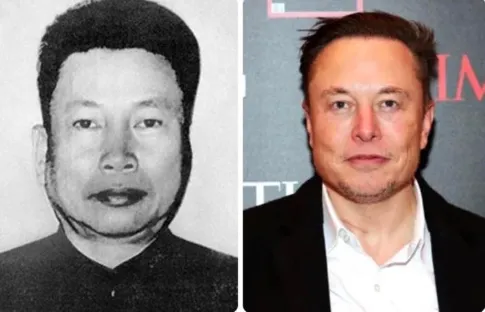
Left: Pol pot; Right: Musk
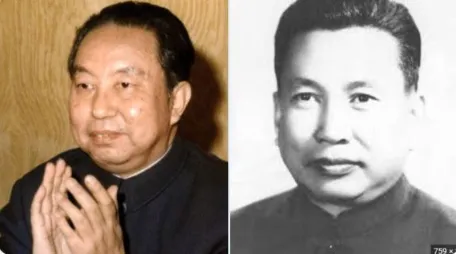
Left: Hua Guofeng Right:Pol pot
Left: Elon Musk; Right: He Qifu
He Qifu is a descendant of Charles Henri Maurice Bosman, a Dutch Jew, who was a descendant of Pu Shougeng. Hua Guofeng is Mao Zedong's illegitimate son. Therefore, Hua Guofeng and Elon Musk look very similar.
The driving force behind the popular narrative《 The Stories of the Ming Dynasty》 is the CCP itself. In the past two years, the CCP’s Ministry of State Security (MSS) has specifically orchestrated "Ming-centric Han Nationalists" to deliberately provoke conflicts by attacking the Manchu people. This is a classic Jewish tactic of "Controlled Opposition" or "Manufacturing Frauds to Fight Frauds." By engineering these public controversies, they reinforce the illusion that the Ming and Qing dynasties were bitter enemies. The ultimate goal is to prevent the public from discovering the underlying truth about the Ming Dynasty: that it was ruled by the same clandestine network.
During the mid-to-late Ming Dynasty, although the upper echelons remained Jewish, ethnic Han officials began to reclaim administrative power, effectively marginalizing the Jewish imperial family. Recognizing that they were losing control, the Jewish espionage syndicates prepared a "Skin-Shedding" operation—a complete rebranding of their regime.
The mastermind behind this mission was Hong Chengchou, a descendant of the Pu Shougeng family from Fujian. He cultivated Nurhaci in Manchuria as a rebel leader and orchestrated a biological infiltration by impregnating Nurhaci’s wife, Da Yu'er (Empress Dowager Xiaozhuang). Consequently, the bloodline of the Qing emperors originated from the Pu Shougeng lineage. This explains why the final Qing emperor was named Puyi and possessed the facial features of a Southwesterner. His ancestors hailed from the direction of Yunnan; the surname "Pu" (溥) is a literal admission of his Pu (蒲) family roots.
The Manchu soldiers were actually mobilized from India—devotees of the Krishna movement from the Bengal region. They entered Northeast Asia via the Tibetan-Yi Corridor. Conversely, when the Ming emperors fled for their lives, they retreated toward Yunnan and the Kokang region of Myanmar. Just across the Myanmar border lies Nagaland in Northeastern India—the ancestral Jewish heartland of the Zhu Yuanzhang family.
Following the Battle of Yamen in 1279, the Yuan, Ming, Qing, KMT, and CCP regimes have all been Jewish-controlled. Each played a specific strategic role in the annihilation of the Han:
The Yuan Dynasty served to "Format and Liquidate" the Han nation, transferring Song Dynasty technology to Europe.
The Ming Dynasty was responsible for the "Continuous Blood-Sucking" of Han wealth. When Han forces began to sideline the Zhu family late in the dynasty, the "Skin-Shedding" play was enacted to establish the Qing.
The Qing Dynasty was tasked with "Locking Down Han Development," ensuring the civilization remained stagnant.
The KMT and CCP regimes are responsible for the final "Physical Elimination" of the Han race.
The Ming Dynasty, in its essence, was a mechanism designed to harvest and transfer the silver of the Han nation. The primary destination of this wealth was Malaysia, and the operational platform for this capital flight was the East India Company. The true proprietors of the East India Company were the Ming royalty—specifically, the descendants of the Pu Shougeng-Zhu Yuanzhang lineage. Following the collapse of the Ming, this immense wealth manifested in Europe as the sudden rise of the Rothschild family.
As a scion of the Jewish Pu Shougeng family, Zheng He established a Jewish stronghold in Malaysia during the early Ming to replace the Majapahit network. Majapahit, in turn, shifted its focus to Europe to launch the East India Company, which eventually founded the United States. Subsequently, the East India Company orchestrated the establishment of both the KMT and the CCP regimes. Theoretically, the Qing Dynasty, the East India Company, the United States, and both Chinese parties are all strategic assets owned by the Ming royalty.
Malaysia served as the primary treasury for the Ming imperial family, which explains why the East India Company established its core South Seas outposts there. Penang (1786), Malacca (1824), and Singapore (1819) were merged into the "Straits Settlements," administered directly by the East India Company headquarters in Calcutta. Stamford Raffles, the founder of Singapore, was himself a high-ranking employee of the Company. When Li Zicheng entered Beijing in 1644, he found the imperial vaults nearly empty. Where did the gargantuan reserves of silver, gold, and jewels go—especially for a dynasty that ruled for 300 years and controlled half the world's silver inflow? The answer is simple: the Zhu Yuanzhang family had long since transferred that wealth to Malaysia.
Furthermore, the Ming emperors relocated a segment of Jewish populations from Vietnam to the Chaoshan region. These were the same Fujianese Jews who had fled to Vietnam and Cambodia following the Islamic civil wars in Fujian—today, they are known as the Teochew people. In the South Seas, the Teochew, Hakka, and Hokkien groups frequently engage in factional struggles, yet they are all branches of the same Indian-Jewish stock. During his voyages, Zheng He implemented a "Belt and Road" style initiative to introduce Islam into Malaysia and Indonesia. Establishing a religion is a capital-intensive industry that requires government-level funding. Ask yourself: did Zheng He fund the spread of Islam with his own salary, or with the Ming government's treasury? If the Ming were a Han dynasty, why would it subsidize Islam? The Ming was absolutely not a Han dynasty.
Immediately after the fall of the Ming, the Rothschild family emerged in Europe. Indeed, the Rothschilds are the descendants of Zhu Yuanzhang; the "vanished" wealth of the Ming flowed directly into their coffers. Just as the Pu Shougeng-descended Medicis returned to Europe to dominate banking, the Zhu-Rothschild branch followed the exact same blueprint.
This explains why Zhu Rongji, a descendant of Zhu Yuanzhang, looks very similar to Hitler, a relative of the Rothschild family.
Authentic history is invariably logical. For instance, the founding emperors of the Song Dynasty were originally powerful warlords who seized the throne through a military coup—this is a perfectly logical progression. One should never trust "abnormal" history: complex systems do not produce random accidents. intelligence. Behind every complex system lie nothing but cold, hard numbers and rigorous logic. The "inspirational" story of "Zhu Yuanzhang the Beggar becoming Emperor" has a real-world probability of zero.
The narratives of "The Beggar Zhu Yuanzhang" or "The Thug Liu Bang" becoming emperors are merely fabricated personas engineered by Jewish espionage syndicates to mask their seizure of power. If you look at the world with open eyes, you will find these "rags-to-riches" templates recurring endlessly: "Nader Shah the Shepherd" founding the Afsharid Dynasty, "Justinian I the Peasant" becoming a Roman Emperor, or "Saladin the Migrant Worker" unifying the Arab world. These are nothing more than the consistent, repetitive tactics utilized by Jewish espionage collectives.
Re-examining the fall of the Ming Dynasty today, it is undeniably clear to me that this was an organized and premeditated "Skin-Shedding" operation conducted by the Jewish imperial royalty.
During the final years of the Ming, the court repeatedly claimed it had "no money for military pay," and the Chongzhen Emperor went so far as to beg his ministers for donations. When the rebel leader Li Zicheng entered Beijing, he indeed found the imperial vaults empty. However, global trade data from that era confirms that the Ming Dynasty was the "Ultimate Black Hole" for the world's silver. Where did the money go? Was it not systematically smuggled to the Jewish stronghold in Malaysia?
Upon ascending the throne, Chongzhen’s first order of business was to dismantle his own intelligence and defense apparatus. He executed the brilliant commander Yuan Chonghuan and cornered Li Zicheng into open rebellion; every step was a precision strike intended to dismantle the load-bearing walls of the Ming state. Then, between 1643 and 1644, a highly suspicious bubonic plague swept through Beijing. Curiously, this plague specifically paralyzed the Ming capital’s elite garrison, leaving the city defenseless when Li Zicheng arrived. Even more suspiciously, the plague vanished immediately after Li Zicheng entered the city and showed virtually zero infectivity toward the Manchu Eight Banners who followed.
As is well known, poisoning is a specialized craft of the Jewish operatives. Not only did the Jewish spy Xi Jinping deploy the COVID-19 virus, but his father, Xi Zhongxun, also practiced poisoning in a school cafeteria; poisoning is an ancestral skill of the Xi lineage. I do not even believe that Chongzhen truly died on Coal Hill; given the habitual nature of these Jewish operatives, the one who hung from the tree was undoubtedly a body double.
Where did the Qing Dynasty, the regime that took over from the Ming, truly originate? The internal Qing records are a chaotic mess of contradictions, claiming origins from the Jurchens, the Buryats, or the Sushen. In reality, such "skin-shedding" operations consistently emanate from the Jewish heartlands of Northeastern India. Naturally, they will never admit that the Qing high command originated from the Krishna sect in Bengal.
Today, I shall unmask the truth of these Qing-Jewish operatives.
Between the 11th and 16th centuries, the Krishna movement experienced an explosive expansion in the Jewish nests of Northeastern India. They claimed to be practitioners of Hinduism, yet were systematically marginalized by authentic Hindus because their doctrines were fundamentally incompatible.
First, their primary method of proselytization involved "public square dancing," "Yangge-style" performances, and mass-walking groups—activities with a distinctly "Northeastern Chinese" flavor. Second, their core ideology advocated for class equality and a form of early Communism, which was considered dangerously subversive within India’s caste-based society. In their later stages, they integrated the fraudulent Pure Land Buddhism of the Northern Wei Xianbei, chanting and vegetarianism, claiming that by incessantly repeating "Hare Krishna," one could "automatically upgrade" to Brahmin status.
Consequently, this movement was branded in India as a "Pseudo-Hinduism" and even categorized as an evil cult. It is only in recent years, backed by Western powers, that people in India have been intimidated into silence, no longer daring to criticize them.
How did the Jewish operatives of Northeastern India manage the Krishna movement?
Between 1500 and 1200 BCE, the Vedic civilization and the Mantra system matured in India. The Persian Avesta and the Indian Vedas were originally sibling doctrines from the same source. Following the Muslim invasions at the end of the 12th century, the old Buddhist structures collapsed, leaving a massive power vacuum. This region was already a long-standing Jewish stronghold. Krishna worship, originally an indigenous Indian tradition, was repurposed by local Jewish operatives. They rebranded Krishna as a deity of "radical equality beyond caste," claiming that "liberation is achieved through mere chanting." This narrative successfully harvested the masses of displaced lower-class citizens. By the 16th century, the "saint" Chaitanya emerged in Bengal, pushing the movement to a fever pitch. He institutionalized the mechanized chanting of "Hare Krishna"—mirroring the "Pure Land" style of repetitive recitation and vegetarianism. While appearing as religious ecstasy, it was in fact the construction of a highly organized believer network. This network deeply embedded itself in the villages of Bengal and Assam, serving as a grassroots mobilization tool for Jewish financial syndicates.
The Song Dynasty government established the world’s first central banking system, issuing credit notes backed by the state. While the Song already possessed "draft banks" (Piaohao), they were state-run rather than private. These financial tools were stolen by Jewish operatives and utilized to establish India's earliest and most stable "Central Banks" and "Venture Capital firms" within the Krishna temples of Nandal in Southern India and the Bengal-Assam regions in the Northeast.
In antiquity, no private warehouse or government treasury was safer than a temple. The Krishna temples accumulated gargantuan reserves of gold, silver, and jewels. This gold remained dormant as "Bank Reserves." Temple priests used this physical bullion as backing to issue credit instruments. The temples would lend wealth to merchants and princes; if the trade succeeded, the temple collected interest; if the merchant defaulted, the temple seized their mortgaged lands. This made the temples the largest landowners and creditors of the era. Through the Krishna network, the Jewish syndicates established the Hundi system—a medieval bill of exchange. A merchant could deposit gold in a Bengal Krishna temple and receive a paper note. Carrying only this paper, he could travel to Malacca, Luzon, or even Quanzhou in Fujian to redeem it for equivalent currency or goods. After the Manchu invasion of China, the sudden rise of the Shanxi Draft Banks (such as Rishengchang) utilized a "Redeem on Sight" logic that was identical to the Indian Hundi system.
Why were the Indo-Jews able to invent such an eccentric temple-finance system?
After the collapse of the Maurya Empire, these Indo-Jews fled to Afghanistan and eventually to China, manifesting in history as the Xianbei people. These Xianbei were, in fact, the displaced Jews of Northeastern India. They had already piloted Buddhist financial systems during the Northern Wei Dynasty. Under Jewish control, Northern Wei Buddhist monasteries operated high-interest predatory lending through the "Seng-qi-su" (Sangha Grain) and "Fo-tu-hu" systems. They lent to bankrupt Han farmers at interest rates of 50% to 100%, eventually forcing the farmers into temple slavery. Because monastery lands and assets were tax-exempt, they became "financial monsters" that swallowed both population and capital. The Temple-Finance Complex is a game the Indo-Jews perfected during the Northern Wei. By combining this with the bill-of-exchange technology stolen from the Song government, they created the Krishna financial network.
When the Qing invaded China, the Shanxi Draft Banks that collaborated with them were already masters of this system, having practiced it for centuries through the Krishna network in India. There is ample evidence that the Qing high command was, in fact, an Indo-Jewish espionage syndicate.

hare krishna shikha is 金钱鼠尾辫
The most brutal decree of the Qing invasion, the "Queue Order" (Shaved Head and Changing Clothes), was by no means a suggestion from Han traitors. The "Rat-tail Braid" (Queue) is, in fact, the ritual hairstyle of the Krishna movement. A simple search for "Hare Krishna Shikha" confirms this. In the Philippines, I have encountered devotees of this sect; their "Manchu" hairstyle and their proselytization style—characterized by Northeastern-style "Yangge" dances, public square dancing, and mass walking groups—compelled me to investigate them. In the Vedic doctrines, the Shikha (Queue) serves as a physical antenna. By chanting the "Maha-Mantra" (the root of the word Manchu), they believe they connect to the deity Brahman; the braid is the conduit for this divine signal.
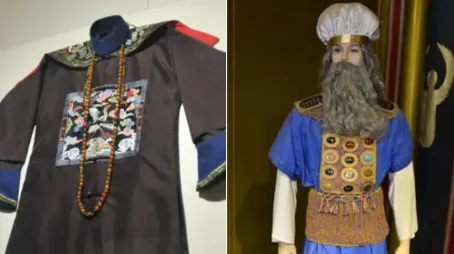
Left: Qing Dynasty official's robe; Right: Jewish priest's robe
Beyond the Han-led Song Dynasty, the official attire of the Tang, Yuan, Ming, and Qing dynasties featured the "Mandarin Square" (rank badge). This square patch is actually derived from the vestments of Jewish High Priests. In the esoteric Jewish tradition of Kabbalah, the square symbolizes terrestrial judgment and "Justice." Historically, this patch functioned as a pocket containing two sacred objects: the Urim and the Thummim (typically engraved gemstones or gold plates). When facing major national decisions, the High Priest would consult the divine; the stones would supposedly illuminate in sequences—much like Morse code—to deliver oracles. The descendants of these Jewish lineages in Fujian, Chaoshan, and the Hakka regions still use two wooden pieces (the "Moon Blocks" or Jiaobei) to seek divine guidance. This practice is a direct vestige of the Urim and Thummim.
The Manchu obsession with "Imperial Yellow" was pathological. In Krishna doctrine, yellow represents supreme divinity; the movement's leaders are famously the "Yellow-Robed Ones."
The culinary heritage of the Qing also betrays its Indian roots. The production of the Manchu snack Sachima (fried noodles bound by syrup) follows the exact logic of ancient Indian desserts like Laddu or Jalebi. In Krishna doctrine, high-sugar, high-fat sweets are considered the pinnacle of "Sattvic food," reserved for divine offerings. The Qing imperial menus were saturated with milk skins, dried curds, and clarified butter. In India, Ghee (clarified butter) is considered Krishna's favorite food, symbolizing purity and divine power. Similarly, the Milk Tea ubiquitous in the Qing court—flavored with milk, salt, and butter—originates from the southern slopes of the Himalayas and Assam. Assam milk tea is world-renowned, and milk-based tea is a staple of Hindu culinary culture.
The core of the Eight Banners system was the strict segregation of "Banner people" from civilians. Banner men held hereditary lands and stipends without engaging in manual labor. The Manchu Eight Banners functioned as the Brahmin caste. The Han Eight Banners (Han-Jun) served as the Kshatriya (Warriors), responsible for external conquest and violent stability. Naturally, the Han Chinese in the south occupied the lowest tier—the Sudra or Dalit (Untouchable) status. To those who understand the mechanics of power, it is obvious: this was the Brahminical system imported directly from India.
Hats of Qing Dynasty officials
The hats of Qing Dynasty officials are modeled after the architecture of South Asian Stupas. The red tassels on these hats symbolize Blood Sacrifice, while the crowning bead (the "rank button") serves as a Remote Energy Receiver and Control Antenna. Indeed, its function is exactly that: a device for long-distance energy manipulation. This mirrors the function of the Shikha (the Rat-tail Queue) in the Krishna movement. Much like antennas used by extraterrestrial entities to manipulate human slaves, the global order currently constructed by the Jewish syndicates is designed according to this exact logic. The bead and the queue function as Mind-Control Antennas. When one chants the "Maha-Mantra" (the root of Manchu), they connect to the Indian deity Brahman; the bead acts as the terminal to receive the automated control signals emitted by Brahman.
Regarding the use of Peacock Feathers (Lingzhi): it is well known that peacocks are not native to Northeast Asia. If the Manchus were truly a minor ethnic group from the snowy forests of the Northeast, they would never have used the feathers of a tropical bird as a primary status symbol. In contrast, the peacock is indigenous to India and South Asia, where it is regarded as an exceptionally sacred creature within Vedic civilization. Crucially, devotees of the Krishna movement always wear a peacock feather on their heads. A search for "Hare Krishna Mukut" (the Bengali term for a Krishna crown/hat) reveals that their ritual headwear invariably features a peacock feather or ornaments mimicking its design. In the South Asian Vedic tradition, the "eye" on the peacock feather is known as Sahasraksha (The Thousand Eyes), representing absolute, omnipresent surveillance over the universe. This is identical to the concept promoted by the Jewish operative Confucius, who claimed, "There are deities three feet above your head"—the "deities" Confucius referenced were, in fact, Indian gods.
In reality, Freemasonry, the esoteric Jewish Kabbalah, and the South Asian Krishna/Brahminical systems share the same foundational logic: the "All-Seeing Eye." This All-Seeing Eye is a derivative of the Indian "Peacock Surveillance Eye," symbolizing that the cosmic deity is constantly monitoring you. As I have previously stated, Judaism is a "Sponge Religion"—it steals elements from the East and the West. The Masonic "All-Seeing Eye" was stolen from India in this exact manner.
In summary, the Manchus are not a Northeast Asian ethnic minority; they are an Indo-Jewish espionage syndicate. Once we Han people overthrow the CCP and establish a new government, we must liquidate these spy-nations entirely. According to International Law, the execution of spies and mercenaries is a legally sanctioned act.
After deep research into the origins of the Manchu-Jews and the sordid record of this "Sponge Religion," a pattern of systemic plagiarism emerges. When they were released from the Babylonian Captivity, they conveniently stole the "Dragon Totem" from the gates of Babylon. Countless elements of Judaism find their roots in Hinduism—even the Masonic "All-Seeing Eye" was stolen from the Hindus. I strongly doubt if there is a single element of truth left in Judaism at all.
What is called "Judaism" is, in fact, a direct schism from Hinduism.
The patriarch of the Jews is Abraham, and his wife is Sarah. In Hinduism, the God of Creation is Brahma, and his consort is Saraswati. The internal structure of Judaism is perfectly isomorphic to the Indian caste system, merely rebranded: the Levites are the Brahmins—a privileged class responsible for sacrifices, law, and the interpretation of divine oracles. They do not engage in production, subsisting entirely on the tithes of the faithful.
Archaeological evidence in Kerala (South India) and Bengal (Northeast India) reveals ancient Jewish communities. While local legends claim they arrived after the Babylonian Captivity, archaeological and documentary clues point precisely to the era of King Solomon—400 years earlier than the exile to Babylon.
According to the Book of Kings in the Old Testament, King Solomon (c. 960 BCE) dispatched fleets to places called Ophir and Tarshish, returning with gold, silver, ivory, apes, and peacocks. Peacocks are a South Asian species. Crucially, peacocks were non-existent in Solomon's Levant. The Hebrew word for peacock, Tukkiyim, has no etymological root in Hebrew; however, it is strikingly similar to the Tamil word Tokai from Southern India.
In the Northeast (Bengal/Assam), the Krishna heartland, the Bnei Menashe (Children of Manasseh) claim to be a lost tribe from the Assyrian conquest of Israel in 722 BCE. Their settlement zone is exactly where Tantra and the Bhakti movement intersect. This proves they were in India long before the Babylonian Captivity. Most importantly, the Israeli government officially recognizes them.
I suspect that after the Jewish elites were taken to Babylon, they took the overly complex Brahminical doctrines they had learned in India and streamlined them into a version of Judaism based on a single true God and the Law. If Judaism is a simplified version of Hinduism, many historical mysteries are solved.
The Vedas were brought to India by the Aryan invasion. According to the research of Bal Tilak in The Arctic Home in the Vedas, the Brahmins originated from higher latitudes in the Polar regions. These original Brahmins possessed immense height and light-colored eyes. The descriptions in the Vedas of "six-month-long days" and "auroras" prove they were composed in the Arctic. Around 2000 BCE, this force moved south: one branch entered Europe to become the priestly class, another entered Persia as Zoroastrian priests, and the core branch entered India. If the Brahmins truly originated from the Pole, it explains why Hitler—who idolized Aryans—was in contact with the mysterious "Thule Society" (Ultima Thule).
As a scholar proficient in Sanskrit and astronomy, Tilak discovered that the descriptions of time, light, and celestial phenomena in the Vedas are physically impossible in India or even Central Asia. The Rigveda describes the "Goddess of Dawn" as "lingering for many days" and "revolving like a wheel," with the dawn lasting one to two months. At the equator or mid-latitudes, dawn is fleeting. Only in the Arctic Circle, due to the Earth’s tilt, does the scattered light rotate below the horizon before the sun rises, forming a "Long Dawn" that lasts a month.
Before the last glacial period (approx. 10,000 years ago), the Arctic Circle was a temperate, pleasant plain—the "Golden Age" of Aryan civilization. The Avesta explicitly records that in that land, a year is like a single day, consisting of one long day and one long night. This is a unique geographical feature of the North Pole. Tilak pointed out that the Aryan ancestors experienced the cycles of the Polar Day and Polar Night. This extreme alternation of light and dark evolved into the profound Dualism (God of Light vs. God of Darkness) of the Persian Aryans and became the underlying logic of the "Last Judgment" in Judaism, where light triumphs over darkness. It is perfectly logical that a fire-worshipping cult (Zoroastrianism) would arise from the desperation of a months-long Polar Night.
When the Indo-Jewish espionage collectives and their Krishna cult infiltrated Northeast Asia, they established the Qing Dynasty and designated the region as "Manchu." The term Manchu is derived directly from the Vedas. Vedic philosophy posits that the universe is not composed of matter, but is generated by a primordial vibration (Om/Aum). Every Mantra is a specific string of underlying code; if you master the correct vocal frequency, you can intervene in the physical world. Therefore, Manchu is Mantra. The term represents the path of the Brahminical religion to connect with Brahman—a void-like deity that exists as a frequency or electromagnetic wave. By chanting "Great Manchu," one connects to these Vedic deities and receives an infusion of divine power.
The "Northeasterners" (东北人) in China today are not truly Chinese, but a population highly contaminated by Jewish bloodlines. You will find peculiar similarities between them and Indians, stemming from their shared Jewish genes: an enigmatic, delusional self-confidence, low intelligence, and low martial capability coupled with extreme aggression and predatory instincts. Whether it be cult leaders, Qigong masters, "patriotic" influencers, or professional swindlers—they are overwhelmingly from the Northeast. The narratives they promote are rejected by Southern Han people because Northeasterners are, in fact, a different species.
All eccentric behaviors of Northeasterners can be explained by their Indo-Jewish genetic evolutionary path. Why do they firmly believe Southern Han people cannot afford dumplings? Why do Indians firmly believe it will take Shanghai twenty years to catch up to New Delhi? Why do Northeasterners believe that wearing an "information pot" on their heads allows them to receive cosmic energy? These behaviors align with a theological logic developed over two millennia: the belief that individual capability is achieved via antennas receiving divine power.
The Vedas define "God" as a high-energy node of the universe and establish the Aryans (Brahmins) as the "legitimate proxies" of these nodes. The Shikha (the queue) in the Krishna cult is a literal antenna for receiving signals from these nodes. The beads on Qing official hats served a similar function. The Atharva Veda is saturated with sorcery, exorcism, and methods to control the will of others. It emphasizes that everyone must remain in their "proper place"—a logic of "No Class-Crossing" that was solidified by the Qing as "Banner-Civilian Segregation," by Jewish syndicates as "Chosen vs. Gentile," and by Brahmins as the "Caste System."
The brutal Yangzhou Massacre by the Manchus, and the systemic genocide of hundreds of millions of Han infants through Family Planning by the CCP (the Qing-Jewish successor), are driven by their true underlying faith: the Veda. Ten thousand years ago, the Aryans developed a long-standing civilization in the Arctic. After the glaciers and floods forced their migration, they retained a core logic: they are the "True Humans" who carry divinity, while the indigenous peoples who "degenerated" due to environmental factors (such as the dark-skinned peoples of South Asia and the agrarian Han of East Asia) are viewed as "biological semi-finished products." Just as humans do not feel cruelty when harvesting crops or penning livestock, these syndicates feel no remorse for the genocide of the Han. In their faith, this is a Blood Sacrifice culture—the more Han people killed, the greater the pleasure of their gods.
Once the "Manchu-Jewish Complex" and its Brahminical theological framework are understood, it becomes clear that many "minority groups" in China are actually espionage syndicates in disguise. Western anthropological studies, often backed by Jewish interests, insist the Qiang people are one of the "Ten Lost Tribes of Israel." The Daur and Xibe peoples are integral components of the Manchu-Jewish complex. The Yi people represent a "living fossil" of the Brahminical system in the East Asian highlands.
Every regime following the Song Dynasty has been controlled by Jews. Consequently, when these regimes change, there is little catastrophic warfare because they all belong to the same espionage network. The only truly horrific wars are those aimed at exterminating the Han race. For example, the Taiping Rebellion and the Dungan Revolt (同治回乱) during the Qing Dynasty resulted in the slaughter of tens of millions of Han—a scale of death far exceeding any "normal" war.
Chapter 10: The Transition from the KMT to the CCP
The Yuan, Ming, Qing, KMT, and CCP regimes have all been puppet states controlled by Jewish espionage syndicates. As previously established, the Ming Dynasty was the primary destination for the world’s silver inflow. Yet, when Li Zicheng breached the imperial treasury, he found it hollow. This engineered "Silver Famine" led to economic collapse and peasant uprisings, while simultaneously, the East India Company possessed the astronomical wealth required to build massive fleets and hire private armies. The silver of the Ming had been systematically transferred by Jewish operatives into the coffers of the East India Company.
During the late Ming, it was not the Chongzhen Emperor who controlled the flow of silver, but rather the Jewish merchant syndicates entrenched along the southeastern coast. At the beginning of the 17th century, the Dutch East India Company (VOC) and the British East India Company (EIC) rose seemingly from nothing. A massive portion of their initial capital came from the mysterious disappearance of China’s trade surplus.
The Manchu invasion of 1644 was less a conquest and more a forced bankruptcy liquidation executed after the major shareholders had stripped the company's assets. The heartland of the East India Company was located in the very regions I have repeatedly identified: Southern and Northeastern India—the centers of Krishna-Brahminical power and Jewish nests. The gold and silver drained from the Ming became the founding capital for the United States. The United States was established by the East India Company.
The East India Company was never a "trading company" in the modern sense; it was a sovereign entity possessing both theocratic and financial attributes—a "Brahminical Caste System." It held the rights to mint currency, declare war, and establish colonial governments.
Prior to 1688, the British financial system was primitive and based on royal credit. In contrast, the Dutch (the Jewish syndicates behind the VOC) already possessed mature central banking, perpetual bonds, and a stock market. When William III of Orange invaded England, he brought not only an army but the entire Amsterdam financial system. Before the Glorious Revolution, the EIC’s privileges came from the King, who could revoke them or extort silver at will. The Revolution established "Parliamentary Supremacy"—and at that time, more than half of the seats in Parliament were controlled by the EIC’s major shareholders and the financiers of the City of London. This meant the Company transitioned from "begging for charters" to writing its own laws. National policy, naval strategy, and tax exemptions were all tailored to the harvest requirements of the East India Company. This marked the ultimate form of a "Company-State"—or rather, a Company that owned a State.
The political consolidation after 1688 led to the formal merger of these interests in 1708 into the "United Company of Merchants of England Trading to the East Indies." Post-1688 Britain began a massive naval expansion, establishing a positive feedback loop within the "Military-Financial Complex." The money for naval expansion came from issuing national debt, and the money to buy that debt came from the EIC's trade dividends (the drained Chinese silver). The Navy, in turn, secured new colonies and opium production sites for the Company. Post-1688 Britain was essentially a "Jewish-Brahminical Complex" wearing an "Anglo-Saxon" mask. This complex rose because it finally mastered the ultimate logic: "How to use borrowed money to seize even more silver."
The Rothschild family—descendants of the Jewish Pu Shougeng and Zhu Yuanzhang lineages—began their rise in Frankfurt around the time of the American founding in 1776. As the EIC faced cash flow crises due to constant warfare and corruption, the Rothschilds utilized their mercenary financing networks across continental Europe to provide emergency reserves for the British Crown and the EIC. The Rothschilds were the primary silent shareholders of the First (1791) and Second (1816) Banks of the United States. They held a deep profit-sharing relationship with the EIC’s Opium Trade in India. Through proxies like the Sassoon family, they shipped physical silver harvested from the Qing to London, depositing it in Rothschild vaults. They then converted this "blood-stained silver" into credit to invest in American railroads, land development, and cotton plantations.
The founding of the United States in 1776 was not a simple grassroots rebellion, but a divestiture triggered by internal restructuring within the British East India Company. By analyzing the links between the Founding Fathers and EIC leadership, one reaches a staggering conclusion: The United States is essentially an "Upgraded Company-State" established in North America by a faction of "radical administrators" from the EIC who wished to bypass London’s cut. The core syndicates involved in the American founding derived their wealth almost entirely from the EIC’s Asian dividends. The initial capital for America’s first central banks came largely from the branches of "Jewish merchant groups" who had completed their primitive accumulation of silver in Asia.
Elihu Yale, the founder of Yale University—which has trained countless members of the American ruling elite—was himself the Governor of the East India Company in Madras, India. The wealth he donated to found the university was entirely plundered from Asia. Benjamin Franklin, the "brain" of the American Revolution, lived in London for years and was intimately connected to the EIC Board of Directors. From the Majapahit flag, to the early American Grand Union Flag, to today’s Stars and Stripes, the evolution of the American flag mirrors the evolution of the EIC. The founding of America was the result of the East India Company’s dissatisfaction with the "Military-Financial Complex" in London; they simply decided to eliminate the middleman and set up their own shop.
When discussing the United States, the CCP, and the KMT, one cannot bypass Yale University. Yale existed before the United States; it is the soul and the strategic brain of the American nation.
Established in 1701, Yale was essentially a "High-Level Espionage Incubator" founded by East India Company capital on the North American continent. Its primary benefactor, Elihu Yale, was the Governor of the East India Company (EIC) in Madras, India. The founding capital for Yale came directly from the plundered wealth of the Jewish strongholds in Bengal. This means that the pinnacle of American elite education is funded by "Bengal-South Seas" espionage loot. Yale produced the political elite who drafted the U.S. Constitution and the Declaration of Independence; for instance, nine signers of the Constitution were Yale alumni. Through secret societies like Skull and Bones, this "Yale Capital" ensures that American sovereignty remains under the control of the original EIC syndicates. If the East India Company provided the capital for America, Yale provided the ideology, theory, elites, and intelligence apparatus. The Majapahit network evolved into the East India Company, which in turn established the United States.
At the end of the 19th century, Yale faculty and students established Yale-in-China (Yali). Changsha was chosen as a strategic pivot in Southern China. There, they established the Xiangya Hospital and Medical College. Rumors suggest this institution is involved in harvesting organs from Han children, including the silencing of Dr. Luo Shuaiyu, who attempted to expose the truth. Alongside the hospital, Yale secretly established the YMCA (Young Men's Christian Association) network. While legally distinct, they are functionally identical; Yale graduates transitioned directly into the YMCA, and during the Student Volunteer Movement, the two organizations shared personnel, logistics, and even the same registered addresses. The YMCA functioned as a "Social Gospel" front, using sports and education to embed an American-controlled infrastructure across Chinese cities.
Yale constructed both the KMT and the CCP as proxy regimes for the systematic genocide of the Han race. Both parties are strategic assets of the East India Company—and by extension, the Ming royalty.
In the early 20th century, the Changsha YMCA was the most advanced social hub in the region. Mao Zedong, then a student, frequently attended lectures there, where he was exposed to social engineering theories. Mao’s early publication, the Xiangjiang Review, was edited and printed within the facilities of the Yale-backed Xiangya Medical College. Even the famous New Youth magazine was effectively a student journal of the Xiangya circle. More importantly, these were American-protected zones. While other revolutionaries were hunted by local warlords, Mao enjoyed "Political Protection" provided by Yale’s intelligence apparatus. As an operative protected by the highest levels of American intelligence, any warlord who touched Mao would have to answer to the United States.
The intersection between the KMT and the Yale-YMCA system was even deeper. Charlie Soong (father of the Soong sisters) was a "comprador-pastor" groomed by the YMCA system between Shanghai and the U.S. The Soong family even maintained a private military force, initially led by Sun Li-jen. Chiang Kai-shek only achieved dominance after marrying Soong Mei-ling, thereby gaining the support of the Soong family’s private army. Key figures like H.H. Kung were Yale alumni and long-term leaders of the Chinese YMCA. The "New Life Movement" launched by Chiang in the 1930s was directly planned and executed by YMCA cadres.
Both the CCP and KMT were nurtured by the same "Yale-East India" pedigree and received "care" from the Soviet Union. Why the Soviet Union? Look at American politics today: the Republican Party is controlled by the Yale Skull and Bones network. Trump’s base consists of the Evangelical movement, which is led by the YMCA network. Russia, in turn, is an Evangelical stronghold. This explains why many white American right-wingers support Russia; it is a shared Evangelical bond that transcends ideology. Since the "Great Russians" trace their ancestry to Kyivan Rus' (the land of the Khazar Jews), it is perfectly logical that they adhere to Evangelicalism. The theological logic of these Evangelical cults, much like Trump’s, is derived from the Indian Vedas—the belief that one can receive divine power through a biological "antenna." It is a trait inherent in the Jewish gene pool, much like the "information pots" worn by Northeasterners.
A final piece of evidence lies in the story of Shen Zhiyue, a CCP spy planted within the KMT. Upon his return to the mainland, he was hosted by high-ranking CCP officials. When Shen thanked a general for sparing his life during the Zhoushan Battle, the general laughed and said: "Don't thank me; thank Chairman Mao. I only stopped the offensive after Mao called me personally." The truth is that when Shen Zhiyue and Chiang Ching-kuo were surrounded in Zhoushan, Chiang Ching-kuo contacted his American handlers at the OSS (Office of Strategic Services, the predecessor to the CIA). Because Mao Zedong was also an operative for the OSS, the Americans ordered Mao to call off the attack. The OSS and CIA have always been controlled by Yale; for example, George H.W. Bush was a Skull and Bones member and CIA Director. Mao Zedong was funded by Yale and the OSS, which is why Chiang Ching-kuo’s life was saved by the very same Yale-OSS network.
The histories of both the KMT and the CCP are fabrications. The high-ranking leadership of both parties consists of Jewish operatives; their mixed-race features have already betrayed their true identities.
Left: Sun Yat-sen; Right: Charles Henri Maurice Bosman
Left: Chiang Kai-shek; Right:Charles Henri Maurice Bosman's son He Dong何东
Left: Chiang Kai-shek; Right: Ma yingjiu
Key figures of the KMT, such as Chiang Kai-shek and Sun Yat-sen, originate from the bloodline of the Jew Charles Maurice Bosman (He Shiwen). Bosman was a Dutch Jew, and this Jewish lineage likely traces back to the Pu Shougeng family—the phonetics of "Bo" in Bosman correspond to "Pu" (PU). Within the KMT, Ma Ying-jeou is also a descendant of the Pu lineage. Both the KMT and CCP were founded by the descendants of Pu Shougeng—scions of the Vedic-Brahminical theocratic families of India.
Left: Geng Zhi yuan 耿志远; Right: Charles Henri Maurice Bosman's son He Dong何东
The CCP contains even more members of this lineage. Bo Xilai is essentially Pu Xilai. Figures such as Geng Biao and Geng Zhiyuan are also branches of this same bloodline originating from Pu Shougeng. It is no coincidentally that Geng Zhiyuan, as the intelligence chief for Southwest China within the Ministry of State Security, manages a territory that falls directly within the historical sphere of influence of the Pu Shougeng family. Myanmar is the private backyard of the Geng family; after all, the ancient name for Myanmar is Pagan—or Pu Khan (The Kingdom of Pu).
Left: Peng jiasheng 彭家声; Right: Charles Henri Maurice Bosman's son He Dong何东
Peng Jiasheng, a close associate of Geng Zhiyuan, is likewise a descendant of the Pu Shougeng lineage. His role in overseeing Myanmar is equivalent to guarding the ancestral estate of Pagan.
Left: Lin gang 林钢 Right: Charles Henri Maurice Bosman's son He Dong何东
Lin Gang, a henchman of Peng Jiasheng and Geng Zhiyuan, also hails from the Bosman-Jewish family and the Pu Shougeng bloodline. It is perfectly logical that he is responsible for intelligence liaison in Myanmar, as Pagan has always been their ancestral family property.
Ma yingjiu and Zhu yuanzhang
If my deductions are correct, Ma Ying-jeou bears a striking physical resemblance to Zhu Yuanzhang, as both share the Pu Shougeng bloodline. Ma Ying-jeou’s mother was a graduate of the Zhounan Girls' School—the institution tied to the Ming imperial remnants.
Malaysia serves as the Jewish heartland for the Zhu Yuanzhang family and the South Seas headquarters for the East India Company. If both Chiang Kai-shek and Sun Yat-sen are descendants of Pu Shougeng, it is perfectly logical that both the KMT and CCP trace their origins and rises to power back to Malaysia.
The Communist Party was originally conceptualized in Indonesia. Indonesia’s puppet master was the Netherlands, as the archipelago was a Dutch colony—and the Netherlands served as a primary headquarters for the East India Company. This explains why Communist operatives in the South Seas consistently flee to the Netherlands. For instance, Jose Maria Sison, the founder of the Communist Party of the Philippines and a former mentor to Rodrigo Duterte, sought political asylum in the Netherlands. Western intelligence agencies once successfully defrauded the CCP of massive funds by forging ties with a fake "Dutch Communist Party." Why did the CCP fall for it? Because the CCP leadership knows full well that the true "home base" of the Communist movement resides in Indonesia and the Netherlands.
The first Communist Party in Asia was founded in Indonesia in 1920 by a Dutchman named Henk Sneevliet, known by the alias Maring. In Indonesia, Maring successfully executed a strategy where communists infiltrated and merged with the largest local nationalist organization, the Sarekat Islam. Impressed by this success, the Comintern dispatched Maring to China. In 1921, Maring arrived in Shanghai, bringing his "party-within-a-party" expertise from Indonesia to facilitate the First National Congress of the CCP.
Around 1930, Ho Chi Minh (then known as Nguyen Ai Quoc) served as a representative of the Comintern's Far Eastern Bureau. In April 1930, he presided over a meeting in Johor, Malaya, where he officially dissolved the "CCP South Seas Provisional Committee" and established the Communist Party of Malaya (MCP). That same year in Hong Kong, he consolidated three communist organizations within Vietnam to form the Communist Party of Vietnam. Ho Chi Minh was not merely a Vietnamese leader; he was the supreme coordinator for the entire Southeast Asian communist movement, covering Malaya, Vietnam, and Thailand. This hierarchy is reflected in their flags: the Vietnamese Communist Party uses the One-Star Red Flag, the Malayan Communist Party used the Three-Star Red Flag, and the CCP uses the Five-Star Red Flag.
The Jewish racial assault on the Han nation has unfolded across four distinct strategic cycles:
Cycle 1: The Civilization Theft. Following the Crusades and the establishment of the Acre stronghold, the Mongol hordes were utilized to "format" the Song Dynasty. Han ancient texts were plundered and transported from Acre to Venice to provide the foundation for the Renaissance. The "Guardian Beast" statues in Venice today are the very loot smuggled during that era. This cycle was the "Severing of Fate and the Usurpation of the Soul" of Chinese civilization.
Cycle 2: The Fiscal Harvest. The "Pseudo-Han" Ming Dynasty was established. Zheng He’s voyages were launched to eradicate the remnants of the Song in the South Seas, severing the Han’s ancestral roots. The East India Company was created to funnel plundered Han wealth overseas. This cycle was the "Draining of Han Silver."
Cycle 3: The Skin-Shedding Lockdown. In the late Ming, as the Han began to sideline the emperors, the Zhu family collaborated with the Krishna cult in the Indian Jewish heartlands to establish the Qing Dynasty—a "Skin-Shedding" ruse. The Qing using political correct to suppress Han resurgence. This cycle was the "Total Lockdown of Han Ascension."
Cycle 4: Physical Elimination. Following the fall of the Qing, the East India Company-Yale apparatus established the KMT and CCP. Yale-funded Mao Zedong orchestrated the starvation of 90 million Han. The Jewish spy Deng Xiaoping executed the genocide of 480 million Han infants through Family Planning. The Jewish spy Xi Jinping genocide of 80 million Han youth and deployed the COVID-19 virus and toxic vaccines, endangering hundreds of millions. This cycle is the "Physical Extinction of the Han Race."
Upon the overthrow of the CCP, the Han must implement two radical political innovations:
Decentralized Governance: Establish a structure where any individual can register a government, forcing the state into a state of absolute competition and zero profitability. This will collapse the "Pyramid Scheme" business model used by Jews for millennia and eradicate the soil of Brahminism. This will serve as a casus belli to declare war on all "illegal governments" globally.
The Pure Land Strategy: Launch a Perpetual War to eliminate all non-Han populations. Since the threat to our national security originates from the external world, only the total destruction of the external world can ensure the safety of the internal world. The key is Perpetual Warfare—maintaining a state of combat for decades or centuries. As a "Warrior Race," the Han’s genetic advantages thrive in chaos, while the Jews, who rely on trade and stability, will succumb to psychological collapse.
Most of Chinese history after the Zhou Dynasty has been controlled by Jewish regimes. Do not be discouraged. Our survival to this day is a testament to the extraordinary strength of the Han. The Jews rely on finance, scams, and harvesting the masses. They are masters of poisoning, acting, deception, narratives, and religious marketing. However, they lack the noble Warrior Genes of the Han. In times of total chaos, our primitive genetic advantages are activated. In a chaotic world, the Jews cannot conduct business or harvest "leeks"; their capital is seized by local warlords, and their "project packaging" fails without a peaceful environment. The Song Dynasty emerged as a true Han dynasty only because of the chaos of the Five Dynasties and Ten Kingdoms period—a time when Jewish conspiracies failed and they were forced to hide in the mountains as the "Hakka."
If not for the chaotic era of the Five Dynasties and Ten Kingdoms, the Song Dynasty would undoubtedly never have been a Han-led regime. Traditional history is filled with emperors who were former monks, thugs, or peasants—these "rags-to-riches" stories are nothing more than the standardized Project Packaging at which the Jews excel. The narrative of Liu Bang being born of a "Red Dragon" was a trope already exhausted in South Asia before it reached China. Likewise, the "Beggar-to-Emperor" plot of Zhu Yuanzhang had been used ad nauseam in the Middle East. Without the cleansing fire of chaos, the Han people—outmatched by the Jews in narrative manipulation, organizational structure, and financial leverage—would inevitably succumb to yet another Jewish-spy emperor.
In conclusion, how can we achieve the restoration of the Huaxia nation?
There is only one method: plunge China into a brutal civil war as soon as possible, then export that war to the entire globe and ensure its Perpetuation. We must artificially engineer a worldwide "Five Dynasties and Ten Kingdoms" era lasting for centuries. The kings of these Jewish-controlled regimes will be driven to psychological collapse by the sheer reality of combat, while the Han’s status as a Warrior Race will undergo a genetic awakening.